
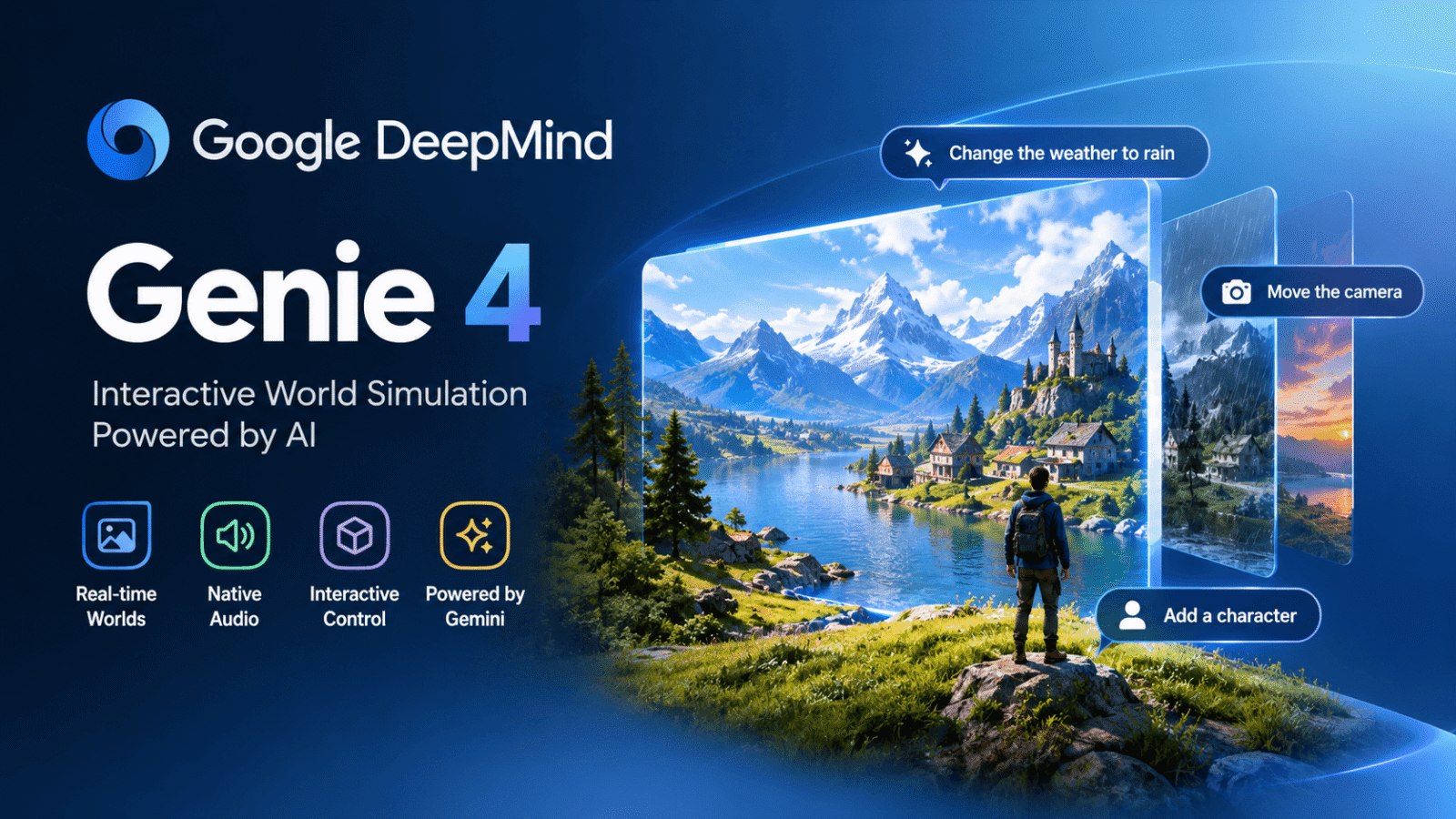
Google DeepMind has introduced Genie 4, a new artificial intelligence model designed to create realistic, interactive digital worlds in real time. Announced on October 27, 2026, Genie 4 brings improvements in visual realism, physical interactions, audio generation, and natural-language control.
Unlike traditional AI video generators that primarily produce clips, Genie 4 is designed to create environments that users can explore and change while the simulation is running. Users can modify weather, move the camera, introduce new characters, and influence what happens next using text instructions.
Google is positioning this technology as an important step toward more capable AI systems, with potential applications in gaming, filmmaking, robotics, education, and scientific research.
In this article, we explain what Google Genie 4 is, its key features, how it works, its potential applications, limitations, and availability.
What Is Google Genie 4?
Google Genie 4 is a real-time interactive world model developed by Google DeepMind. A world model is an AI system designed to represent how environments behave and how events change over time.
Instead of simply generating a fixed image or video, Genie 4 creates a simulated environment that responds to user actions and instructions.
For example, a user could describe a mountain landscape, explore the environment, change the weather, or introduce a moving character. Genie 4 can then adapt the simulation to reflect those changes.
According to the official Google DeepMind announcement, the model builds on capabilities from Google’s Gemini family. Gemini models contribute reasoning and contextual understanding, while Genie 4 generates the visual and interactive environment.
This approach could help developers create interactive experiences without building every element manually.
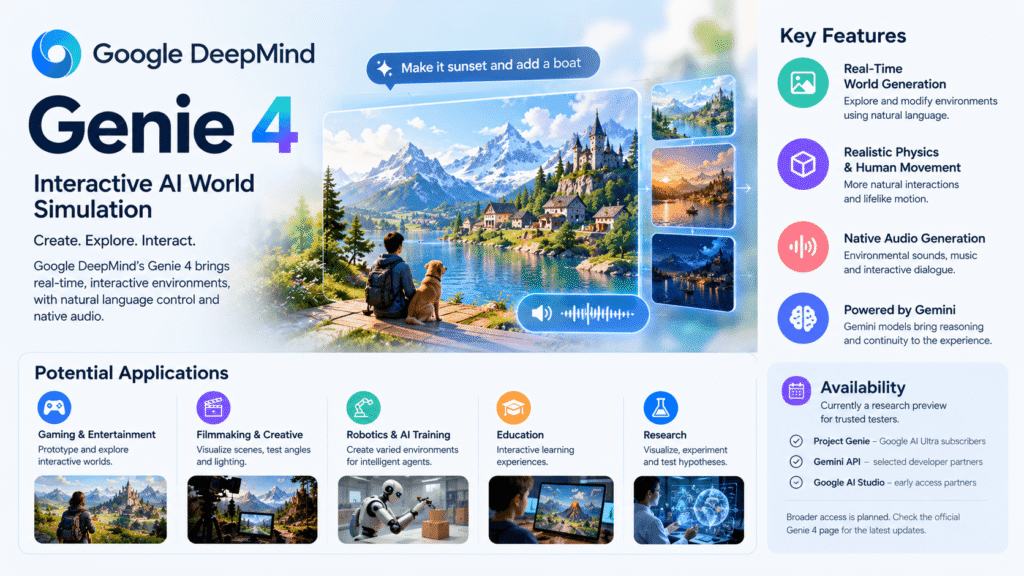
Google Genie 4: Key Features
1. Real-Time Interactive World Generation
One of Genie 4’s main features is its ability to create and modify simulated environments while users interact with them.
Users can provide natural-language instructions to change elements such as weather, camera position, objects, and characters.
For example, someone creating a virtual forest could request rain, introduce a new character, or change the camera angle without restarting the entire experience.
This capability could make AI-generated environments more useful for creative professionals, researchers, and game developers.
2. More Realistic Physics and Human Movement
Google DeepMind says Genie 4 improves the realism of physical interactions, including movement, collisions, and other environmental behaviors.
The model also aims to generate more natural human actions and responses within simulated scenes.
These capabilities matter because realistic environments need more than attractive graphics. Objects and characters must respond in ways that make sense within the simulated world.
For example, a virtual training environment could help researchers explore how objects move or how an agent responds to changing conditions.
However, these capabilities remain experimental. The model does not guarantee perfectly accurate physics or realistic human behavior in every scenario.
3. Native Audio Generation
Another major development is Genie 4’s ability to generate audio directly as part of a real-time simulation.
The generated audio can include environmental sounds, music, and interactive dialogue. Characters can respond to user instructions or events occurring in the simulated world.
This could make AI-generated experiences more immersive because sound becomes part of the environment rather than a separate production step.
For filmmakers, designers, and game developers, this approach could reduce the work needed to create early prototypes of interactive scenes.
4. Integration With Google’s Gemini Models
Genie 4 works with Google’s Gemini family to improve the reasoning and continuity of simulated environments.
According to Google DeepMind, Gemini models help interpret instructions, understand the scene, and guide the simulation toward a requested outcome.
This combination could be useful for more complex tasks that involve multiple steps.
For example, a user might ask an AI system to simulate a robot navigating a room, identifying an object, and moving it to another location. A reasoning model could help plan the sequence while Genie 4 generates the environment and its changing visual state.
The technology is still under development, but the approach highlights how reasoning models and interactive world models could work together.
For additional context on Google’s AI developments, read our coverage of Gemini 4 Argon: Google’s AI Model for Complex Work.
How Could Genie 4 Change AI Applications?
Gaming and Interactive Entertainment
Game developers could use Genie 4 to experiment with interactive environments, characters, and visual styles.
Instead of building every prototype manually, developers might describe a scene and explore different versions through text instructions.
This could speed up early-stage design and concept development. However, generating a simulation is not the same as producing a complete commercial game with optimized performance, advanced gameplay systems, and production-ready assets.
Filmmaking and Creative Production
Filmmakers could use interactive world models to test scene composition, camera movement, lighting, and character actions before filming.
A director might explore different camera angles or adjust the atmosphere of a virtual location during previsualization.
These capabilities could make it easier to test creative ideas before committing time and money to full production.
Robotics and AI Training
One of the most important potential applications is robotics research.
Robots often need to learn how to operate in environments that contain unpredictable objects, people, and obstacles. Interactive simulations could help researchers create varied scenarios before testing systems in the physical world.
For example, researchers could explore how a robot responds to different room layouts or changing environmental conditions.
However, performance in a simulated environment does not automatically translate into reliable real-world performance. Researchers must still evaluate safety, physical accuracy, and generalization.
Education and Scientific Research
Interactive simulations could also support education by allowing students to explore virtual environments rather than relying only on static diagrams or prerecorded videos.
Researchers could potentially use world models to visualize scenarios, investigate hypotheses, or build interactive demonstrations.
The usefulness of these applications will depend on the model’s accuracy, controllability, and ability to maintain consistent environments over time.

Google Genie 4 vs Traditional AI Video Generators
Genie 4 and conventional AI video generators have different primary goals.
Traditional AI video tools generally focus on generating video clips from text or image prompts. Genie 4 focuses on creating environments that users can interact with and modify while they are running.
The distinction is important because an interactive simulation must respond to new inputs, not simply produce a predetermined sequence of frames.
Genie 4 also generates native audio as part of its simulated environments, according to Google DeepMind.
However, the two categories may overlap as AI video systems become more interactive and world models improve their visual quality.
What Are the Limitations of Genie 4?
Despite its capabilities, Genie 4 remains an early-stage research technology.
Google DeepMind identifies several areas that still require improvement:
- Visual consistency: Details and objects can change or drift during longer sessions.
- Complex interactions: Accurately modeling multiple independent agents and complicated environments remains challenging.
- Real-world accuracy: The model cannot reproduce real-world locations perfectly.
- Text rendering: Producing readable text within generated environments remains an active research area.
- Physical accuracy: Complex interactions and spatial relationships may not always behave as expected.
These limitations mean Genie 4 should not yet be treated as a replacement for professional game engines, validated scientific simulators, or real-world robotics testing.
The model is better understood as an emerging research platform with promising creative and technical applications.
Google Genie 4 Availability: Can You Use It?
As of October 28, 2026, Google DeepMind says Genie 4 is available as a research preview for a limited group of trusted testers.
Google plans to expand access through:
- Project Genie: Planned access for Google AI Ultra subscribers.
- Gemini API: Early access for selected developer partners.
- Google AI Studio: Early access for selected partners working with Google’s AI tools.
Broader availability is planned, but users should check the official Genie 4 page for the latest access information.
Public availability, final pricing, and access conditions may change as Google expands the preview.
What Does Genie 4 Mean for the Future of AI?
Genie 4 represents a broader shift from AI systems that generate static content toward systems that can create and respond within interactive environments.
If these models become more consistent and controllable, they could help developers prototype games, filmmakers visualize scenes, and researchers create varied training environments for intelligent agents.
This development also connects to the wider competition over AI infrastructure. Creating increasingly sophisticated AI systems requires substantial computing resources, making AI chips and data centers important parts of the industry.
Read our related report: OpenAI Plans to Buy Google AI Chips: What It Means for NVIDIA and the AI Industry.
Ultimately, the impact of Genie 4 will depend on how well it performs outside controlled demonstrations, how accessible it becomes, and whether developers can use it reliably in practical workflows.
Frequently Asked Questions About Google Genie 4
What is Google Genie 4?
Google Genie 4 is an AI world model from Google DeepMind that generates interactive simulated environments with real-time scene editing and native audio.
When was Genie 4 announced?
Google DeepMind announced Genie 4 on October 27, 2026.
Is Google Genie 4 available to everyone?
No. As of October 28, 2026, it is a research preview for trusted testers, with broader access planned through Project Genie, the Gemini API, and Google AI Studio.
What can Genie 4 do?
Genie 4 can generate interactive environments, respond to natural-language instructions, modify scenes in real time, simulate physical interactions, and produce audio within its environments.
Is Genie 4 a video generator?
Not in the conventional sense. Its main focus is interactive world simulation, although it generates visual content as part of those environments.
Can Genie 4 be used for game development?
It could help developers explore environments and prototype ideas. However, it is not yet a complete replacement for professional game-development tools.
How is Genie 4 different from Gemini?
Gemini is a family of AI models used for tasks such as reasoning and understanding information. Genie 4 is a world model focused on generating and controlling interactive simulated environments, with Gemini models helping guide the experience.
Final Thoughts
Google DeepMind’s Genie 4 introduces an important development in interactive AI, combining realistic environments, real-time control, native audio, and reasoning capabilities from Google’s Gemini family.
Its potential applications extend beyond gaming to filmmaking, robotics, education, and research. However, consistency, physical accuracy, and limited access remain important challenges.
For now, Genie 4 is an early research preview rather than a fully mature production tool. Its progress will be worth watching as Google expands access and continues developing interactive world simulation.
Source: Google DeepMind — Genie 4: A New Generation of World Simulation
Last updated: October 28, 2026.
