
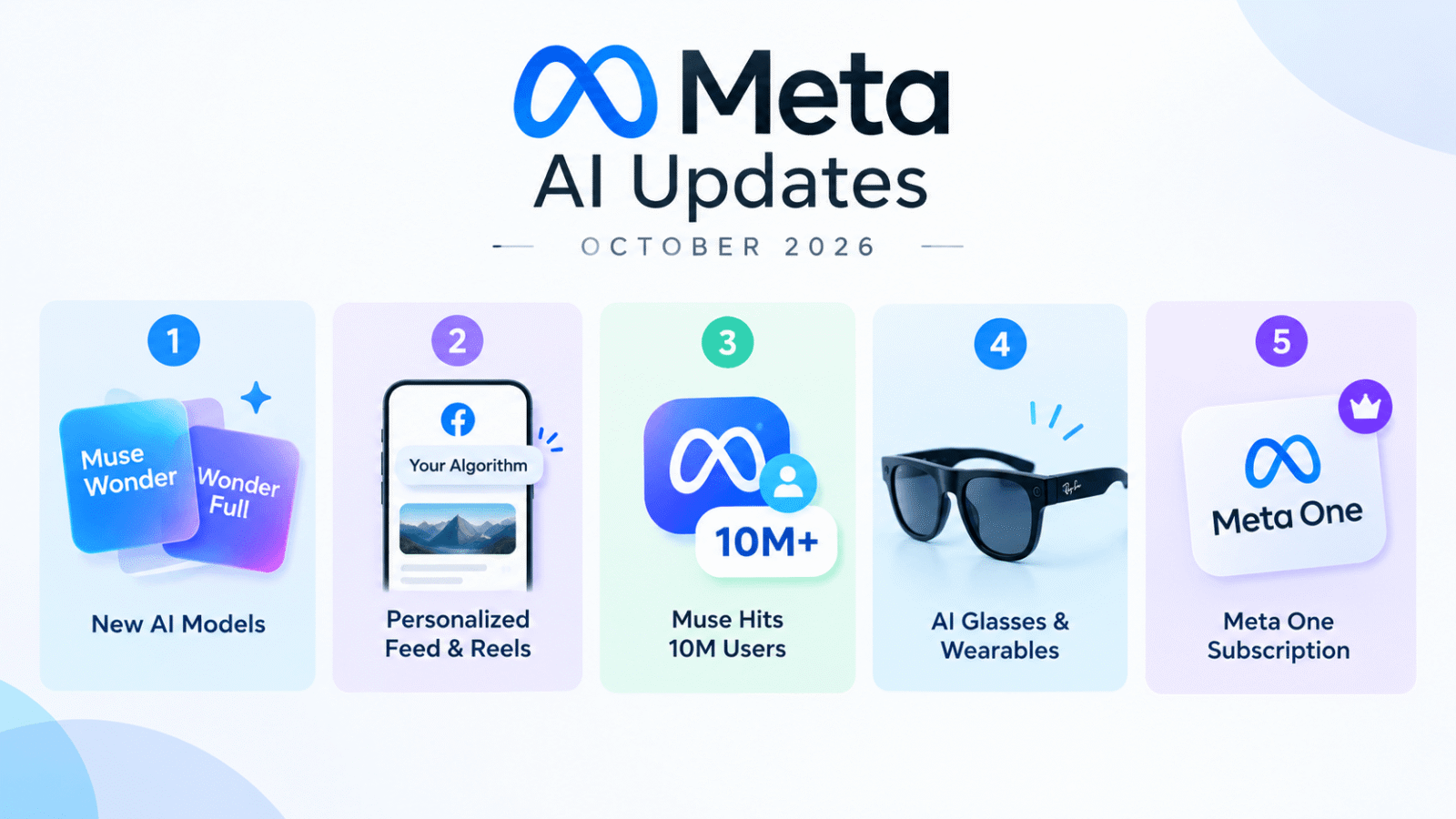
Meta AI updates in October 2026 highlight the company’s growing focus on artificial intelligence, personal AI agents, social media recommendations, smart glasses, and subscription services. Meta is working to make AI more useful in everyday life, from helping users discover content on Facebook to assisting with shopping, coding, and complex tasks.
Several important developments have emerged this month. Meta introduced its Muse Wonder AI models, announced a new way to personalize Facebook recommendations, reported strong early adoption of its Muse AI app, continued expanding its AI-powered wearable strategy, and pushed forward with paid subscriptions that offer additional features.
These updates matter to AI users, developers, content creators, marketers, and businesses looking to understand where consumer AI is heading.
In this article, we explore five major Meta updates from September and October 2026, explain their key features, and examine what they could mean for the future of AI.
Quick Summary: The Latest Meta AI News
- Muse Wonder and Wonder Full: New AI models designed for complex personal and professional tasks.
- Facebook Your Algorithm: An AI-powered feature that lets users influence Feed and Reels recommendations using natural language.
- Muse reaches 10 million users: Meta reported more than 10 million users for its Muse AI app in the United States and Canada.
- Meta AI glasses: Meta continues expanding AI-powered wearables and immersive computing.
- Meta One subscriptions: Paid plans offer additional features and AI capabilities across Meta’s products.
1. Meta Introduces Muse Wonder and Muse Wonder Full AI Models
Meta introduced Muse Wonder and Muse Wonder Full on October 12, 2026. These models represent an important step in the company’s effort to develop AI systems that can do more than answer questions.
According to Meta, the new models are designed to handle personal and professional tasks that require planning, reasoning, and multiple steps.
What Can Muse Wonder Do?
Muse Wonder is designed to help users work toward goals by keeping track of relevant information and focusing on important tasks. Meta highlights features such as Active Memory and Active Focus, which aim to help the model maintain useful context and work toward a user’s objectives.
Potential use cases include:
- Understanding complicated documents, such as rental agreements.
- Helping users navigate insurance claims.
- Assisting with coding and software development.
- Supporting planning and other multi-step activities.
- Helping users organize information and complete work more efficiently.
Muse Wonder Full is the more advanced model in this family, targeting demanding agentic tasks and complex workflows.
An AI agent differs from a conventional chatbot because it can potentially plan and carry out a sequence of actions rather than simply provide a written response. However, its actual capabilities depend on the tools, permissions, and environment available to it.
Who Can Access the New Models?
Meta’s initial announcement made Muse Wonder available to developers and builders through the Meta Model API and Muse Code. Muse Wonder Full was made available to Muse Code subscribers.
This means access depends on the specific product and intended use. The announcement should not be interpreted as confirmation that every user can access both models through the standard Meta AI app.
For more information, read Meta’s official Muse Wonder announcement.
You can also explore our related coverage: Meta Muse Wonder and Wonder Full: New AI Models Built for Complex Tasks.
Why This Update Matters
Meta’s new models reflect a broader shift in AI development. Companies are increasingly competing to build assistants that can help people complete real tasks, including research, coding, document analysis, and planning.
For businesses, more capable AI agents could reduce repetitive work. For developers, these models could create new opportunities to build AI-powered applications.
However, reliability, privacy, and human oversight remain important when AI systems handle sensitive documents or make decisions on a user’s behalf.
2. Facebook Introduces Your Algorithm for Feed and Reels
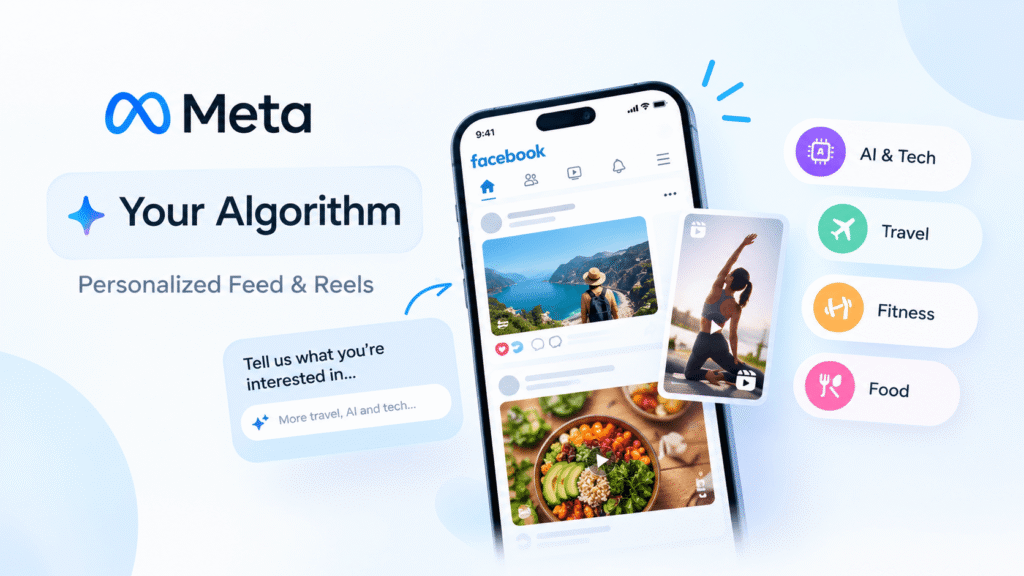
On October 13, 2026, Meta announced an AI-powered Facebook feature called Your Algorithm. It gives users a more direct way to influence the recommendations they see in Feed and Reels.
Traditionally, social media algorithms have relied on signals such as user activity, engagement, and content preferences to recommend posts and videos. Your Algorithm adds a more conversational approach.
How Does Facebook Your Algorithm Work?
The feature allows users to describe, in their own words, the topics and content they want to see more or less frequently.
For example, a user might want more:
- Artificial intelligence and technology news.
- Educational videos and tutorials.
- Travel inspiration and photography.
- Fitness tips and cooking ideas.
Users can also provide feedback on individual posts and recommendations. After selecting options such as “Interested” or “Not interested,” Facebook may ask follow-up questions to better understand their preferences.
According to Meta, these preferences can influence recommendations in real time.
Read Meta’s official announcement about Your Algorithm.
What Does This Mean for Content Creators?
This update is especially relevant to Facebook creators, publishers, and digital marketers.
If users gain more direct control over their interests, creators may need to focus even more on producing content that matches the audiences they want to reach.
For example, a technology publisher could benefit when readers actively request more AI news. However, this does not guarantee that every post will receive more reach or that engagement will automatically increase.
Creators should continue focusing on:
- Publishing original and useful content.
- Using clear headlines that match the content.
- Understanding their target audience.
- Creating videos and posts that deliver genuine value.
- Monitoring reach, engagement, and audience retention.
Will Your Algorithm Replace Facebook’s Recommendation System?
No. Meta has introduced a way for users to influence recommendations, rather than announcing the removal of its recommendation system.
The platform will still use automated systems to determine which content appears to users.
The important change is that users can express their preferences more directly, potentially making recommendations more relevant to their interests.
For businesses and publishers, this is a reason to prioritize audience relevance instead of relying only on viral formats.
3. Meta’s Muse AI App Reaches More Than 10 Million Users
One of the most notable Meta AI developments this month is the growth of its Muse AI app.
On October 21, 2026, Meta CEO Mark Zuckerberg reported that Muse had attracted more than 10 million users in the United States and Canada since its September launch.
The milestone was reported during Meta’s third-quarter earnings discussion. The company also highlighted shopping as an important use case for the app.
Source: TechCrunch’s report on Muse’s 10 million users.
Meta Muse Reaches 10 Million Downloads Faster
US downloads during the first 40 days after launch
Days to Reach 10 Million US Downloads
Source: Sensor Tower data reported by TechCrunch. Figures represent estimated US app downloads, not total users.
What Are People Using Muse For?
Muse is part of Meta’s broader effort to build personal AI assistants that help people with everyday tasks.
Reported use cases include:
- Discovering products and comparing shopping options.
- Getting help with personal productivity.
- Exploring ideas and creative projects.
- Finding information and organizing tasks.
Shopping is particularly interesting because it shows how AI assistants could influence the way people discover products online.
Instead of searching through multiple websites, users may increasingly ask an AI assistant to help them compare options and narrow down their choices.
However, the quality of these experiences depends on access to accurate product information, supported websites, and the ability to complete actions reliably.
Why Is Meta Investing in Personal AI Agents?
Meta already has a large audience across Facebook, Instagram, WhatsApp, and its other products. A successful AI assistant could help the company introduce AI features to more consumers.
It could also create new opportunities for commerce and future AI services.
For businesses, this development raises an important question: how will customers discover products when AI assistants become part of the shopping process?
Brands may need to make their product information clearer, maintain accurate listings, and ensure their websites provide useful information that customers and supported AI tools can understand.
Does 10 Million Users Mean Muse Is Beating ChatGPT?
Not necessarily.
User totals alone do not provide a complete comparison between AI assistants. The platforms may differ in availability, active usage, features, and how they count users.
The milestone does show early interest in Meta’s personal AI strategy. It does not, by itself, establish that Muse is more capable than competing assistants.
For AI Edge Insights readers, this is an important development to watch as consumer AI moves from answering questions toward helping people complete practical tasks.
4. Meta Expands Its AI Glasses and Wearable Technology Strategy
Meta is also investing in devices that bring AI assistance into everyday life.
At Meta Connect 2026 in September, the company presented developments across smart glasses and immersive computing. The announcements reinforced its interest in making AI available through devices beyond smartphones and computers.
Coverage of the event highlighted new Meta VR Glasses, updates to Ray-Ban Meta smart glasses, and Muse Charm, a compact device designed to provide quick access to the Muse assistant.
Source: Business Insider’s coverage of Meta Connect 2026.
How Could AI Glasses Change Everyday Technology?
AI-powered glasses can combine a wearable camera, microphones, speakers, and an AI assistant, depending on the model.
Potential uses include:
- Getting hands-free assistance while walking or travelling.
- Taking photos and videos.
- Asking questions through voice interactions.
- Receiving information without constantly checking a phone.
- Supporting accessibility features on compatible devices.
Some features may require an internet connection, a paired smartphone, a compatible account, or access to a particular AI service.
Meta’s wider wearable strategy also includes immersive computing, where users can interact with digital content in new ways. These experiences are different from the everyday assistance offered by standard smart glasses.
What Should Consumers Know Before Buying?
AI glasses are not all the same. Buyers should check the exact model, supported features, battery life, regional availability, and compatibility before making a purchase.
Privacy also deserves attention. Camera-equipped wearables may capture other people or sensitive surroundings, so users should follow local laws and respect other people’s privacy.
Availability can vary by country, and an announcement at a technology event does not necessarily mean a device is immediately available in every market.
For consumers in Pakistan and other international markets, checking official regional availability is especially important before relying on a particular AI feature.
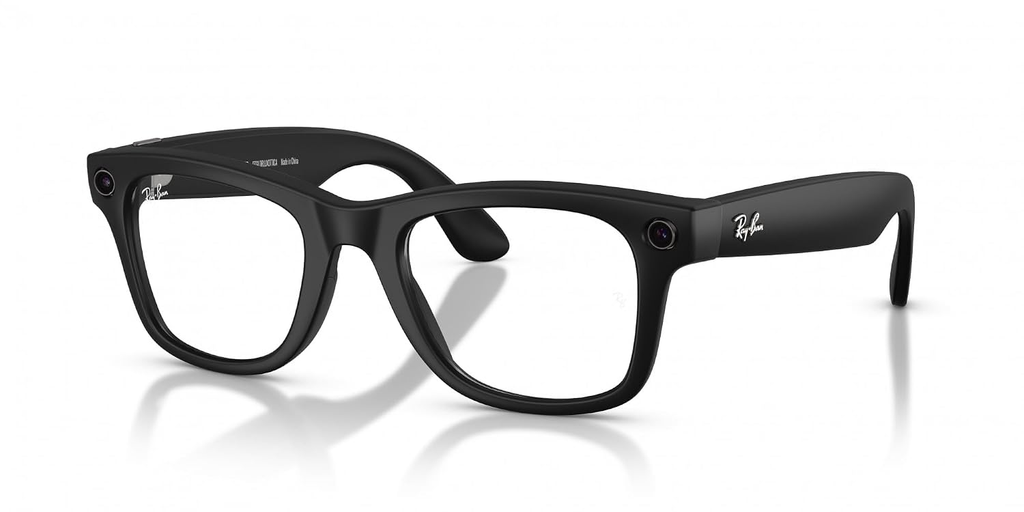
Ray-Ban Meta (Gen 2) Wayfarer, Matte Black, Clear lenses

Meta Oakley, Vanguard AI Glasses
Why This Matters for the AI Industry
Wearable AI could make digital assistants more accessible in situations where typing on a phone is inconvenient.
It also introduces new challenges around privacy, battery consumption, device costs, and whether users find hands-free AI genuinely useful.
Meta’s continued investment suggests that smart glasses and other wearables will remain an important part of its long-term AI strategy.
5. Meta One Subscription Expands Access to Paid Features and AI Tools
Meta is also exploring ways to generate revenue from its AI and consumer products through subscriptions.
On September 15, 2026, Meta announced Meta One, a subscription service intended to provide additional features and AI capabilities across its products.
The announcement reflects a broader industry trend: technology companies are offering free services while charging for selected premium capabilities.
Source: Meta’s official Meta One announcement.
What Is Meta One?
Meta One is designed to offer additional features for creating content, connecting with others, and using AI tools.
Depending on the plan and supported product, subscription benefits may include enhanced AI capabilities and additional creative options.
For example, premium AI features could be useful for people who regularly create images, experiment with AI-assisted content, or use digital tools for professional work.
However, users should check the official plan details before subscribing because features, prices, and availability can differ across services and regions.
Will Meta AI Remain Free?
The introduction of paid plans does not automatically mean that all Meta AI features will become paid.
Companies often maintain free access while offering subscriptions for higher usage limits, additional tools, or more advanced capabilities.
The exact distinction between free and paid access depends on the service and the terms of the relevant plan.
Before purchasing a subscription, users should consider whether the additional features justify the cost and whether those features are available in their country.
What Does This Mean for Creators and Businesses?
Paid AI services could help creators produce content more efficiently, experiment with new formats, and support their marketing workflows.
Small businesses may also find value in AI-assisted content creation, provided that the tools fit their budget and requirements.
At the same time, subscription costs can add up when users pay for multiple AI platforms. Businesses should compare features, usage limits, and actual productivity benefits before committing to paid plans.
Meta’s subscription strategy will be worth watching as it seeks to balance free consumer services with new revenue opportunities.
What Do These Five Meta Updates Mean for the Future of AI?
Taken together, these developments show how Meta is approaching AI from several directions.
Muse Wonder and Wonder Full focus on more capable models. Your Algorithm gives users a more direct way to influence social media recommendations. Muse’s growing user base highlights interest in personal AI assistants. Smart glasses bring AI into physical environments, while Meta One explores paid access to additional capabilities.
Three broader trends stand out.
First, AI is moving beyond chat. Companies are developing assistants that can help users plan, research, create, and complete multi-step tasks.
Second, personalization is becoming more important. AI systems are increasingly designed to understand user interests and adapt their responses or recommendations.
Third, monetization is evolving. Technology companies are exploring subscriptions, commerce, and other ways to turn AI usage into sustainable businesses.
There are still important challenges. AI assistants can make mistakes, access to features varies by region, and privacy concerns become more serious when systems handle personal information or interact with external services.
For consumers and businesses, the best approach is to evaluate these tools based on their actual capabilities rather than announcements alone.
Frequently Asked Questions (FAQs)
1. What are the latest Meta AI updates in October 2026?
Major developments include the Muse Wonder AI models, Facebook’s Your Algorithm feature, Muse reaching more than 10 million users in the United States and Canada, continued investment in AI wearables, and Meta’s subscription strategy.
2. What are Meta Muse Wonder and Wonder Full?
Muse Wonder and Muse Wonder Full are AI models introduced by Meta on October 12, 2026. They are designed to support complex personal and professional tasks, including agentic workflows and coding.
3. What is Facebook’s Your Algorithm feature?
Your Algorithm is an AI-powered feature that allows Facebook users to express their interests in natural language and influence recommendations in Feed and Reels.
4. Has Meta Muse reached 10 million users?
Yes. Meta reported on October 21, 2026, that Muse had attracted more than 10 million users in the United States and Canada since its September launch.
5. Are Meta AI glasses available worldwide?
Availability depends on the specific device, market, and supported features. Consumers should check Meta’s official product information for current regional availability.
6. Is Meta One a free service?
Meta One is a subscription offering additional features and AI capabilities. Users should check the official announcement and current plan information for pricing, benefits, and regional availability.
7. Why are Meta’s AI updates important?
They show how Meta is integrating AI into models, social media, personal assistants, wearable devices, and paid services. These developments could influence how people discover information, create content, shop online, and interact with technology.
Final Thoughts
Meta’s latest developments show that the company wants AI to become part of everyday digital experiences rather than remain a separate chatbot.
More capable AI models, personalized Facebook recommendations, growing interest in Muse, wearable devices, and premium AI services all contribute to this strategy.
However, the long-term impact will depend on how useful these features prove to be, how widely they become available, and how well Meta addresses reliability, privacy, and user trust.
For AI enthusiasts, developers, creators, and businesses, these are important developments to follow as the AI industry continues to evolve.
Stay updated with AI Edge Insights for the latest AI models, technology news, product updates, and practical AI guides.
