
OpenAI Google AI Chips: Latest News (October 28, 2026)
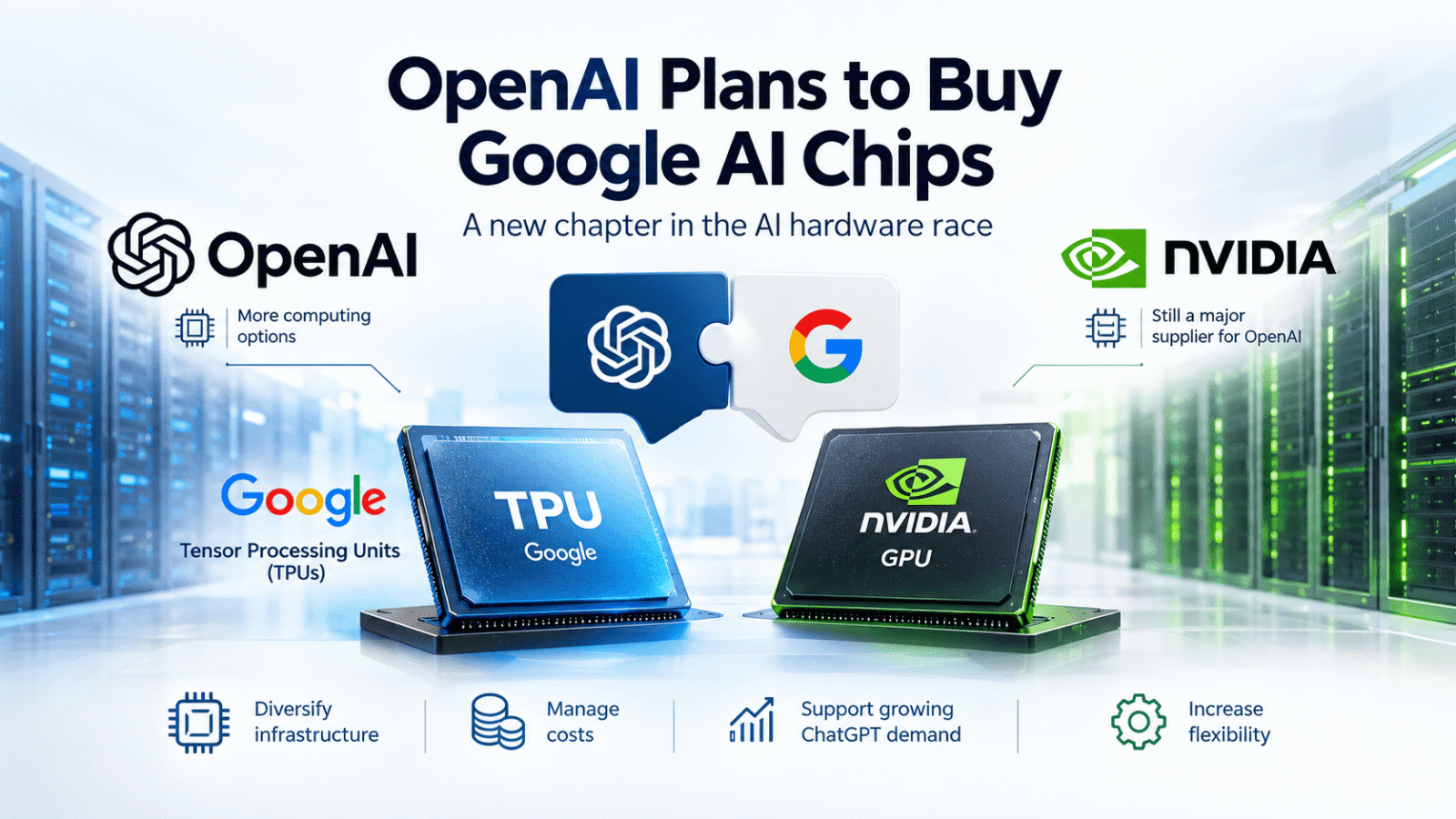
OpenAI is reportedly planning to purchase Google’s artificial intelligence chips, a move that could reshape competition in the rapidly growing AI infrastructure market. According to a report by The Information, cited by Reuters on October 27, OpenAI plans to buy Google’s Tensor Processing Units (TPUs) as demand for computing power continues to rise.
The reported move is significant because OpenAI is one of the biggest users of NVIDIA’s graphics processing units (GPUs). Purchasing Google’s custom AI chips could give the ChatGPT developer another option for running and developing advanced AI models.
However, the proposed purchase has not been officially confirmed by either company, and the financial terms have not been disclosed.
The development highlights a broader shift in the AI industry: major technology companies are looking beyond a single chip supplier as they compete to build faster, more efficient, and more affordable AI systems.
In this article, we explain why OpenAI may be interested in Google’s AI chips, how TPUs compare with NVIDIA GPUs, and what the reported plan could mean for ChatGPT, Google Cloud, and the future of AI computing.

OpenAI Google AI Chips Deal: What Happened?
On October 27, 2026, Reuters reported that OpenAI plans to purchase Google’s AI chips, citing information originally published by The Information.
The reported plan would strengthen the business relationship between OpenAI and Google, even though the companies compete in AI products, search, and cloud services.
OpenAI already relies heavily on NVIDIA GPUs to train and run its AI models. Google, meanwhile, has developed its own processors, known as Tensor Processing Units, to accelerate machine learning workloads.
According to Reuters, OpenAI had previously started renting Google’s AI chips through Google Cloud in 2025. The newly reported purchase plan could represent a further step toward diversifying its computing infrastructure.
Neither company provided further details confirming the proposed purchase in the Reuters report.
Key facts about the reported OpenAI–Google AI chip deal:
- Companies involved: OpenAI and Google.
- Reported development: OpenAI plans to purchase Google’s AI chips.
- Chip technology: Google Tensor Processing Units (TPUs).
- Existing supplier: NVIDIA remains a major provider of AI computing hardware for OpenAI.
- Financial terms: Not disclosed.
- Official confirmation: The reported purchase has not been confirmed by either company.
Source: Reuters — OpenAI plans to buy Google’s AI chips.
What Are Google Tensor Processing Units (TPUs)?
Google’s Tensor Processing Units, commonly called TPUs, are specialized processors designed to accelerate machine learning tasks.
Unlike general-purpose processors, TPUs are developed specifically for workloads involving artificial intelligence, including the mathematical operations used in training and running machine learning models.
Google developed this hardware to support its own AI systems and cloud infrastructure. Through Google Cloud, businesses and developers can access TPU computing resources without building their own data centers.
According to the official Google Cloud TPU documentation, TPUs are application-specific integrated circuits designed to accelerate machine learning workloads.
These processors can be useful for large-scale AI training and inference, depending on the model, software framework, and workload requirements.
Why Are TPUs Important for AI?
Modern AI models require significant computing resources. Training a large model can involve processing enormous datasets and performing billions or trillions of mathematical operations.
After training, companies also need computing power to serve users who interact with AI products every day.
For example, ChatGPT must process user prompts, generate responses, and support additional capabilities such as coding, reasoning, and other AI-assisted tasks.
Specialized hardware can help companies manage these workloads at scale.
Google’s TPUs offer another option for organizations that want to reduce their dependence on conventional GPU infrastructure. However, the actual performance and cost advantages depend on the specific application and configuration.
Why Does OpenAI Want to Buy Google’s AI Chips?
There are several possible business reasons behind the reported purchase plan.
1. Reduce Dependence on NVIDIA
NVIDIA has become a central supplier in the AI industry because its GPUs power many leading AI training and inference systems.
OpenAI is among the major companies using NVIDIA hardware. However, depending heavily on one supplier can create challenges related to availability, pricing, infrastructure planning, and long-term capacity.
Using Google’s TPUs could provide OpenAI with another source of computing power.
This does not necessarily mean OpenAI plans to stop using NVIDIA GPUs. A more likely possibility is that the company wants a broader mix of hardware for different workloads.
For the AI industry, this would demonstrate how even leading AI developers are exploring alternatives to established chip suppliers.
2. Manage the Cost of Running AI Models
Running advanced AI models can be expensive.
Companies must pay for processors, electricity, data centers, networking, storage, and the engineering teams responsible for operating these systems.
As AI products attract more users, the cost of generating each response becomes an important business consideration.
Google’s TPUs could provide a competitive alternative for selected workloads, potentially helping OpenAI improve its computing economics.
However, lower costs are not guaranteed. Total expenses depend on hardware prices, cloud contracts, software optimization, utilization rates, and the engineering required to move workloads between platforms.
OpenAI has not disclosed any expected savings from the reported purchase.
3. Support Growing Demand for ChatGPT and Other AI Products
AI services require substantial computing capacity as usage increases.
OpenAI develops models and products that serve consumers, developers, and businesses. Supporting these services requires infrastructure that can handle both model development and day-to-day user requests.
Adding another chip platform could help the company secure more computing capacity as demand grows.
It may also give OpenAI additional flexibility when deciding where to run particular AI workloads.
The reported purchase should therefore be viewed as a potential infrastructure strategy rather than evidence of a new ChatGPT feature or model launch.
4. Improve Long-Term Computing Flexibility
AI companies are increasingly investing in different types of processors and infrastructure.
OpenAI has also been developing a custom AI chip with Broadcom, which it previously said it planned to deploy by the end of 2026, according to Reuters.
Combining custom processors with hardware from NVIDIA and Google could eventually give OpenAI more control over its computing strategy.
Still, using different chip architectures is technically challenging. AI software must be optimized for each platform, and not every model or workload can be transferred without additional engineering.
Google TPU vs NVIDIA GPU: What Is the Difference?
Google TPUs and NVIDIA GPUs are both used for demanding AI workloads, but they have different hardware architectures and software ecosystems.
| Feature | Google TPU | NVIDIA GPU |
|---|---|---|
| Main purpose | Specialized machine learning acceleration | Broad AI, graphics, and accelerated computing |
| Hardware design | Custom AI-focused processor | Programmable graphics processing architecture |
| Availability | Google Cloud and selected customer arrangements | Cloud providers, data centers, and hardware systems |
| Software ecosystem | Google-supported tools and compatible ML frameworks | CUDA and a broad AI software ecosystem |
| Potential advantage | Efficient execution for suitable workloads | Flexibility and mature AI development tools |
| Main consideration | Workload compatibility and platform optimization | Cost, availability, power, and system configuration |
For more information, see the Google Cloud TPU documentation and NVIDIA’s data center platform.
Which AI Chip Is Better?
There is no single answer for every AI workload.
Google TPUs may be attractive when a model and software stack are well suited to Google’s infrastructure. NVIDIA GPUs can be appealing because of their flexibility, established software ecosystem, and wide adoption across AI development.
Performance depends on the particular hardware generation, model architecture, memory requirements, networking, and optimization.
A processor that performs well for one AI workload may not be the most cost-effective option for another.
For OpenAI, the strategic advantage may come from having more choices rather than replacing one supplier with another.
How Could the Reported Deal Affect NVIDIA?
NVIDIA could face more competition if major AI companies increasingly purchase processors from alternative suppliers.
The company has benefited from strong demand for GPUs used in AI training and inference. Its hardware, networking systems, and software tools form an important part of the infrastructure behind many modern AI applications.
However, the AI chip market is expanding, and major technology companies are investing in their own processors.
Google has developed TPUs, while other companies are exploring custom silicon and alternative computing architectures.
If OpenAI expands its use of Google chips, NVIDIA could face additional competitive pressure when negotiating with large AI customers.
That does not mean NVIDIA will immediately lose its market position.
OpenAI may continue to use NVIDIA GPUs for workloads where they offer the best combination of performance, software compatibility, and availability. Its custom chip program could also complement rather than replace existing suppliers.
The more important long term question is whether large AI developers will increasingly distribute their workloads across several hardware platforms.
For NVIDIA, competition may depend not only on chip performance but also on software, networking, energy efficiency, supply capacity, and total operating costs.
Why the OpenAI Google Relationship Is Becoming More Interesting
OpenAI and Google compete directly in several areas, including AI assistants, model development, and cloud-based AI services.
OpenAI operates ChatGPT and develops its own frontier models, while Google offers Gemini and a broad range of AI products through its ecosystem.
Despite this competition, businesses can still cooperate when they have complementary infrastructure or commercial interests.
Reuters also reported that OpenAI planned to make its advanced AI models available through Google Cloud. That development, alongside the reported chip purchase plan, highlights the increasingly complex relationships between major AI companies.
Google can compete with OpenAI in AI products while potentially supplying computing infrastructure to the same company.
This reflects a broader trend in the industry: AI companies are competitors, customers, suppliers, and infrastructure partners at the same time.
For more context on recent AI model developments, read our coverage of Gemini 4 Argon: Google’s New AI Model for Complex Work.
You can also explore our article on OpenAI’s GPT-6 Astra launch to learn more about the company’s AI model strategy.
What Does This Mean for the Future of AI Computing?
The reported OpenAI–Google chip purchase points to three important developments.
More Competition in AI Hardware
The AI industry has traditionally depended heavily on NVIDIA GPUs for advanced model development. However, custom processors from Google and other technology companies are expanding the available options.
Greater competition could encourage improvements in performance, energy efficiency, and pricing over time.
The extent of these benefits will depend on how quickly alternative platforms mature and how easily developers can use them.
More Focus on AI Infrastructure Costs
As AI applications become more widely used, businesses will pay closer attention to the cost of training models and generating responses.
Companies may increasingly select hardware based on individual workloads instead of relying on one processor type for everything.
This could make infrastructure optimization a major competitive advantage.
More Partnerships Between AI Competitors
The relationship between OpenAI and Google demonstrates that competition does not prevent commercial cooperation.
Companies may continue to compete in AI products while partnering in cloud computing, hardware, and distribution.
Such partnerships could become increasingly important as the cost of developing and operating advanced AI systems rises.
What Should Businesses and AI Developers Watch Next?
Businesses should not assume that the reported purchase will immediately change the AI tools they use.
Instead, they should watch for several developments:
- Official confirmation: Whether OpenAI or Google confirms the purchase.
- Hardware deployment: Which TPU generations and computing workloads are involved.
- Pricing changes: Whether greater hardware competition affects cloud AI costs.
- Performance results: Whether the new infrastructure delivers measurable benefits.
- Software compatibility: How easily AI developers can optimize their models for different processors.
These details will help determine whether the reported deal represents a major shift in AI infrastructure or a targeted expansion of OpenAI’s existing computing strategy.
For companies building AI applications, the practical lesson is to evaluate infrastructure according to performance, cost, reliability, and software requirements rather than assuming one processor is best for every task.
Frequently Asked Questions (FAQs)
1. Is OpenAI buying Google’s AI chips?
Reuters reported on October 27, 2026, that OpenAI plans to purchase Google’s AI chips, citing The Information. Neither company had confirmed the proposed purchase in the report, and financial terms were not disclosed.
2. What are Google’s AI chips called?
Google’s AI chips are called Tensor Processing Units, or TPUs. They are specialized processors designed to accelerate machine learning workloads.
3. Why would OpenAI use Google TPUs instead of NVIDIA GPUs?
OpenAI could use TPUs to diversify its computing infrastructure, secure additional capacity, and potentially reduce costs for suitable workloads. The reported plan does not mean that OpenAI will stop using NVIDIA GPUs.
4. Will this deal make ChatGPT faster or cheaper?
There is no confirmed evidence that the reported purchase will immediately make ChatGPT faster or cheaper. Any impact would depend on the hardware deployed, workload optimization, infrastructure costs, and how OpenAI uses the processors.
5. Is Google becoming an AI chip competitor to NVIDIA?
Google is an increasingly important participant in AI computing through its TPU hardware and cloud infrastructure. However, NVIDIA and Google have different hardware architectures and software ecosystems, and both can serve different AI workloads.
6. Has OpenAI developed its own AI chip?
Reuters has reported that OpenAI developed a custom AI chip with Broadcom and planned to deploy it by the end of 2026. Its custom chip efforts could complement its use of processors from external suppliers.
7. When will the OpenAI–Google AI chip deal be completed?
No confirmed completion date or detailed purchase timeline was provided in the Reuters report. Further official announcements are needed before the timing can be established.
Final Thoughts
OpenAI’s reported plan to purchase Google’s AI chips could mark another important development in the competition to power advanced artificial intelligence.
The move could give OpenAI additional computing options, strengthen its relationship with Google Cloud, and increase competition among AI hardware suppliers. It also highlights the importance of controlling infrastructure costs as demand for AI services continues to grow.
However, the reported purchase remains unconfirmed, and its financial terms, scale, and deployment timeline are not yet known.
For NVIDIA, the development signals growing competition, but it does not establish that OpenAI intends to abandon its GPUs. For Google, it could represent an opportunity to expand the reach of its custom AI processors.
The key takeaway is that the future of AI computing may depend less on a single dominant chip supplier and more on how effectively companies combine different processors, software platforms, and cloud infrastructure.
Stay with AI Edge Insights for the latest AI news, model launches, and technology industry updates.
SEO Publishing Details
SEO title: OpenAI Plans to Buy Google AI Chips: Impact on NVIDIA
Meta description: OpenAI reportedly plans to buy Google’s AI chips. Learn how TPUs compare with NVIDIA GPUs and what the reported move means for AI computing.
URL slug: openai-google-ai-chips
Primary keyword: OpenAI Google AI chips
Secondary keywords:
- OpenAI Google TPU deal
- Google TPUs vs NVIDIA GPUs
- OpenAI AI chip news 2026
- Google Tensor Processing Units
- NVIDIA AI chip competition
- OpenAI computing infrastructure
Suggested WordPress excerpt: OpenAI reportedly plans to buy Google’s AI chips, potentially changing the AI hardware landscape. Explore the implications for NVIDIA, Google TPUs, and AI computing.
Suggested category: AI News
Suggested tags: OpenAI, Google TPU, NVIDIA, AI Chips, AI Infrastructure, Artificial Intelligence
Featured image concept: OpenAI and Google AI chip infrastructure with a data center background and NVIDIA represented as a competing chip supplier. Use a clean, light 16:9 composition with minimal text.
External sources:
- Reuters — OpenAI plans to buy Google’s AI chips
- Google Cloud — Introduction to TPU
- NVIDIA — Data Center Products
Internal links included:
