
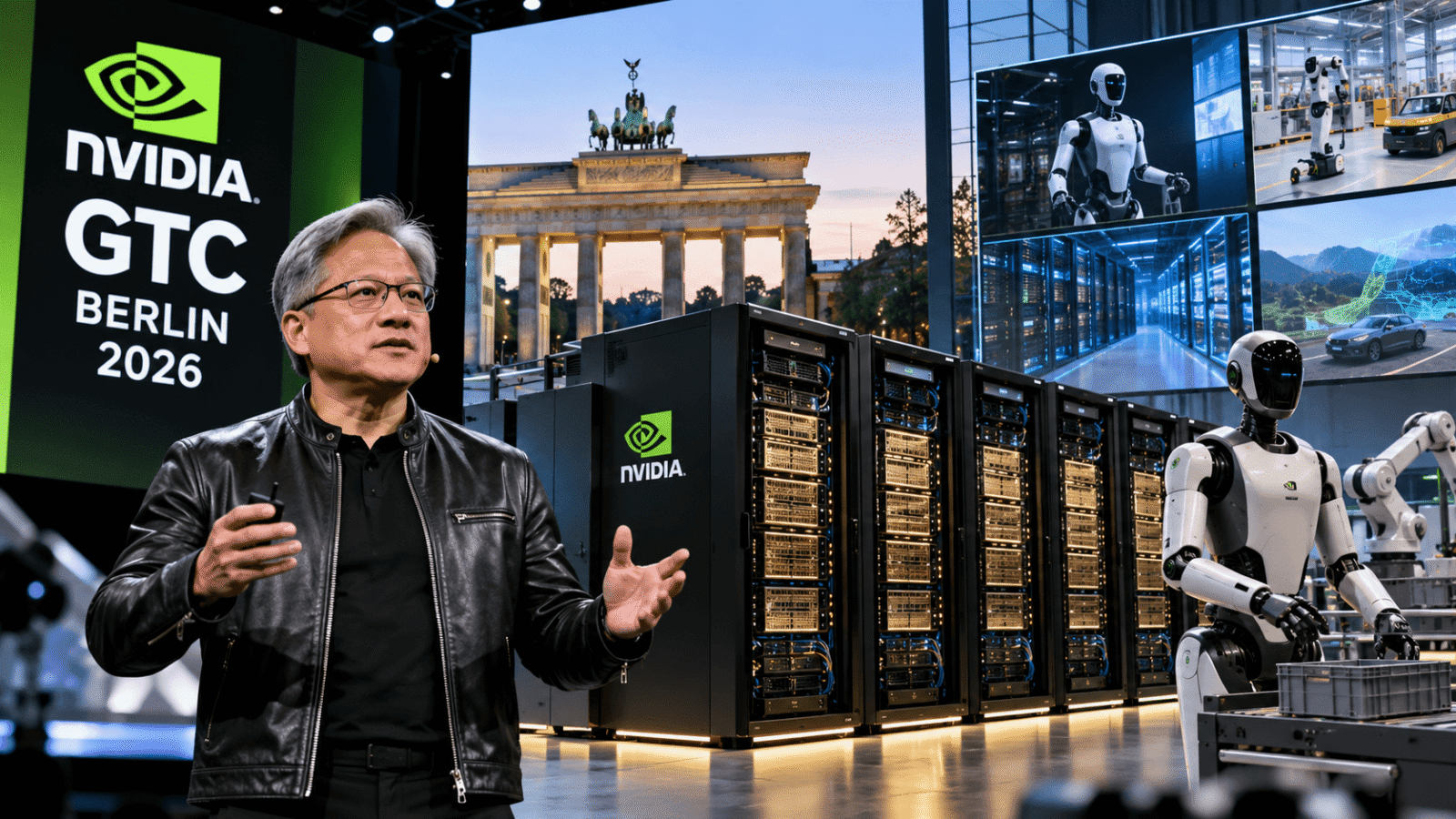
NVIDIA GTC Berlin 2026 put the spotlight on a major shift in artificial intelligence: the industry is moving beyond AI chatbots toward large scale AI infrastructure, autonomous AI agents, and intelligent machines.
At the October 21 keynote in Berlin, NVIDIA CEO Jensen Huang presented the company’s vision for Europe’s AI industry. The announcements included DSX POD modular AI data centers, the OpenShell security runtime for AI agents, the Agent Knowledge Foundation, open AI models, and advances in physical AI and robotics.
Rather than focusing on a single new chatbot or GPU, NVIDIA’s announcements showed how businesses could build, secure, and operate AI systems at scale.
Here are five major NVIDIA GTC Berlin 2026 announcements, what they mean, and why they matter for businesses and developers.
1. NVIDIA DSX POD and Vera Rubin: AI Data Centers in Modular Units
One of the biggest announcements at NVIDIA GTC Berlin 2026 was DSX POD, a modular reference design for deploying AI infrastructure more quickly.
Building a large AI data center normally involves integrating servers, networking, power systems, cooling equipment, and software. These separate processes can take months and require extensive coordination.
NVIDIA’s DSX POD approach moves more of that work into a factory environment. The systems are assembled, connected, and validated before delivery, reducing the amount of integration required at the deployment site.
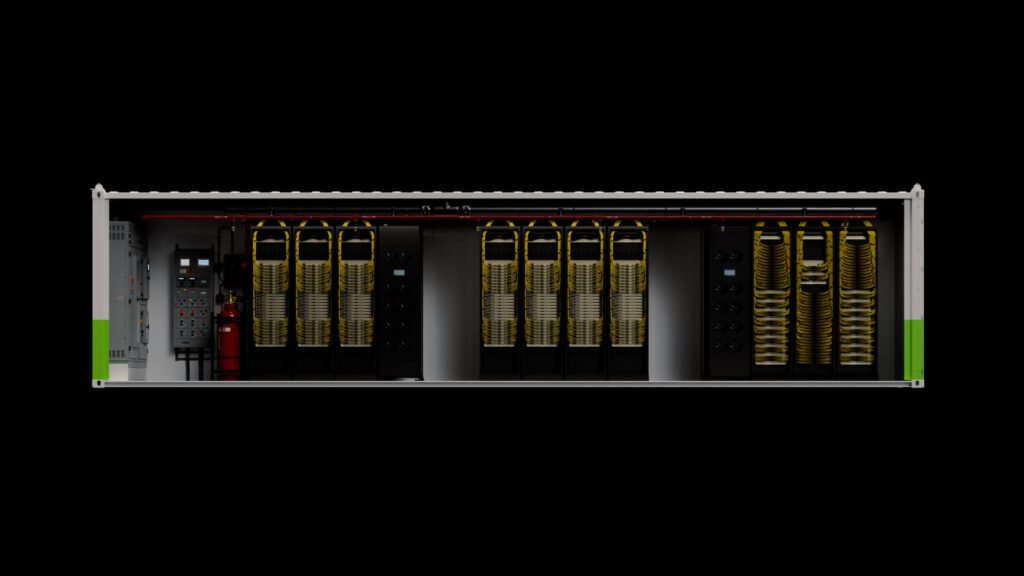
What is NVIDIA DSX POD?
DSX POD is designed to package the computing and supporting infrastructure of a Vera Rubin AI factory into modular units. The system brings together compute racks, networking, power and cooling integration, and management components.
NVIDIA says the approach can reduce on-site deployment time from approximately six months to as little as 14 days, provided the required site utilities are ready.
The 14-day figure is NVIDIA’s stated deployment target, not a guarantee that every data center can become operational in two weeks.
How does Vera Rubin fit in?
Vera Rubin is NVIDIA’s next-generation AI computing platform. DSX POD is the infrastructure design intended to help organizations deploy Vera Rubin-based AI factories more efficiently.
It is important to distinguish the two: Vera Rubin provides the computing platform, while DSX POD describes a modular way to assemble and deploy the broader infrastructure.
NVIDIA is working with infrastructure partners to bring these systems to market, with availability expected from early 2027.
Why does this matter?
Faster deployment could help cloud providers, AI companies, research institutions, and large enterprises expand their computing capacity sooner.
It could also help organizations plan AI infrastructure around growing demand for model training, AI inference, and autonomous AI agents.
Key takeaway: NVIDIA is trying to make AI infrastructure faster to deploy and easier to scale, not just more powerful.
2. NVIDIA OpenShell: A Security Layer for Autonomous AI Agents
AI agents can do more than answer questions. Depending on their permissions and tools, they may read files, access online services, execute code, or interact with business systems.
That flexibility creates a security challenge. An agent may misunderstand a task, encounter malicious instructions, or attempt an action that exceeds its intended permissions.
NVIDIA OpenShell addresses this problem by providing an open-source runtime for building security and governance into the environment where AI agents operate.
How does OpenShell work?
OpenShell helps define and enforce the resources an agent can access, including files, network services, and systems connected to physical devices. It provides controls outside the agent’s own decision-making process.
This is important because an AI model should not be the only mechanism responsible for deciding whether its own actions are safe.
For example, a business could configure an agent to access selected project files while restricting access to confidential financial records. Network permissions and other controls could further limit what the agent can do.
Actual protection depends on how the runtime is configured and integrated into the organization’s systems.
Is OpenShell a new AI model?
No. OpenShell is a security and governance runtime, not a standalone chatbot or foundation model.
NVIDIA introduced it as part of its broader approach to safer agentic AI. Its underlying concept is that organizations need technical controls around autonomous systems rather than relying entirely on model instructions.
Why does this matter?
As businesses deploy agents for coding, research, customer support, and internal workflows, controlling their access becomes increasingly important.
OpenShell could be relevant to developers, enterprise IT teams, security professionals, and companies building autonomous AI applications.
Key takeaway: AI agents need enforceable boundaries, not just instructions telling them to behave safely.
3. NVIDIA Agent Knowledge Foundation: Connecting AI Agents to Business Data
AI agents are only as useful as their ability to find and interpret relevant information.
A general-purpose model may understand language and reasoning, but it will not automatically know a company’s latest internal policies, customer records, product documentation, or operational data.
NVIDIA’s Agent Knowledge Foundation is designed to help organizations connect enterprise information to AI agents so they can use that information when answering questions and completing tasks.
What can Agent Knowledge Foundation do?
According to NVIDIA, the platform helps agents retrieve relevant information, understand business context, and use that information to support predictions and decisions.
It is intended to work with existing enterprise data and governance arrangements, helping businesses avoid unnecessary data movement or wholesale replacement of their current systems.
For example, a customer support agent could retrieve information from approved product documentation, consult relevant service records, and use that context to prepare a response.
A business analyst could use an agent to locate information across company sources and help identify patterns that support planning.
These are illustrative use cases; the results depend on the connected data, system configuration, and agent workflow.
How is this different from a regular chatbot?
A basic chatbot may rely mainly on information learned during model training or on context supplied in a conversation.
An enterprise agent connected to company data can retrieve more relevant information at the time a task is performed. This can make responses more useful for specific business operations.
However, connecting an agent to company information does not automatically make every answer accurate. Organizations still need access controls, source validation, evaluation, and human review for important decisions.
Why does this matter?
Businesses increasingly want AI systems that can work with their own information rather than provide only general answers.
A platform that helps agents use enterprise knowledge could support customer service, internal research, document analysis, and operational decision-making.
Key takeaway: Enterprise AI is moving from answering general questions toward working with an organization’s own data and processes.
4. NVIDIA Open Models: More Choices for Building Specialized AI
NVIDIA also highlighted open AI models and tools as part of its broader AI ecosystem.
Open models give developers more options for adapting AI systems to particular industries, applications, and computing environments. Depending on the model’s license, they may be able to download model weights, run models on their own infrastructure, customize them, or integrate them into specialized applications.
NVIDIA’s model ecosystem includes Nemotron language models, Cosmos world models, and GR00T models for robotics.
These model families existed before the Berlin keynote. They should not all be described as newly launched products at GTC Berlin 2026.
What are NVIDIA Nemotron models?
Nemotron is NVIDIA’s family of language models and related AI tools. It supports developers building language-based applications and AI agents.
Potential applications include document analysis, information retrieval, enterprise assistants, and specialized AI workflows.
Model size, performance, hardware requirements, and license terms vary by release, so developers should check the documentation for the specific model they intend to use.
What are Cosmos and GR00T?
Cosmos focuses on world models and physical AI development, including the generation and understanding of data relevant to real-world environments.
GR00T is NVIDIA’s model family for humanoid robotics. It is part of the company’s broader effort to help robots perceive their surroundings, understand tasks, and learn how to perform actions.
These are different from conventional language models because they support applications involving physical environments, simulation, and robot behavior.
Why do open models matter?
Open models can give developers greater flexibility over where AI runs and how it is adapted. They may also help organizations build more specialized systems without relying entirely on a single hosted AI service.
However, open does not always mean unrestricted. Usage rights, commercial permissions, training data disclosures, and redistribution rules depend on each model’s license.
Key takeaway: NVIDIA’s strategy includes the computing infrastructure, models, and development tools needed to build AI applications—not just the hardware that runs them.
5. Physical AI: Bringing Intelligence Into Robots and Machines
Physical AI was another major theme at GTC Berlin 2026.
Traditional generative AI often produces text, images, audio, or code. Physical AI extends AI capabilities into systems that perceive and act in the real world, including robots, autonomous vehicles, and industrial machines.
NVIDIA is building tools for this area through simulation platforms, robotics models, and accelerated computing.
What did NVIDIA highlight in robotics?
The Berlin event emphasized the role of European manufacturers and robotics companies in developing intelligent machines.
NVIDIA’s existing physical AI ecosystem includes Cosmos world models, GR00T robotics models, and simulation tools designed to help developers train and test systems before deploying them in the real world.
The keynote also highlighted Agile Robots’ plans to manufacture 1,000 to 2,000 humanoid robots in 2027 using NVIDIA technology, according to Reuters’ reporting.
This is a reported production plan, not evidence that those robots have already been manufactured or deployed.
How can physical AI be used?
Physical AI could support several applications:
- Manufacturing: Robots that assist with assembly, inspection, and material handling.
- Warehousing: Systems that help move goods and coordinate logistics.
- Autonomous vehicles: AI that interprets road conditions and makes driving decisions.
- Healthcare and services: Robots that assist with selected repetitive or physically demanding tasks.
- Industrial simulation: Virtual environments where companies can test workflows before making changes to real equipment.
Real-world performance depends on sensor quality, training, safety systems, operating conditions, and the task being performed.
Why does this matter?
Robots must handle physical uncertainty, not simply generate convincing text. They need to interpret their surroundings and respond safely to changing conditions.
Simulation and physical AI models can help developers test more scenarios and improve systems before real-world deployment.
Key takeaway: NVIDIA wants to help AI move from digital applications into factories, vehicles, and robots.
What NVIDIA GTC Berlin 2026 Means for the Future of AI
Taken together, the announcements point to a broader strategy.
NVIDIA is positioning itself across several connected layers of the AI ecosystem:
- Infrastructure: DSX POD and Vera Rubin help provide the computing capacity required by large AI workloads.
- Security: OpenShell provides controls for AI agents operating with access to data and tools.
- Enterprise knowledge: Agent Knowledge Foundation helps agents use relevant company information.
- Models: Nemotron, Cosmos, and GR00T support different kinds of AI applications.
- Physical AI: Robotics and simulation tools extend AI into real-world environments.
These components address different challenges, but they can work together within a larger AI system.
For example, an enterprise could deploy AI models on its computing infrastructure, connect an agent to approved business data, and use a governed runtime to restrict its actions. A robotics company could use a different combination of models and simulation tools to develop physical systems.
The announcements do not mean every component is available immediately or that all systems work together automatically. Product availability, licensing, hardware requirements, and integration support must be checked individually.
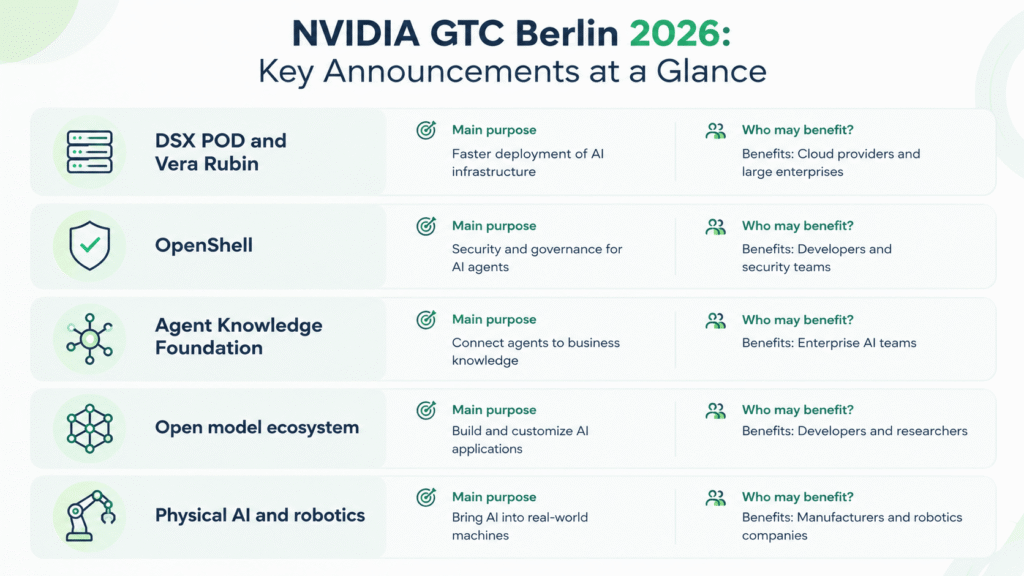
NVIDIA GTC Berlin 2026: Key Announcements at a Glance
| Announcement | Main purpose | Who may benefit? |
|---|---|---|
| DSX POD and Vera Rubin | Faster deployment of AI infrastructure | Cloud providers and large enterprises |
| OpenShell | Security and governance for AI agents | Developers and security teams |
| Agent Knowledge Foundation | Connect agents to business knowledge | Enterprise AI teams |
| Open model ecosystem | Build and customize AI applications | Developers and researchers |
| Physical AI and robotics | Bring AI into real-world machines | Manufacturers and robotics companies |

Frequently Asked Questions
What is NVIDIA GTC Berlin 2026?
NVIDIA GTC Berlin 2026 is an NVIDIA technology conference held in Berlin, Germany, featuring developments in AI infrastructure, agentic AI, open models, robotics, and accelerated computing. CEO Jensen Huang delivered the keynote on October 21, 2026.
What is NVIDIA DSX POD?
DSX POD is a modular reference design for deploying AI data-center infrastructure. NVIDIA says it can reduce on-site deployment time from approximately six months to 14 days when the required utilities are ready.
What is NVIDIA Vera Rubin?
Vera Rubin is NVIDIA’s next-generation AI computing platform. DSX POD is designed to help organizations deploy Vera Rubin-based AI infrastructure more quickly.
What is NVIDIA OpenShell?
OpenShell is an open-source runtime designed to provide security and governance controls for AI agents. It helps define which resources and systems an agent can access.
What is NVIDIA Agent Knowledge Foundation?
Agent Knowledge Foundation helps enterprise AI agents retrieve and use relevant company information. It is designed to connect agents with enterprise data while supporting existing governance arrangements.
Did NVIDIA launch all its AI models at GTC Berlin 2026?
No. Nemotron, Cosmos, and GR00T are existing NVIDIA model families. The Berlin keynote highlighted NVIDIA’s broader model ecosystem and how it fits into the company’s infrastructure, agentic AI, and robotics strategy.
What is physical AI?
Physical AI refers to AI systems designed to understand and interact with the real world. Applications include robotics, autonomous vehicles, industrial automation, and simulation.
When will NVIDIA DSX POD become available?
NVIDIA has indicated that DSX POD systems are expected to become available through infrastructure partners from early 2027. Actual availability may depend on the partner, configuration, and deployment requirements.
Final Thoughts
NVIDIA GTC Berlin 2026 showed that the AI industry is expanding beyond foundation models and chatbots.
The next stage involves building the infrastructure to run AI at scale, giving agents access to relevant information while controlling their actions, and developing systems that can operate in the physical world.
DSX POD, OpenShell, Agent Knowledge Foundation, open models, and physical AI each address a different part of that challenge.
For businesses, the main question is no longer just which AI model to use. It is how to build a secure, reliable, and scalable system around it.
As these technologies mature, their real impact will depend on practical deployment, cost, reliability, security, and measurable business value.
Sources and Further Reading
- NVIDIA — GTC Berlin 2026: Live Updates From Jensen Huang’s Keynote
- NVIDIA — GTC Berlin 2026 News
- NVIDIA Developer Blog — How NVIDIA OpenShell Secures and Governs AI Agent Workloads
- NVIDIA — Agent Toolkit Expands, Grounding Enterprise AI Agents in Business Knowledge
- Associated Press — Nvidia CEO Encourages Europe’s AI Sector at GTC Berlin
- Reuters — Nvidia’s Huang Hails Europe’s AI Potential and Robotics
Editorial note: This article distinguishes new announcements from NVIDIA’s previously existing model families and platforms. Deployment timelines and performance claims attributed to NVIDIA should be understood as company statements, not independent guarantees.
