
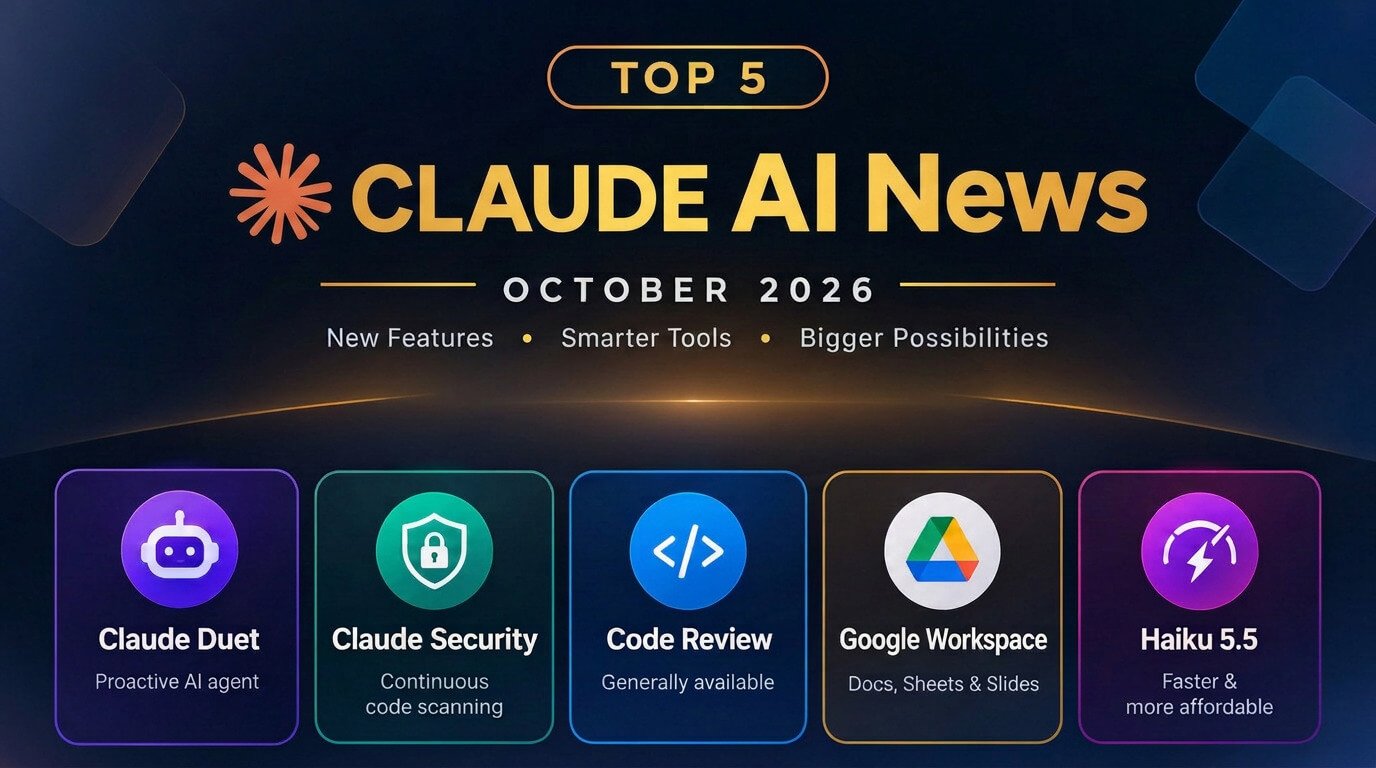
Artificial intelligence continues to change how people work, create content, write software, and manage businesses. In October 2026, Anthropic introduced several important updates to Claude AI, its artificial intelligence assistant. These developments focus on smarter AI agents, faster models, improved software security, coding assistance, and workplace productivity.
For businesses, developers, and everyday users, these updates could make AI tools more useful in daily work.
In this article, we cover the top five Claude AI news updates from October 2026, explain what has changed, and explore why each development matters.
Top 5 Claude AI News
October 2026 · Major AI Updates
1. Claude Duet
A proactive AI agent designed to help organize information and manage everyday tasks.
AI AGENTS2. Claude Security
Continuous code scanning and vulnerability tracking for software security teams.
CYBERSECURITY3. Claude Code Review
AI-powered code reviews to help developers identify potential bugs before release.
AI CODING4. Google Workspace
Claude integrations for working with Docs, Sheets, and Slides.
PRODUCTIVITY5. Claude Haiku 5.5
A smaller AI model designed for fast, high-volume tasks and agent workflows.
AI MODELS1. Claude Duet Introduces a More Proactive AI Assistant
On October 21, 2026, Anthropic announced Claude Duet, a new AI agent application designed to help professionals and small business owners manage their work more efficiently.
Unlike a traditional chatbot that mainly responds to prompts, Claude Duet is designed to identify tasks that need attention, prepare useful updates, and continue working on assigned tasks when the user steps away.
According to Anthropic’s official announcement, Claude Duet can help with tasks such as preparing reports, organizing information, building dashboards, creating forecasts, and managing administrative work.
The application can also work with connected tools and services. It prepares a daily summary of important information and can notify users when something requires attention.
However, it does not have unlimited permission to act independently. For important actions, such as sending messages, making payments, or deleting information, it requires user approval.
Why does Claude Duet matter?
AI agents are becoming an important part of business automation. Instead of using separate tools for every task, professionals may be able to delegate several connected tasks to one AI assistant.
Claude Duet’s research preview is initially available through a waitlist for eligible Pro and Max subscribers in the United States.
For small businesses, entrepreneurs, and busy professionals, this development highlights the growing shift from conversational AI toward AI systems that can help complete real work.

2. Claude Security Adds Continuous Code Scanning
Cybersecurity is another major area of development in artificial intelligence. On October 21, 2026, Anthropic announced new capabilities for Claude Security, including continuous repository scanning and improved vulnerability tracking.
The updated tool is designed to monitor software repositories as code changes, identify potential security problems, and track findings until they are fixed.
According to the official Claude Security announcement, the tool can also use additional context provided by development teams and connect with other systems through an application programming interface (API) and Model Context Protocol (MCP).
These capabilities could help security teams manage vulnerabilities throughout the software development process instead of relying only on occasional manual reviews.
For example, a development team working on an online shopping platform may need to check its code for weaknesses that could expose customer information. Continuous scanning can help identify potential problems earlier, allowing developers to investigate and address them.
Why is this update important?
Cyberattacks and software vulnerabilities can create serious risks for businesses. AI-powered security tools can help teams identify issues faster and organize the process of fixing them.
Claude Security is available in public beta for Claude Enterprise customers. Organizations should still use human security reviews and established testing procedures alongside AI tools.
3. Claude Code Review Becomes Generally Available
Software developers are increasingly using AI to write code, but reviewing that code remains an important step. A small mistake can create bugs, performance problems, or security weaknesses.
On October 15, 2026, Anthropic announced that Claude Code Review was generally available for Claude Team and Enterprise organizations.
The tool reviews code changes and identifies potential bugs before they reach production. It integrates with GitHub pull requests, allowing teams to receive automated feedback during their development workflow.
According to Anthropic’s Code Review announcement, the company improved the tool’s speed, review quality, and customization options.
Anthropic reports that most reviews now finish in approximately six to ten minutes, compared with around 20 minutes during the research preview. Teams can also choose between Quick, Standard, and Deep review modes, depending on the needs of their repositories.
How can developers benefit?
AI code review can help developers find issues earlier, reduce repetitive checking, and spend more time solving complex problems.
For software companies managing multiple projects, automated reviews may also help reduce delays when human reviewers have large workloads.
However, AI-generated feedback is not a replacement for professional judgment. Developers should verify suggested fixes, run tests, and review important changes before releasing software.
4. Claude Integrates with Google Docs, Sheets, and Slides
On October 6, 2026, Anthropic introduced new ways to use Claude with Google Workspace applications, including Google Docs, Google Sheets, and Google Slides.
The update includes a Claude add-on that works alongside open files, as well as connectors that allow Claude to create and edit supported Google files directly from a conversation.
According to the official Google Workspace integration announcement, the integration is available in beta on paid Claude plans.
Users can work with documents, spreadsheets, and presentations without constantly switching between browser tabs. For example, a marketing professional could use Claude to improve a document, analyze spreadsheet information, or prepare a presentation based on business data.
The tools also offer different levels of editing control. Users can review proposed changes before approving them or enable a mode that accepts edits automatically.
For enterprise customers, existing administrative and security controls also apply to the add-on.
Why does this matter for productivity?
Many businesses already use Google Workspace for daily operations. Bringing AI assistance into familiar applications could make it easier for employees to adopt AI without completely changing their workflows.
The integration may be particularly useful for marketers, students, business owners, researchers, and teams that regularly prepare reports and presentations.
Users should check permissions and review AI-generated content before sharing important documents.
5. Claude Haiku 5.5 Targets Faster and More Affordable AI
On October 7, 2026, Anthropic announced Claude Haiku 5.5, describing it as its fastest and most capable small model.
The model is designed for high-volume tasks where speed and operating costs are important. Examples include summarization, browser use, and supporting other AI agents.
Read the official Claude Haiku 5.5 announcement for the latest information about the model.
Smaller AI models can be useful when businesses need to process large numbers of requests. For example, an online store might use AI to summarize customer feedback, organize support requests, or categorize incoming messages.
Similarly, a company building an AI-powered application may need a model that can handle repeated tasks without the cost of using a larger model for every request.
Why is Claude Haiku 5.5 important?
AI adoption is not only about creating more powerful models. Businesses also need tools that balance performance, speed, and cost.
A smaller model designed for high-volume work can be a practical option for certain workflows. However, the best choice depends on the complexity of the task, the required accuracy, and the available budget.
Businesses should test model performance on their own workloads before choosing a model for production use.
What Do These Claude AI Updates Mean for the Future?
The October 2026 Claude AI announcements highlight five important trends in artificial intelligence.
First, AI assistants are moving toward agent-based workflows that can help manage tasks across connected applications. Second, cybersecurity tools are becoming more focused on continuous monitoring and vulnerability management.
Third, AI-assisted software development is expanding beyond code generation into code review. Fourth, integrations with familiar workplace applications may make AI easier to adopt. Finally, smaller models are helping address the need for faster and more cost-effective AI systems.
These developments could benefit businesses of different sizes, from startups and independent developers to large enterprises.
However, organizations should consider data privacy, access permissions, reliability, and human oversight before deploying AI tools in important workflows.
Frequently Asked Questions About Claude AI
What are the biggest Claude AI updates in October 2026?
Five notable updates include Claude Duet, continuous scanning in Claude Security, general availability of Claude Code Review, Google Workspace integrations, and the launch of Claude Haiku 5.5.
What is Claude Duet?
Claude Duet is a proactive AI agent application designed to help users organize information, prioritize tasks, and complete work across connected applications. Its October 21 announcement introduced a research preview for eligible US Pro and Max subscribers.
Is Claude Code Review available to everyone?
No. As announced on October 15, 2026, Claude Code Review became generally available to Claude Team and Enterprise organizations.
Can Claude AI work with Google Docs and Sheets?
Yes. Anthropic announced beta integrations for Google Docs, Sheets, and Slides on October 6, 2026. Availability and functionality depend on the supported plan and setup.
What is Claude Haiku 5.5 used for?
Claude Haiku 5.5 is designed for fast, high-volume tasks, including summarization, browser use, and supporting AI agent workflows.
Final Thoughts
The latest Claude AI news shows how Anthropic is developing AI tools for practical business use. From proactive assistance and software security to coding workflows, office productivity, and faster AI models, these updates address several real-world needs.
For developers, businesses, and AI enthusiasts, following these developments can help identify new opportunities to improve workflows and automate repetitive tasks.
As AI technology continues to evolve, the most valuable tools will be those that combine useful capabilities with reliable results, appropriate security, and meaningful human oversight.
For more updates on artificial intelligence, AI tools, and emerging technology, keep following AI Edge Insights.
