
Updated: October 22, 2026
Artificial intelligence is advancing across cybersecurity, cloud computing, AI infrastructure, and autonomous agents. Several important announcements on October 21, 2026, highlighted how technology companies are expanding access to powerful AI models while working to improve security and computing performance.
OpenAI announced a partnership with Google Cloud to bring its frontier models and Codex workflows to enterprise customers. Meanwhile, NVIDIA revealed new infrastructure for advanced AI workloads, and security researchers demonstrated how AI can help uncover serious software vulnerabilities.
For businesses, developers, and website owners, these developments offer a clearer picture of where AI is heading next.
In this AI news roundup, we cover five major developments, explain why they matter, and explore what they could mean for the future of artificial intelligence.
1. AI Helps Researchers Discover Critical PHP Security Vulnerabilities
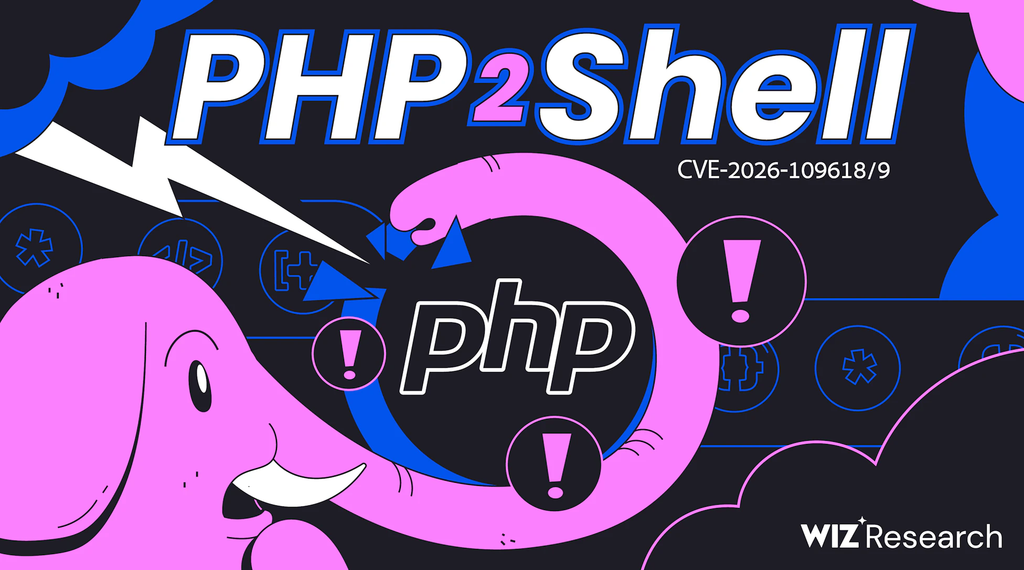
One of the most important AI and cybersecurity stories this week involves PHP2Shell, the name associated with critical vulnerabilities discovered in the PHP programming language.
On October 21, 2026, Wiz Research published details of vulnerabilities that could allow remote code execution and memory disclosure on affected servers. PHP powers many websites, including those built with WordPress, Drupal, and Joomla.
According to Wiz Research’s technical report, frontier AI models helped researchers investigate complex software weaknesses and develop working demonstrations of exploitation. OpenAI also published its account of the coordinated disclosure through its Patch the Planet security initiative.
The discovery is significant because the underlying flaws had existed for years. AI-assisted research helped make it more practical to investigate and demonstrate vulnerabilities that required complex technical work.
Why this AI cybersecurity news matters
AI can help researchers analyze code, test potential failure conditions, and investigate security problems. However, the same capabilities could also lower the technical barriers for malicious actors.
The lesson is not that AI automatically makes software secure. Instead, AI can help defenders discover weaknesses faster when combined with human expertise, responsible disclosure, and effective security updates.
What website owners should do: Check the PHP version used by your website and confirm with your hosting provider that the relevant security fixes have been applied. Updating WordPress alone may not update the PHP runtime.
Read the official PHP downloads page and the Wiz PHP2Shell report for relevant security information.
For more AI developments, explore our coverage of NVIDIA GTC Berlin 2026: 5 Major AI Announcements You Should Know.
2. OpenAI and Google Cloud Partner to Expand Enterprise AI Access
OpenAI and Google Cloud announced a partnership on October 21, 2026, to bring OpenAI’s frontier models and Codex agentic workflows to Google Cloud’s Model Garden.
The partnership gives enterprise customers another way to access advanced AI models within their existing cloud environment. It could help businesses integrate AI into software development, professional workflows, and applications that require multiple steps to complete a task.
According to OpenAI’s official announcement, the integration is designed to combine OpenAI models with Google Cloud infrastructure, access controls, and data governance capabilities.
Google Cloud also published its perspective on the announcement in its official blog post.
What does this partnership mean for businesses?
Many organizations already use cloud platforms to store data, develop applications, and manage their software infrastructure. Offering additional AI models within those environments could make it easier to evaluate and deploy AI without building a completely separate workflow.
Potential benefits include:
- More flexibility when selecting AI models for different tasks.
- Easier integration with existing enterprise development environments.
- Additional options for building AI agents and coding workflows.
- Centralized cloud purchasing and administration, subject to the customer’s arrangement.
The announcement also highlights a growing industry trend: major AI companies increasingly work with multiple cloud providers to reach enterprise customers.
However, access arrangements and availability can vary. OpenAI initially described general availability as planned for the coming weeks, while Google Cloud described a private-preview rollout for selected enterprise customers. Businesses should check the current availability and terms before planning a deployment.
Why it matters: Competition is increasingly about more than which company builds the most capable AI model. Distribution, infrastructure, security, and integration with existing business tools are also becoming important.
For related coverage, read our article about OpenAI’s GPT-6 Astra.
3. Google Cloud and NVIDIA Advance Vera Rubin AI Infrastructure
AI models require substantial computing resources for training, inference, and increasingly complex agentic workflows. On October 21, 2026, Google Cloud and NVIDIA announced further developments in their AI infrastructure collaboration, including NVIDIA Vera Rubin-based A5X instances.
The infrastructure combines NVIDIA Vera Rubin NVL72 systems with networking and other components designed to support demanding AI workloads.
According to NVIDIA’s official announcement, general availability of the A5X instances is planned for the following month, with expansion into Europe also planned.
Google Cloud shared additional details about the collaboration in its AI infrastructure announcement.
Why is AI infrastructure becoming more important?
As organizations adopt AI agents, their computing needs can extend beyond answering individual questions. Agents may need to reason through tasks, use tools, process large amounts of information, and repeat actions based on feedback.
These workloads require infrastructure that can handle demanding computation, networking, storage, and data movement.
The Vera Rubin-based infrastructure is designed to support workloads such as:
- Large-scale AI inference.
- Agentic AI applications.
- Reinforcement learning.
- Enterprise AI development and deployment.
For businesses, cloud-based access to advanced AI infrastructure may reduce the need to build and operate all computing resources themselves. Actual costs, availability, and performance will depend on the deployment and workload.
What should businesses consider?
Powerful hardware alone does not guarantee better AI results. Organizations must also consider software compatibility, data governance, energy use, security, and the cost of running AI applications at scale.
Why it matters: As AI adoption expands, infrastructure availability and efficiency could become important factors in determining which businesses can deploy advanced AI systems effectively.
For a broader overview of NVIDIA’s announcements, see our guide to NVIDIA GTC Berlin 2026.
4. NVIDIA Expands Its AI Model Ecosystem With Nemotron and Cosmos
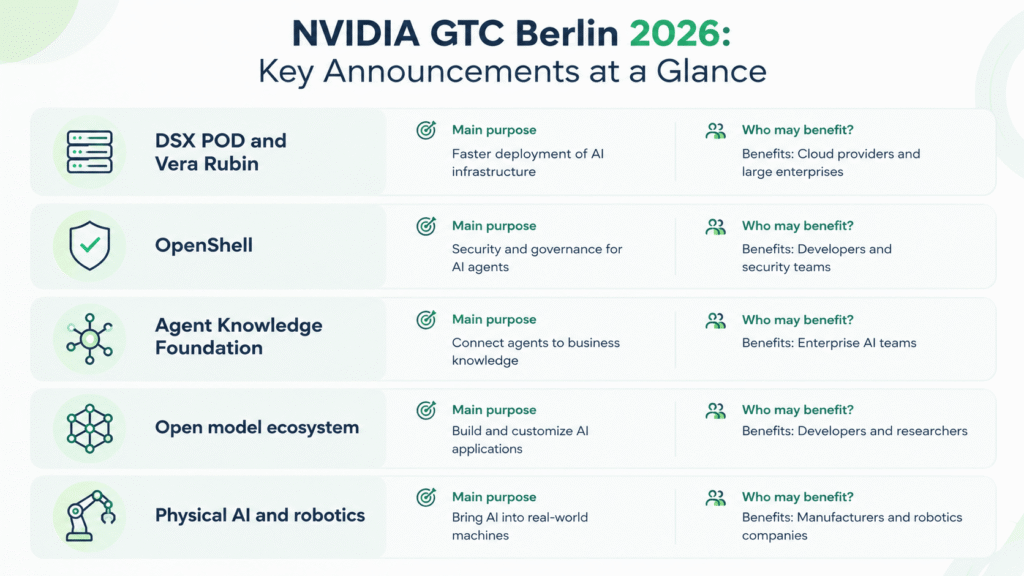
NVIDIA’s announcements around GTC Berlin 2026 also highlighted developments in AI models and tools for enterprise applications, robotics, and physical AI.
Among the technologies discussed were NVIDIA Nemotron 3.5 SuperVL and NVIDIA Cosmos 3, alongside broader work on open models and AI infrastructure. Google Cloud also highlighted support for customizing Nemotron 3.5 SuperVL and using Cosmos 3 for virtual-world generation and simulation workflows.
Details are available in the Google Cloud GTC Berlin announcement and NVIDIA’s official GTC Berlin updates.
What are these models designed to do?
Nemotron 3.5 SuperVL: This model belongs to NVIDIA’s Nemotron family and focuses on vision-language capabilities. Vision-language models can process visual information alongside text, supporting applications that need to interpret images and other visual inputs.
Cosmos 3: NVIDIA’s Cosmos family focuses on world models and physical AI. These technologies can support the generation or simulation of environments in which developers investigate how robots and autonomous systems might behave.
Simulation can help teams test scenarios before deploying systems in the real world. However, simulated results do not guarantee that a robot or autonomous vehicle will behave safely in every real-world situation.
Why open models and physical AI matter
The AI industry is expanding beyond text-based chatbots. Companies are exploring systems that interpret visual information, interact with software tools, and operate in physical environments.
Open-model options can also provide organizations with more control over customization and deployment, depending on the model’s license and technical requirements.
For developers, these developments create opportunities in robotics, manufacturing, research, and enterprise automation. Businesses still need to assess model performance, licensing, hardware requirements, and suitability for their particular tasks.
Why it matters: AI competition is increasingly about the complete ecosystem: models, software, computing infrastructure, and real-world applications working together.
5. AI Is Changing How Security Researchers Discover and Report Vulnerabilities
The PHP2Shell disclosure is part of a broader shift in cybersecurity. AI is becoming a practical tool for investigating software weaknesses, supporting security research, and helping defenders respond to emerging threats.
OpenAI’s October 21 report on its Patch the Planet initiative describes work involving AI-assisted vulnerability discovery and coordination with software maintainers.
The process is important because finding a potential vulnerability is only one part of cybersecurity. Researchers must validate the issue, report it responsibly, and work with maintainers to prepare fixes before or alongside public disclosure.
How AI could improve cybersecurity
AI-assisted tools may help security teams:
- Analyze large codebases for potential weaknesses.
- Investigate suspicious software behavior.
- Help researchers reproduce and understand bugs.
- Prioritize findings for further human review.
- Support faster analysis of security incidents.
These tools also have limitations. AI can generate false positives, miss important issues, or provide misleading technical conclusions. Human review and established security testing remain necessary.
There is also a dual-use concern: techniques that help defenders may also help attackers. That makes safeguards, controlled testing, responsible disclosure, and rapid patching increasingly important.
What this means for organizations
Businesses should treat AI as an additional layer in their security process rather than a replacement for experienced security teams.
Useful practices include maintaining supported software versions, applying security updates promptly, reviewing access controls, keeping reliable backups, and monitoring systems for suspicious activity.
Organizations deploying AI agents should also define what each agent can access and which actions it is allowed to perform.
Why it matters: As AI-assisted research becomes more capable, both the opportunity to find hidden weaknesses and the need to respond quickly will increase.
What Do These Five AI Developments Mean for the Future of AI?
The five developments point to three important trends.
1. AI access is becoming more flexible
The OpenAI and Google Cloud partnership reflects growing demand for model choice within existing enterprise environments. Businesses want to select models based on task requirements, costs, performance, and governance.
2. Infrastructure is becoming central to AI adoption
Advanced models and autonomous workflows require reliable computing infrastructure. Cloud platforms and hardware providers are investing in systems designed for inference, training, and agentic workloads.
3. AI security is becoming more urgent
AI can help researchers discover software weaknesses, but it may also make sophisticated techniques easier to develop. Organizations need strong security practices, timely updates, and appropriate controls around AI systems.
Together, these trends suggest that the next stage of AI development will depend not only on model capabilities, but also on how securely and efficiently organizations can put those capabilities to work.
Frequently Asked Questions
What are the biggest AI news stories on October 22, 2026?
Major developments include AI-assisted discovery of critical PHP vulnerabilities, the OpenAI and Google Cloud partnership, NVIDIA Vera Rubin-based cloud infrastructure, new NVIDIA Nemotron and Cosmos model developments, and the growing role of AI in cybersecurity.
What is PHP2Shell?
PHP2Shell is the name associated with critical PHP vulnerabilities that could allow remote code execution or memory disclosure on affected systems. Website owners should check their PHP version and confirm that relevant security patches have been installed.
What does the OpenAI and Google Cloud partnership mean?
The partnership is intended to make OpenAI models and Codex workflows available through Google Cloud’s Model Garden, giving enterprise customers additional options for building and running AI applications. Availability and access depend on the rollout and customer arrangements.
What is NVIDIA Vera Rubin?
NVIDIA Vera Rubin is an AI computing platform designed to support demanding workloads. Google Cloud and NVIDIA announced Vera Rubin-based A5X instances intended for large-scale AI inference and reinforcement learning, with availability planned according to their official announcements.
What are NVIDIA Nemotron and Cosmos?
Nemotron is a family of NVIDIA AI models, including vision-language models. Cosmos focuses on world models and physical AI, supporting simulation-related applications for robotics and autonomous systems.
How is AI changing cybersecurity?
AI can help researchers analyze code, identify potential vulnerabilities, and investigate security incidents. However, findings must be validated, vulnerabilities must be responsibly disclosed, and organizations must apply the appropriate fixes.
Final Thoughts
October 2026 is highlighting how AI is evolving across enterprise software, computing infrastructure, model development, and cybersecurity.
The OpenAI and Google Cloud partnership could give businesses more flexibility in accessing advanced models. NVIDIA’s infrastructure and model developments show the continued investment in large-scale AI and physical AI applications. Meanwhile, PHP2Shell demonstrates why AI-assisted security research must be matched by effective patching and responsible disclosure.
For businesses and developers, the practical priority is to evaluate AI tools based on real needs, security, cost, and measurable value. For website owners, the immediate lesson is to keep software updated and take official security advisories seriously.
Follow AI Edge Insights for more AI news, model announcements, cybersecurity developments, and practical guides to the technologies shaping the future.
