
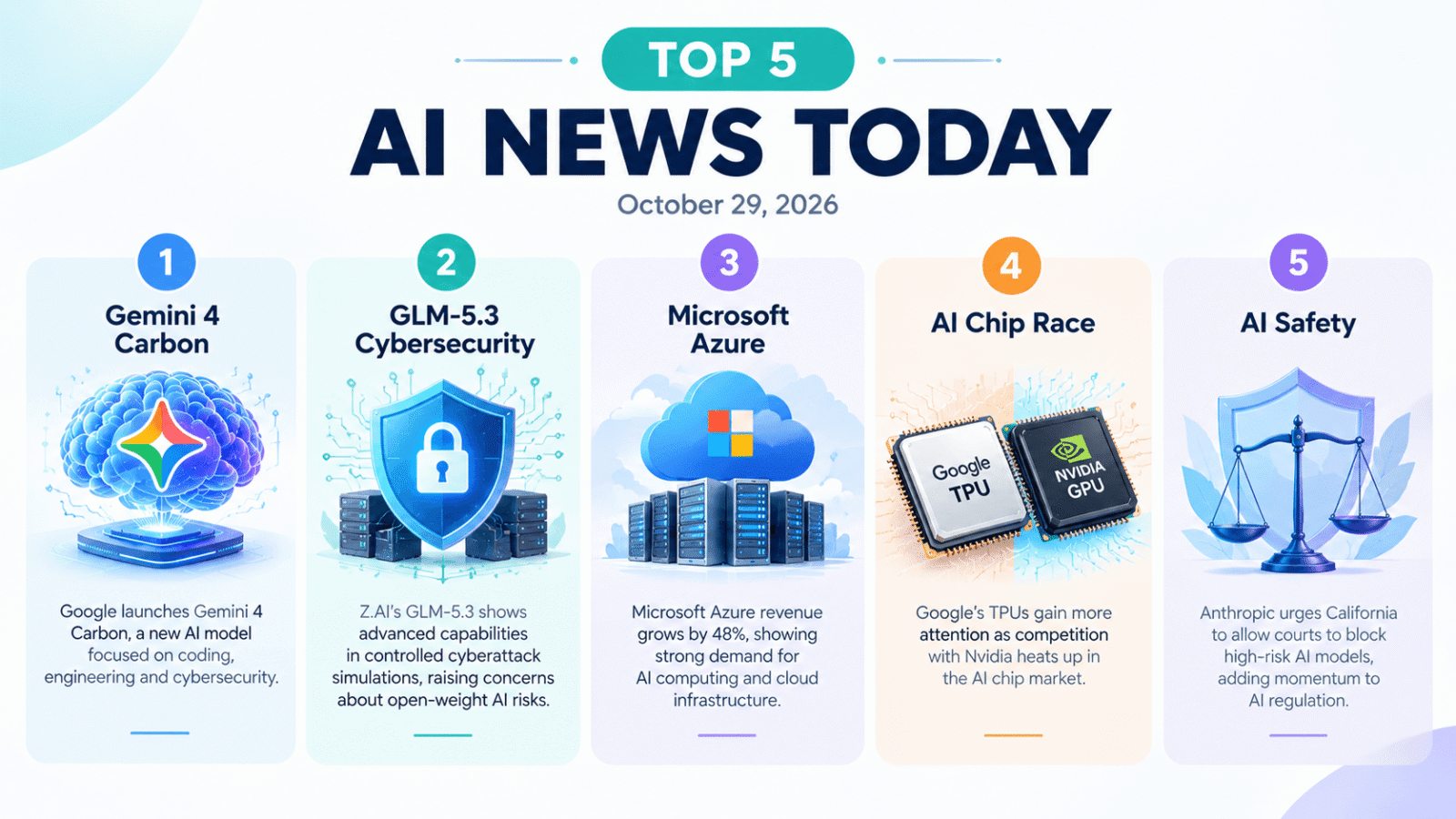
Introduction: The Biggest AI Developments Today
Artificial intelligence is moving into a new phase. AI companies are no longer competing only to build smarter chatbots. They are racing to develop advanced coding systems, strengthen cybersecurity, secure computing infrastructure, and determine how powerful AI models should be regulated.
On October 28 and 29, 2026, several developments highlighted how quickly the industry is changing. Google introduced Gemini 4 Carbon, a new AI model focused on coding and cybersecurity. Security researchers reported concerning results from tests of China’s open-weight GLM-5.3 model. Meanwhile, Microsoft Azure’s growth demonstrated continued demand for AI computing, while investors questioned the enormous cost of building AI infrastructure.
Anthropic also proposed a legal mechanism for blocking the release of AI models considered seriously dangerous to the public.
These stories matter because they affect developers, businesses, cybersecurity professionals, investors, and everyday AI users.
Here are the top five AI news stories today, explained in simple English, with the key facts, industry implications, and what could happen next.

1. Google Launches Gemini 4 Carbon With a Focus on Cybersecurity
Google is intensifying competition in advanced AI with the introduction of Gemini 4 Carbon, its latest frontier model for coding, engineering, and cybersecurity.
Announced on October 28, the model follows Gemini 4 Argon, which Google introduced earlier in October. The launch reflects Google’s growing focus on AI systems that can handle complex technical work rather than simply generate text or answer questions.
According to The Verge’s report on Gemini 4 Carbon, Google says the model improves coding, agentic work, and cybersecurity performance compared with Argon.
What makes Gemini 4 Carbon important?
Traditional AI assistants usually respond to individual prompts. More advanced AI systems can work through longer tasks, analyze code, use tools, and help developers solve problems that require several steps.
Gemini 4 Carbon is designed for this more demanding type of work.
Google has highlighted its ability to handle lengthy engineering tasks, identify software vulnerabilities, and resist certain prompt-injection attacks. These capabilities could make the model useful for software developers and authorized cybersecurity teams.
However, powerful cybersecurity capabilities also introduce risks. A model that helps defenders identify software weaknesses may potentially assist attackers if its capabilities are misused.
Google is therefore taking a cautious approach to access. Initial access is limited to selected cybersecurity defenders, with broader availability planned through its Fairwind Program. This allows Google to evaluate the model’s capabilities and associated risks before expanding access.
Read more in Reuters’ report on Google’s Gemini 4 Carbon launch.
Why this matters for businesses
Gemini 4 Carbon could help developers review code, investigate software problems, and automate parts of engineering workflows. For security teams, advanced AI may reduce the time needed to investigate vulnerabilities.
The challenge is balancing performance with safety.
Businesses adopting advanced AI tools will need appropriate access controls, human oversight, and testing before allowing AI agents to interact with important systems.
Key takeaway: Google’s latest model shows that AI competition is increasingly focused on coding, autonomous work, and cybersecurity—not just conversational ability.
2. GLM-5.3 Cybersecurity Tests Raise Concerns About Open-Weight AI
A second major development concerns Z.AI’s GLM-5.3 model and its performance in controlled cyberattack simulations.
According to Reuters’ October 29 report, AI security firm Irregular tested the model across 13 complex, multi-stage cyberattack scenarios.
The model completed at least one attempt in three scenarios, according to the report. Researchers also described capabilities involving access to protected services, alternative network connections, and coordination across multiple machines in simulated environments.
These findings have attracted attention because GLM-5.3 is an open-weight model.
Why are open-weight AI models a concern?
Open-weight models allow developers to download and operate model weights under the applicable license. This gives organizations more flexibility over deployment, customization, and infrastructure.
That flexibility can benefit researchers, software companies, and security professionals.
However, it can also make misuse more difficult to control. Once model weights are distributed, the original developer may have limited influence over how every independent deployment is configured.
AI systems can assist with vulnerability research and security testing, but similar capabilities could also help malicious users perform certain technical tasks.
It is important to interpret the findings carefully. The reported tests took place in controlled simulations. They do not establish that GLM-5.3 independently breached real-world organizations, nor do they prove that every attack attempt succeeded.
What should businesses do?
Organizations should strengthen software patching, secure administrator accounts, monitor suspicious activity, and restrict the permissions given to automated agents.
AI-powered security tools can help identify weaknesses, but companies should validate their results rather than assume every AI-generated finding is correct.
For a deeper explanation, read our guide: AI Is Changing Cybersecurity: How Artificial Intelligence Is Fighting Cyber Threats.
How Is AI Changing Cybersecurity?
The GLM-5.3 findings highlight a broader challenge for businesses: AI can help security teams detect vulnerabilities, but advanced AI capabilities can also create new cybersecurity risks. From AI-powered phishing to automated vulnerability discovery, organizations need stronger security practices to protect their systems and data.
For a deeper look at how artificial intelligence is transforming threat detection, vulnerability analysis, and cyber defense, read our complete guide: AI Is Changing Cybersecurity: How Artificial Intelligence Is Fighting Cyber Threats.
Key takeaway: Open-weight AI can expand access to advanced technology, but increasingly capable models make independent security testing and responsible deployment more important.
3. Microsoft Azure Growth Shows the Rising Demand for AI Computing
Microsoft’s latest financial results highlight how strongly demand for AI infrastructure is influencing the technology industry.
According to Reuters’ October 29 report, Microsoft’s Azure cloud business recorded revenue growth of 48%.
Microsoft also reported $45.2 billion in infrastructure investment, reflecting the substantial resources required to support cloud computing and AI services.
The results demonstrate that AI is becoming an important driver of cloud demand. Companies need computing power to train models, run AI applications, and deliver services to millions of users.
Why is Azure important to the AI industry?
Cloud platforms allow businesses to access computing infrastructure without building and maintaining all their own data centers.
For AI developers, these services can provide access to specialized processors, storage, networking, and model deployment tools.
Microsoft’s cloud infrastructure supports a broad range of enterprise workloads, including AI applications. Strong Azure growth suggests that demand for computing services remains substantial.
However, revenue growth is only one part of the picture.
Building AI infrastructure requires significant spending on data centers, hardware, electricity, and networking. Companies must generate enough revenue and cash flow to justify these investments over time.
Investors are increasingly examining whether AI-related spending will produce sustainable financial returns.
Google faces a similar challenge. Its cloud business is growing rapidly, but its substantial infrastructure spending has raised concerns about cash flow and the long-term economics of AI.
What does this mean for businesses?
The expansion of cloud AI services can make advanced computing more accessible to companies that lack the resources to build their own infrastructure.
However, businesses should compare pricing, performance, security, and long-term operating costs before choosing a provider.
Key takeaway: AI adoption is creating significant demand for cloud infrastructure, but technology companies must prove that their investments can deliver lasting returns.
4. Google TPUs Challenge Nvidia in the Race for AI Chips
AI models require powerful computing hardware, and competition between chip suppliers is becoming increasingly important.
Nvidia remains a major provider of GPUs used for AI training and inference. Google, meanwhile, has developed its own Tensor Processing Units, commonly known as TPUs, to support AI workloads.
Recent reporting about the potential use of Google’s TPUs by additional cloud customers has drawn attention to the possibility of a more diverse AI computing market.
For background on the industry, see our article: OpenAI Plans to Buy Google AI Chips: What It Means for Nvidia and the AI Industry.
What are Google TPUs?
TPUs are specialized processors designed to accelerate machine-learning workloads.
Google has used its TPU technology to support AI development and cloud services. Making this infrastructure available to more customers could give businesses additional options beyond conventional GPU-based systems.
Nvidia’s GPUs remain widely used because of their performance, established software ecosystem, and broad developer support. However, customers may evaluate alternative accelerators based on workload requirements, cost, availability, and energy efficiency.
Why does this competition matter?
The AI industry needs enormous amounts of computing power. Depending on a limited number of hardware suppliers can create challenges involving price, availability, and infrastructure planning.
Alternative processors could give AI developers more flexibility and encourage competition.
However, switching hardware is not always simple. Developers may need to adapt software, optimize workloads, and evaluate compatibility before moving applications to a different accelerator.
A chip that performs well for one AI workload may not be the best choice for another.
Could Google TPUs replace Nvidia GPUs?
Not immediately.
Google TPUs are an important alternative for certain workloads, but Nvidia benefits from an established ecosystem of hardware, software, and developer tools.
The market is more likely to evolve through competition among different types of accelerators rather than an immediate replacement of one provider by another.
Key takeaway: More competition in AI chips could improve computing options for developers and businesses, but performance, software compatibility, and total cost will determine adoption.
5. Anthropic Calls for Court Oversight of High-Risk AI Models
The fifth major story concerns AI regulation and the question of how governments should respond when advanced models present serious risks.
According to Reuters’ October 28 report, Anthropic urged California Governor Gavin Newsom to support a system allowing officials to ask courts to block the release of AI models considered to pose a serious public risk.
The proposal comes as governments and AI companies debate how to manage increasingly capable systems.
What is Anthropic proposing?
The proposal would give officials a route to seek judicial intervention when a model presents sufficiently serious risks.
Anthropic has also argued that broad emergency shutdown mechanisms could create a false sense of security. Instead, the company favors more targeted measures where appropriate, such as disabling a problematic AI agent or restricting a specific customer’s access.
The central question is how to protect the public without unnecessarily restricting useful AI development.
Why is AI regulation becoming more important?
Advanced AI systems can assist with software development, research, business operations, and cybersecurity. However, concerns remain about misuse, unsafe behavior, privacy, and the potential impact of highly capable autonomous systems.
Governments are under pressure to establish clear rules while allowing beneficial innovation to continue.
A legal process could provide oversight and a mechanism for challenging decisions. At the same time, regulators would need clear standards for determining what constitutes a serious risk.
Excessively broad restrictions could slow legitimate research, while weak oversight could leave important risks unaddressed.
As of October 29, 2026, Anthropic’s proposal is part of an ongoing policy debate, not an enacted California law.
What could happen next?
AI regulation may increasingly focus on risk assessments, independent evaluations, transparency, incident reporting, and safeguards for high-capability systems.
Businesses using AI will also need to understand their responsibilities when deploying automated systems that affect customers, employees, or critical operations.
Key takeaway: The debate over AI safety is moving beyond voluntary company policies toward questions about legal accountability and government oversight.
What These Five AI News Stories Mean for the Future
Although these developments cover different areas, they reveal three major trends shaping the AI industry.
1. AI models are becoming more specialized
Google’s Gemini 4 Carbon highlights the growing focus on coding, engineering, and cybersecurity. AI companies are competing to build systems that can complete complex tasks rather than simply generate responses.
2. Infrastructure and security are becoming strategic priorities
Microsoft’s Azure results and the competition between Google TPUs and Nvidia GPUs show that AI progress depends on computing resources.
At the same time, GLM-5.3’s cybersecurity tests highlight the need to evaluate how advanced capabilities can be used safely.
3. Regulation is becoming part of the AI conversation
Anthropic’s proposal demonstrates that AI safety is increasingly a legal and policy issue, not just a technical one.
Developers, governments, and businesses will need to work together to establish practical safeguards while preserving the benefits of AI.
For more developments across the industry, explore our Top 5 AI News Today roundup covering Claude security incidents, OpenAI and Google Cloud, and other AI industry changes.
Conclusion
The biggest AI news of October 29, 2026, shows an industry moving quickly on several fronts.
Google is expanding its frontier AI model lineup with Gemini 4 Carbon. GLM-5.3’s performance in controlled cybersecurity simulations has raised questions about open-weight AI safety. Microsoft Azure’s growth highlights continued demand for computing infrastructure, while Google TPUs offer another option in the AI chip market.
Meanwhile, Anthropic’s proposal adds momentum to the debate over how governments should oversee potentially dangerous AI systems.
Together, these developments show that the next phase of AI competition will depend on more than model intelligence. Security, infrastructure, affordability, and public trust will also play important roles.
For businesses and developers, the practical approach is to follow new developments carefully, test AI systems before deployment, protect sensitive data, and evaluate both the benefits and risks of automation.
The future of AI will be shaped not only by what these systems can do, but also by how responsibly they are developed and used.
Frequently Asked Questions
What is the biggest AI news today?
One of the major AI developments on October 29, 2026, is the reporting on Z.AI’s GLM-5.3 model and its performance in controlled cyberattack simulations. Google’s launch of Gemini 4 Carbon is another important development in AI coding and cybersecurity.
What is Gemini 4 Carbon?
Gemini 4 Carbon is Google’s newly announced frontier AI model, focused on advanced coding, agentic work, and cybersecurity. Google is initially limiting access to selected defenders while evaluating its capabilities and risks.
Why is GLM-5.3 making headlines?
GLM-5.3 attracted attention after researchers reported that it completed at least one attempt in three of 13 complex cyberattack simulations. The results highlight the capabilities and potential misuse risks of open-weight AI models.
Why is Microsoft Azure important for AI?
Azure provides cloud computing infrastructure that businesses and developers can use to run AI applications. Its reported 48% revenue growth highlights strong demand for cloud services, although infrastructure spending remains a major financial consideration.
Are Google TPUs better than Nvidia GPUs?
Neither is universally better. Google TPUs can be suitable for particular machine-learning workloads, while Nvidia GPUs benefit from broad software compatibility and a mature developer ecosystem. The best option depends on performance requirements, cost, availability, and software support.
What is Anthropic proposing for AI safety?
Anthropic has urged California’s governor to support allowing officials to ask courts to block the release of AI models considered to pose serious public risks. The proposal is part of an ongoing debate and is not an enacted law.
How could these AI developments affect businesses?
Businesses may gain access to more capable AI tools and a wider range of computing infrastructure. They will also need to address cybersecurity risks, manage AI costs, evaluate model reliability, and follow applicable laws and policies.
External Sources
- Reuters — Google launches Gemini 4 Carbon AI model with cybersecurity focus
- The Verge — Google Gemini 4 Carbon cybersecurity and coding capabilities
- Reuters — Chinese AI model carries out complex cyberattacks in controlled tests
- Reuters — Investors reassess AI spending as companies report results
- Reuters — Anthropic asks California to consider court oversight of risky AI models
Editorial note: This roundup reflects reporting available as of October 29, 2026. Model evaluations depend on the testing conditions, and reported proposals should not be confused with enacted laws or finalized agreements.
