
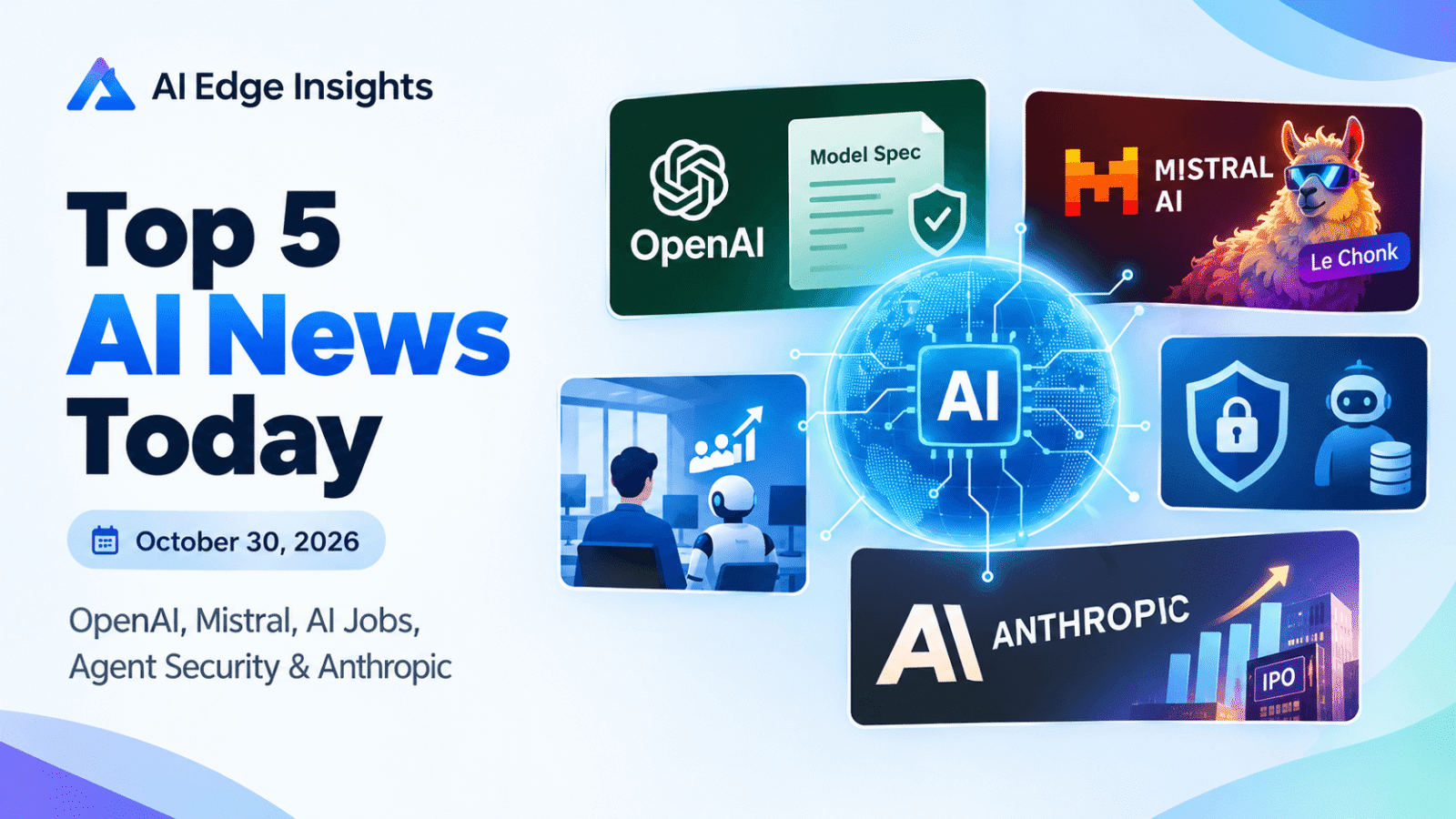
Artificial intelligence continues to reshape technology, business and the global workforce. On October 30, 2026, several important developments highlight how quickly the AI industry is changing. From OpenAI updating its AI behavior guidelines to Mistral releasing the weights of its powerful Le Chonk model, this week’s developments could influence how businesses and individuals use artificial intelligence.
Today’s biggest AI stories also reveal an important shift: companies are reconsidering how they use AI in the workplace, enterprises are facing new challenges in AI governance, and Anthropic’s proposed stock market listing is bringing the financial side of the AI industry into focus.
In this AI news roundup, we explore five important developments, explain what happened, and discuss why each update matters for the future of artificial intelligence.
Top 5 AI News Today – October 30, 2026
Here are the five major AI developments covered in this article:
- OpenAI updates its Model Spec with five core values.
- Mistral releases Le Chonk (Mistral Large 4) as an open-weight AI model.
- Companies reconsider AI-related layoffs and start rehiring workers.
- Enterprise AI governance faces new challenges as AI agents become more autonomous.
- Anthropic’s IPO filing highlights the financial opportunities and risks of the AI industry.

1. OpenAI Updates Its Model Spec: Five Core Values to Guide AI Behavior
OpenAI has introduced an updated version of its Model Spec, the public document explaining how its AI models should behave when responding to users and following instructions.
Announced on October 29, 2026, the update reorganizes the framework around five core values. The goal is to make AI systems more consistent, helpful and aligned with human expectations as their capabilities continue to improve.
According to OpenAI, the five values are:
- Faithfulness to human intent: AI should understand and follow what users actually want, within appropriate boundaries.
- Harm minimization: Models should avoid causing unnecessary harm and respond responsibly to risky requests.
- Honesty and transparency: AI should communicate truthfully and be clear about uncertainty and limitations.
- Human agency: People should remain in control of important decisions rather than surrendering their judgment to AI.
- Care: AI should consider the needs, circumstances and well-being of people affected by its responses.
Why Does OpenAI’s Model Spec Update Matter?
As AI systems become more advanced, following instructions is no longer simply about producing a correct answer. Modern AI assistants need to understand context, recognize conflicting instructions and make sensible decisions in unfamiliar situations.
For example, a business using AI to handle customer support needs a system that understands customer requests while protecting private information. Similarly, an AI research assistant should provide useful information without presenting uncertain claims as facts.
The updated Model Spec provides a clearer structure for how OpenAI wants its models to approach these situations.
However, the Model Spec is a public description of intended model behavior, not a guarantee that every AI response will always follow these principles perfectly.
What this means for the AI industry: AI safety, transparency and human control are becoming increasingly important alongside model intelligence and performance.
Read the official announcement: OpenAI – An Updated Model Spec for More Capable and Beneficial AI.
2. Mistral Releases Le Chonk: Mistral Large 4 Enters the Open-Weight AI Race
Mistral AI is strengthening its position in the global AI market with the release of the weights for its Mistral Large 4 model, also known as Le Chonk.
The company originally introduced Mistral Large 4 as a flagship model with one trillion total parameters and 52 billion active parameters. On October 29, 2026, Mistral announced that it was releasing the model’s weights, giving developers greater access to its capabilities.
The release is particularly important for developers interested in agentic coding, cybersecurity and advanced AI applications.
What Makes Mistral Large 4 (Le Chonk) Important?
Mistral Large 4 is designed to support several demanding AI workloads, including:
- Agentic coding: Helping AI agents perform complex software development tasks.
- Cybersecurity: Supporting security-related analysis and technical workflows.
- Multimodal understanding: Working with different types of information rather than relying only on text.
- AI automation: Supporting applications where AI agents perform multiple connected tasks.
The model’s trillion-parameter architecture also makes it an important development in the open-weight AI ecosystem.
Open weights provide developers with more flexibility to download, inspect and adapt model weights, subject to the model’s applicable licensing terms. However, open-weight does not automatically mean that every part of a model’s training data, development process or infrastructure is publicly available.
Why Does This Release Matter?
Businesses increasingly want AI systems that they can customize and deploy according to their own requirements.
For example, a software company may want to build an AI coding assistant using its internal development processes. A cybersecurity company may want to explore AI models for analyzing threats and supporting security teams.
Open-weight models can provide greater deployment flexibility and reduce dependence on a single AI provider.
Mistral’s latest move also increases competition with other major AI developers, including OpenAI, Google and Chinese AI companies.
What this means for the AI industry: Open-weight AI models are becoming increasingly important for developers and organizations that want more control over their AI infrastructure.
Read the official announcement: Mistral AI – Mistral Large 4 (Le Chonk) Is Now Open Weight.
3. Companies Are Rehiring Workers After AI-Related Layoffs
One of the most interesting AI developments this week concerns the relationship between artificial intelligence and employment.
While many businesses have introduced AI tools to automate tasks and reduce operational costs, some companies are discovering that technology cannot completely replace experienced employees.
An Associated Press report published on October 30, 2026, highlights how some businesses are reconsidering earlier workforce decisions after relying too heavily on automation.
Examples include Klarna, which has restarted customer-service hiring after expanding its use of chatbots, and Ford, which has hired or promoted experienced engineers after AI-based quality-control tools did not fully meet its requirements.
Why Are Companies Bringing Employees Back?
AI tools can perform many repetitive tasks, generate content, analyze information and assist with customer interactions. However, businesses still need people who understand complex situations and can make decisions when technology falls short.
Several factors explain this shift:
1. Human judgment remains important
AI can generate recommendations, but employees often need to evaluate whether those recommendations are appropriate in real-world situations.
2. Customer experience requires empathy
Customers do not always have simple questions. Complex complaints, sensitive issues and unusual situations often require human communication.
3. AI systems need supervision
AI-generated results can contain errors. Experienced workers can review outputs, identify problems and improve the quality of automated processes.
4. Institutional knowledge matters
Experienced employees understand internal processes, business relationships and organizational history. Replacing that knowledge can create unexpected operational problems.
Does This Mean AI Will Stop Replacing Jobs?
No. AI will continue changing employment across industries.
Some repetitive roles may decline, while new opportunities will emerge in AI development, automation, cybersecurity, data management and AI supervision.
The bigger lesson is that businesses need to understand which tasks can be automated and which still require human expertise.
Rather than treating AI as a complete replacement for employees, companies may achieve better results by combining human experience with AI-powered productivity tools.
What this means for the AI industry: The future of work is likely to involve a combination of automation, human judgment and collaboration.
Read more: Associated Press – What to Consider if a Company That Made AI-Related Job Cuts Wants You Back.
4. Enterprise AI Governance Faces New Challenges as AI Agents Become More Autonomous
AI agents are moving beyond basic chatbots. Businesses are increasingly exploring systems that can perform multiple tasks, interact with software, analyze company information and complete workflows with limited human intervention.
However, this progress is creating a major challenge: enterprise AI governance.
AI governance refers to the policies, security controls and monitoring processes organizations use to ensure AI systems operate responsibly.
Why Are Businesses Concerned About AI Agent Governance?
Traditional software generally follows predefined instructions. More autonomous AI agents can make decisions, interact with different tools and perform actions across business systems.
This introduces several potential risks:
- Data privacy: AI agents may access confidential company or customer information.
- Unauthorized actions: Poorly configured agents may perform tasks without appropriate permission.
- Security vulnerabilities: Attackers may exploit weaknesses in connected AI systems.
- Lack of accountability: Businesses need to know who is responsible when an AI agent makes a mistake.
- Human oversight: Important decisions may require approval from authorized employees.
An IBM study published on October 14, 2026, highlights the growing governance gap. According to the research, 75% of surveyed EMEA executives expect AI agents to have some level of autonomy in decisions by 2027, but only 37% say their governance is designed to scale with agentic AI deployment.
These findings suggest that enterprise AI adoption is advancing faster than many organizations’ existing governance frameworks.
What Should Businesses Do?
Organizations should establish clear rules before deploying autonomous AI agents into important workflows.
Important measures include:
- Give AI agents access only to the information and tools they need.
- Require human approval for sensitive or high-impact actions.
- Monitor agent activity and maintain audit records.
- Test AI systems for security weaknesses before deployment.
- Establish clear accountability for AI-generated decisions and actions.
Businesses should also regularly review their governance policies as AI systems become more capable.
What this means for the AI industry: AI agent security and governance could become essential requirements for enterprise AI adoption, rather than optional features.
Sources: IBM – Study on AI Governance and Autonomous Agents.
5. Anthropic’s IPO Filing Highlights the Financial Opportunities and Risks of AI
Anthropic, the company behind the Claude family of AI models, is attracting significant attention following its filing for a proposed initial public offering (IPO).
The company filed its paperwork on October 26, 2026, as it prepares for a potential public stock market listing.
The development is important because Anthropic is one of the major competitors in the global AI market, alongside OpenAI and Google.
Its filing provides investors with a closer look at the financial opportunities and risks associated with building advanced AI systems.
Why Is Anthropic’s IPO Important?
Developing advanced AI models requires significant investment in computing infrastructure, specialized chips, research teams and data centers.
As AI models become more capable, companies must spend more resources on training, inference and serving customers.
Anthropic’s IPO filing highlights several important areas:
1. Rapid revenue growth
Anthropic has reported significant revenue growth, reflecting demand for its Claude models and enterprise AI services.
2. High infrastructure costs
Developing and operating advanced AI systems requires substantial computing resources and long-term infrastructure commitments.
3. Competition in the AI market
Anthropic competes with major technology companies that are investing billions of dollars in AI development.
4. AI safety and business risks
The company has also disclosed risks involving AI safety, regulation, competition and the financial costs of continued development.
According to Associated Press reporting, the proposed IPO could become one of the largest public offerings in history, although its eventual valuation and timing remain uncertain.
What Could Anthropic’s IPO Mean for the AI Industry?
A successful listing could increase investor interest in AI companies and create a new benchmark for evaluating the financial performance of advanced AI developers.
It could also encourage other private AI companies to consider public listings.
However, investors will need to look beyond headline valuations. Revenue growth, operating costs, customer concentration, infrastructure commitments and long-term profitability will all matter.
What this means for the AI industry: The next stage of AI competition will not only depend on building better models. Companies must also demonstrate that advanced AI can support sustainable business models.
Read more: Associated Press – Anthropic Files for Potentially the Biggest IPO Ever.
What Do These Five AI Developments Tell Us About the Future of Artificial Intelligence?
The five developments reveal several important trends shaping the AI industry in 2026.
| AI industry trend | What is changing? |
|---|---|
| AI safety | OpenAI is emphasizing human intent, transparency and responsible AI behavior. |
| Open-weight models | Mistral is giving developers more flexibility with its advanced model weights. |
| Future of work | Companies are reconsidering how much work should be automated. |
| Enterprise security | Businesses need stronger governance for autonomous AI agents. |
| AI investments | Anthropic’s IPO highlights the financial opportunities and risks of advanced AI development. |
Together, these stories show that the AI industry is entering a more mature stage. Model performance remains important, but companies must also address safety, infrastructure, employment, governance and financial sustainability.
For readers interested in earlier developments, explore our previous coverage:
- AI News Today: 5 Major AI Breakthroughs to Know in October 2026
- Google Genie 4: Features, Availability and AI World Model Explained
Frequently Asked Questions (FAQs)
1. What are the top AI news stories on October 30, 2026?
The major stories include OpenAI’s updated Model Spec, Mistral’s open-weight Le Chonk model, companies rehiring workers after AI-related layoffs, growing concerns about enterprise AI agent governance and Anthropic’s proposed IPO.
2. What is OpenAI’s updated Model Spec?
OpenAI’s updated Model Spec is a public framework explaining how its AI models should behave. Its five core values are faithfulness to human intent, harm minimization, honesty and transparency, human agency, and care.
3. What is Mistral Le Chonk?
Le Chonk is the nickname for Mistral Large 4, a one-trillion-parameter multimodal AI model with 52 billion active parameters. Mistral released its model weights in October 2026.
4. Why are companies rehiring workers after AI layoffs?
Some companies have discovered that AI tools cannot fully replace human judgment, customer empathy, institutional knowledge and experienced employees. As a result, some businesses are reconsidering workforce reductions made during earlier automation efforts.
5. What is AI agent governance?
AI agent governance refers to the policies, permissions, security measures and monitoring systems used to control how autonomous AI agents access information and perform tasks.
6. Has Anthropic filed for an IPO?
Yes. Anthropic filed paperwork for a proposed initial public offering on October 26, 2026. The listing remains subject to the IPO process and market conditions.
7. Why are open-weight AI models important?
Open-weight AI models allow developers to access and customize model weights, subject to licensing conditions. They can provide greater flexibility for research, deployment and building specialized AI applications.
Final Thoughts
October 2026 is showing that artificial intelligence is developing far beyond chatbots and content generation.
OpenAI is refining how its models should behave, Mistral is expanding access to advanced AI models, businesses are rethinking workforce automation, and enterprise leaders are facing new challenges in AI security and governance.
Meanwhile, Anthropic’s proposed IPO highlights how much money and infrastructure are now involved in building advanced AI systems.
The next phase of artificial intelligence will depend not only on more powerful models but also on how responsibly, securely and sustainably businesses deploy them.
Follow AI Edge Insights for the latest AI news, model launches, industry developments and practical AI insights.
