
Published: November 21, 2026
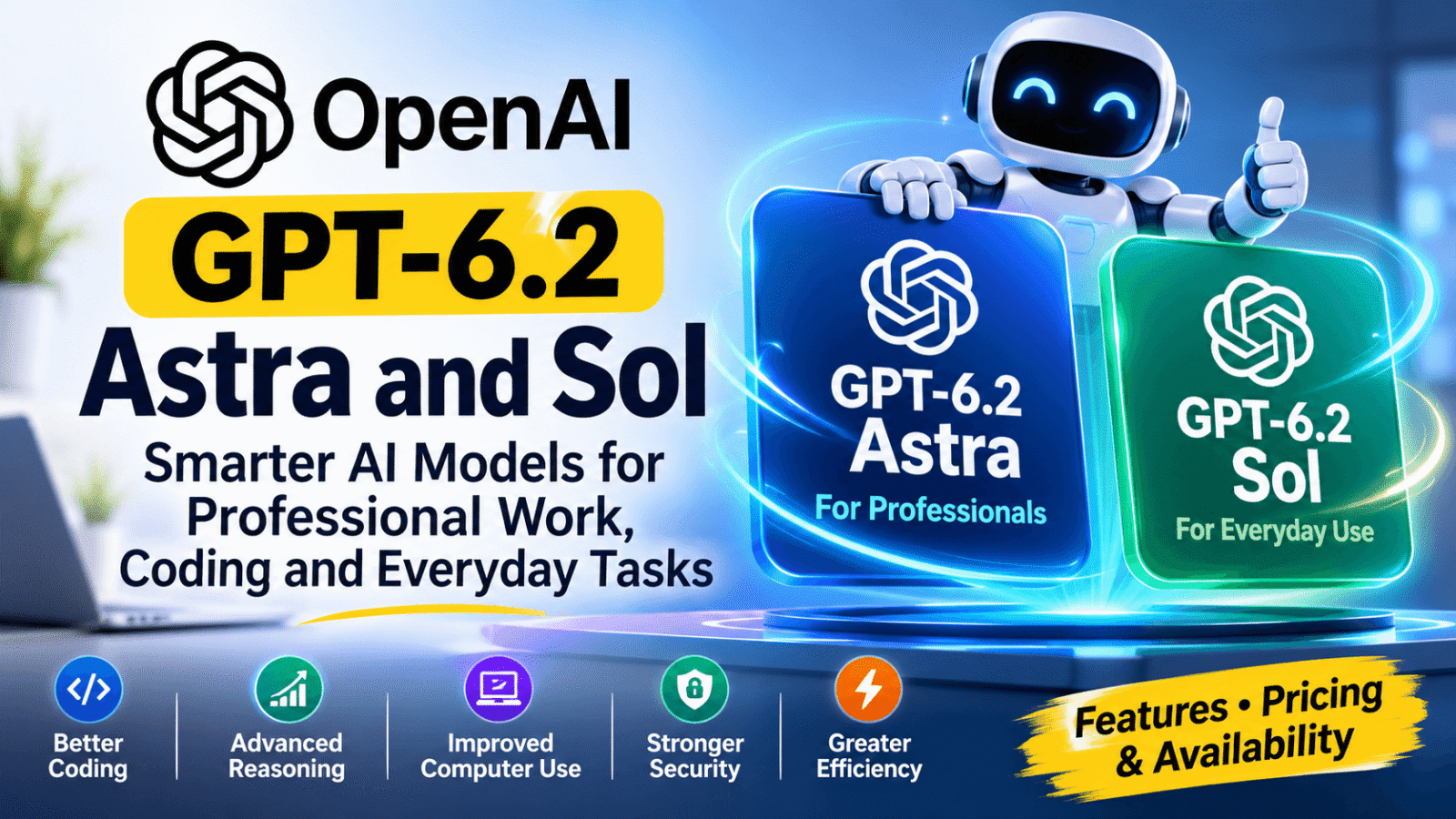
OpenAI has introduced GPT-6.2 Astra and GPT-6.2 Sol, two upgraded artificial intelligence models designed to improve professional productivity, software development, scientific research, computer use, and everyday tasks. Announced on November 17, 2026, the new models focus on delivering better results while using fewer AI tokens, helping businesses and developers reduce the cost of complex AI workflows.
GPT-6.2 Astra is designed for demanding professional projects that require advanced reasoning, coding, research, and complex problem-solving. GPT-6.2 Sol, meanwhile, focuses on everyday productivity, faster responses, and multi-step tasks at a lower operating cost.
According to OpenAI, both models outperform their predecessors on several demanding evaluations while improving token efficiency. The announcement represents another step in OpenAI’s strategy to make advanced AI more useful for businesses, developers, researchers, and everyday users.
The new release also builds on the company’s previous GPT-6 generation, including GPT-6 Astra and its advanced AI capabilities.
What Are GPT-6.2 Astra and GPT-6.2 Sol?
GPT-6.2 Astra and GPT-6.2 Sol are two models within OpenAI’s latest AI model family, but they serve different purposes.
Rather than offering one model for every situation, OpenAI is providing different levels of capability and efficiency depending on the complexity of the task.
GPT-6.2 Astra is the advanced model for complex professional work. It is designed to handle demanding coding projects, detailed research, financial analysis, presentations, spreadsheets, scientific workflows, and interactive web development.
GPT-6.2 Sol is designed for everyday work. It combines strong reasoning capabilities with improved efficiency, making it suitable for multi-step workflows, coding assistance, writing, planning, and general productivity.
Both models are designed to produce stronger results while generating fewer output tokens, potentially allowing users to complete more work within their available usage limits.
1. GPT-6.2 Astra Improves Professional Work and Productivity
One of the biggest improvements in GPT-6.2 Astra is its ability to produce professional-quality documents and deliverables.
OpenAI says the model has been trained to create better presentations, spreadsheets, reports, and business documents that follow professional standards.
For example, users can work on:
- Financial forecasts and valuation spreadsheets.
- Business reports and investment memos.
- Legal research and contract analysis.
- Professional presentations and slide decks.
- Marketing strategies and business documentation.
- Complex research and data analysis.
OpenAI reports that GPT-6.2 Astra achieved a 6.2-percentage-point improvement over GPT-6 Astra on its internal GDPval v2 evaluation while using 22% fewer output tokens.
The model also achieved a 62.5% result on Artificial Analysis’s AA-AnalystAgent evaluation, answering questions correctly across all five independent attempts in the reported task.
These improvements could make advanced AI more useful for professionals who need structured, detailed outputs rather than simple chatbot responses.
2. GPT-6.2 Sol Targets Everyday AI Tasks
While Astra focuses on complex professional work, GPT-6.2 Sol is designed for everyday productivity.
OpenAI says Sol is smarter and more efficient than GPT-6.1 Sol, helping users complete multi-step tasks with fewer resources.
Its potential applications include:
- Writing emails and business documents.
- Researching information and organizing findings.
- Planning schedules and everyday activities.
- Supporting software development.
- Managing multi-step AI workflows.
- Helping businesses automate repetitive tasks.
One interesting result comes from Cognition’s FrontierCode 2.0 evaluation. OpenAI reports that GPT-6.2 Sol came within 0.5 points of GPT-6.2 Astra at maximum reasoning effort while operating at approximately one-fifth of Astra’s cost.
This makes Sol an interesting option for developers and businesses that need capable AI without using their most expensive model for every task.

3. Better Coding, Computer Use and Website Development
Another important area of improvement is AI-powered software development.
GPT-6.2 Astra is designed to handle complex changes in existing codebases, write cleaner code, and perform more focused testing.
However, its capabilities extend beyond writing code.
OpenAI highlights improvements in computer use, visual reasoning, and interactive web design. The model can work with design tools, understand visual layouts, and turn written instructions into interactive browser-based experiences.
For example, OpenAI demonstrated how GPT-6.2 Astra could create a playable browser-based racing game and interactive 3D experiences.
The model can also support engineering workflows involving CAD designs, mechanical assemblies, and simulations.
For website owners and digital businesses, these capabilities could make AI-assisted website development more practical.
Businesses interested in improving their visibility across AI platforms should also explore our guide on How to Submit Your Website to ChatGPT in 2026.
The combination of stronger coding, visual reasoning, and computer-use capabilities could gradually change how websites, applications, and digital products are created.
4. Improved Scientific Research and Complex Reasoning
Scientific research is another important focus of GPT-6.2 Astra.
OpenAI reports that Astra achieved a nine-percentage-point improvement over GPT-6 Astra on Terminal-Bench-Science 0.1, an evaluation designed to measure how well models perform scientific research tasks using a terminal.
The model also achieved a new high on the Vals Science Index, which evaluates how AI systems interpret biological data and conduct experiments in simulated environments.
These capabilities could support researchers working with scientific datasets, experimental analysis, computational workflows, and technical research.
However, AI-generated scientific findings still require independent verification and expert supervision before being used in real-world research.
5. GPT-6.2 Astra and Sol Bring New Cybersecurity Capabilities
Cybersecurity is one of the most important and sensitive areas highlighted in OpenAI’s announcement.
GPT-6.2 Astra and Sol can identify software vulnerabilities, develop working exploits in controlled evaluations, write more secure code, and generate improved security patches.
OpenAI has classified both models at the Critical threshold for cybersecurity capabilities under its Preparedness Framework.
This is significant because more capable AI coding systems can potentially help security professionals identify weaknesses faster, but they can also create risks if misused.
To address these concerns, OpenAI has introduced stronger safeguards and tighter restrictions for higher-risk cybersecurity requests.
The company is also focusing on defensive applications, including helping developers prevent vulnerabilities and create patches that preserve the intended functionality of software.
For more technical information, OpenAI has published the GPT-6.2 System Card, which explains the models’ capabilities, safety evaluations, and deployment safeguards.
6. GPT-6.2 Astra and Sol Pricing and Availability
OpenAI announced GPT-6.2 Astra and GPT-6.2 Sol on November 17, 2026.
Both models are available to eligible Plus, Pro, Enterprise, and Edu users through ChatGPT Work and Codex. Developers can also access them through the OpenAI API.
The models are not being announced as a general replacement for the standard ChatGPT experience. Access depends on the supported product, subscription, and workspace permissions.
OpenAI API pricing
The following are OpenAI’s published standard API prices per one million tokens:
| Model | Input | Cached Input | Output |
|---|---|---|---|
| GPT-6.2 Astra | $8 | $0.40 | $40 |
| GPT-6.2 Sol | $2 | $0.10 | $10 |
GPT-6.2 Astra offers a 20% reduction in standard input and output token prices compared with GPT-6 Astra, alongside a deeper discount on cached input.
GPT-6.2 Sol maintains the previous GPT-6.1 Sol API pricing.
Developers can review the official OpenAI API documentation and model information for technical details and implementation options.
7. What GPT-6.2 Means for the Future of AI
The GPT-6.2 release highlights an important direction in artificial intelligence: moving beyond simple question-and-answer systems toward AI that can complete complex tasks.
Instead of simply generating text, modern AI models are increasingly being designed to work with documents, software, websites, research tools, and other digital environments.
For businesses, this could mean faster document preparation, improved research workflows, more efficient software development, and greater automation.
For developers, the combination of stronger reasoning and lower token consumption could make AI agents more practical to deploy at scale.
The development also connects with OpenAI’s wider work on GPT-6 Intelligent UI and its interactive ChatGPT experiences.
However, stronger AI capabilities do not eliminate the need for human oversight. Businesses should continue checking generated information, testing software changes, and reviewing important decisions before implementation.
Final Thoughts
OpenAI’s GPT-6.2 Astra and GPT-6.2 Sol represent an important upgrade in professional AI productivity, coding, scientific research, and everyday workflows.
Astra is positioned for demanding projects that require advanced reasoning and high-quality professional outputs, while Sol offers a more efficient option for everyday tasks and multi-step workflows.
The most interesting development is not simply that these models are more capable. It is that OpenAI is working to make advanced AI more efficient and practical for real-world applications.
As competition in the AI industry continues to grow, improvements in performance, reliability, token efficiency, and safety will play an increasingly important role in determining which models businesses and developers choose.
For now, GPT-6.2 Astra and Sol show how quickly AI is evolving from a conversational tool into a more capable partner for professional and digital work.
Frequently Asked Questions (FAQs)
1. What is GPT-6.2 Astra?
GPT-6.2 Astra is OpenAI’s advanced AI model designed for complex professional work, including coding, scientific research, financial analysis, document creation, and multi-step reasoning.
2. What is GPT-6.2 Sol?
GPT-6.2 Sol is an efficient AI model designed for everyday productivity, coding assistance, writing, research, and multi-step workflows.
3. What is the difference between GPT-6.2 Astra and Sol?
Astra focuses on demanding professional projects and advanced reasoning, while Sol prioritizes everyday tasks, efficiency, and lower operating costs.
4. Is GPT-6.2 Astra available in ChatGPT?
GPT-6.2 Astra is available to eligible Plus, Pro, Enterprise, and Edu users through ChatGPT Work and Codex. Availability depends on the subscription and workspace settings.
5. How much does GPT-6.2 Astra cost?
Its standard API pricing is $8 per million input tokens, $0.40 per million cached input tokens, and $40 per million output tokens.
6. Can GPT-6.2 Astra build websites and applications?
Yes. GPT-6.2 Astra offers improved coding, visual reasoning, computer use, and interactive web design capabilities that can help create websites, applications, and browser-based experiences.
7. Is GPT-6.2 Sol cheaper than Astra?
Yes. GPT-6.2 Sol costs $2 per million input tokens and $10 per million output tokens, compared with Astra’s $8 input and $40 output rates.
8. Is GPT-6.2 safe for cybersecurity work?
OpenAI has introduced stronger safeguards because of the models’ advanced cybersecurity capabilities. Some higher-risk security requests face additional restrictions, while authorized defensive work remains an important focus.
Official source: OpenAI – Introducing GPT-6.2 Astra and Sol