
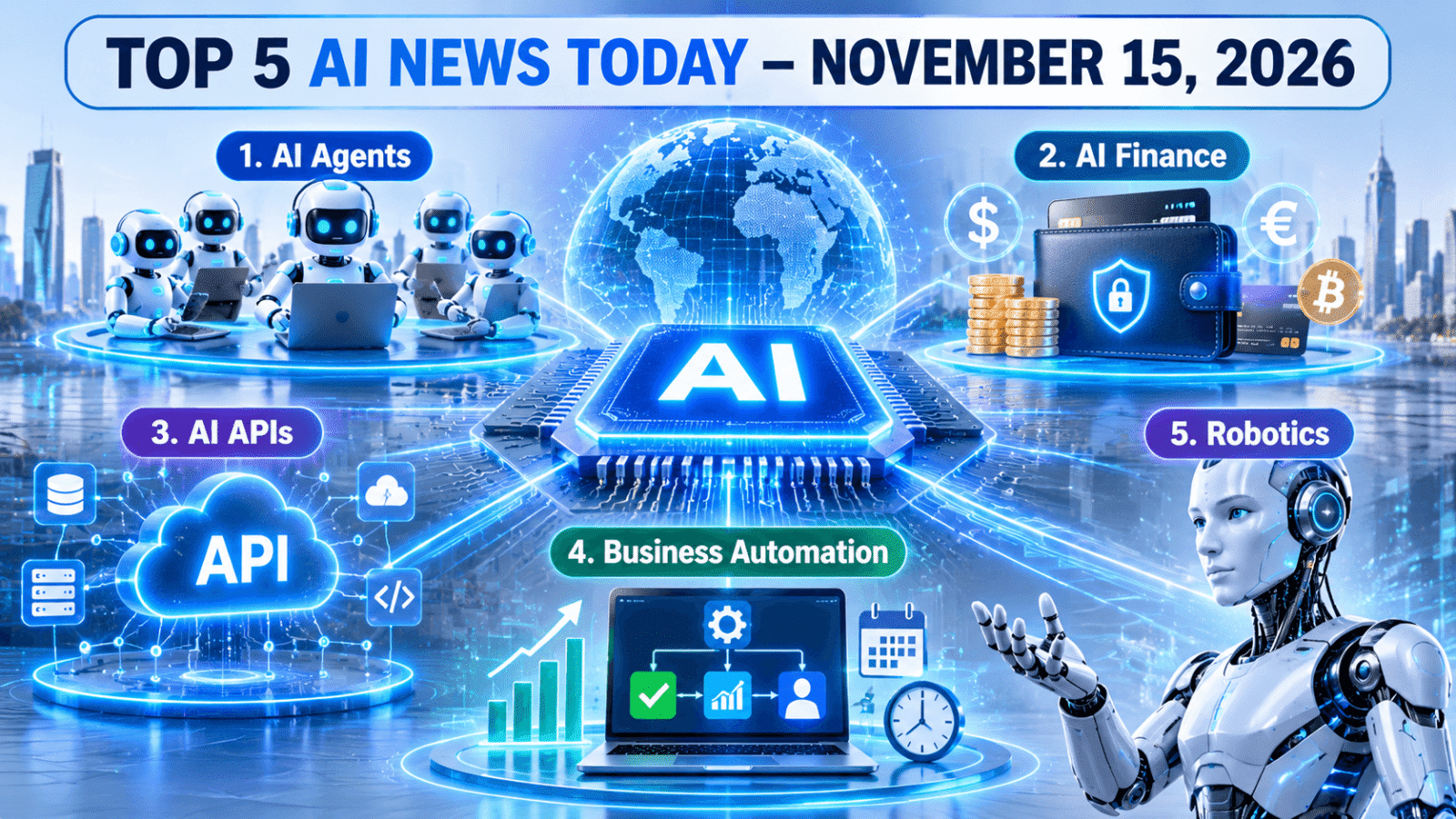
Artificial intelligence is entering a new phase in which AI models are becoming capable of coordinating with other agents, accessing business tools, analysing financial information and completing real-world tasks. The latest developments from Google, OpenAI, DeepSeek and LangChain demonstrate how quickly this technology is changing.
Google Research has shared new results from its Antigravity multi-agent system, OpenAI has introduced ChatGPT Wallet for AI-assisted purchases, and Google has connected Gemini with Google Wallet to provide personal finance insights. DeepSeek is expanding its developer APIs, while LangChain has secured $300 million to strengthen enterprise AI infrastructure.
These developments also raise important questions: How is cybersecurity AI being improved? What are the capabilities and features of Google’s Gemini 4 Argon AI model? How can businesses use AI for automation in 2026? And what is the future of generative AI?
Let’s explore the five major developments and what they mean for businesses, developers and everyday AI users.
1. Google advances multi-agent AI research with Antigravity /teamwork
Google is making progress towards a future where multiple AI agents collaborate to solve problems that are too complicated for a single model.
In its November 13 research update, Google introduced new results from Antigravity’s /teamwork system. The technology coordinates specialised AI agents to investigate difficult problems across mathematics, chemistry, machine learning and software engineering.
Unlike a traditional chatbot that generates one response, a multi-agent system can divide a complicated task into smaller activities. Different agents investigate, develop solutions, run tests and evaluate the results.
How does Google’s multi-agent AI work?
Google’s approach focuses on three important capabilities:
- Parallel problem-solving: Multiple agents can explore different approaches to the same problem.
- Independent verification: Specialised agents and tools check whether proposed solutions actually work.
- Long-term coordination: Agents can pass tasks between specialised workers without continuously carrying the entire conversation history.
Google explains that its system uses verification tools such as Lean 4 proof checking, software test suites, simulators and hardware measurements.
This is particularly important because AI-generated answers are not automatically correct. Verification helps identify mistakes before a proposed solution is accepted.
Google says the research collaborations have produced progress in information theory, formal verification, molecular research and systems engineering. Google Research
Why is this important for businesses?
Multi-agent AI could change how organisations approach complex business automation.
For example, a company could use multiple agents to:
- Research competitors and market trends.
- Analyse customer information.
- Prepare financial reports.
- Check data for inconsistencies.
- Generate recommendations for management.
Instead of depending on one AI assistant, businesses could eventually operate coordinated teams of specialised AI agents.
Read more about related developments in our coverage of Google’s AI research, NVIDIA robotics and Amazon AI cost tracking.
2. OpenAI introduces ChatGPT Wallet: AI agents move into online shopping
OpenAI is taking another step towards agentic commerce with its introduction of ChatGPT Wallet.
Announced on November 13, the feature allows eligible ChatGPT users to authorise AI agents to help complete purchases.
Previously, AI assistants primarily helped users discover products, compare prices and research purchasing options. ChatGPT Wallet introduces a payment experience that brings the purchasing process closer to the AI assistant.
What can ChatGPT Wallet do?
The system is designed to allow an AI agent to prepare a purchase while keeping the user in control.
Its initial capabilities include:
- Helping users find products and prepare purchases.
- Presenting purchase information for review.
- Supporting eligible American Express, Mastercard and Visa cards.
- Using payment tokens rather than exposing actual card details.
- Requiring user approval through a security check before completing a purchase.
The initial availability is limited to eligible US ChatGPT Pro subscribers aged 18 or older using Dots agents.
How could AI shopping change online businesses?
Imagine asking an AI assistant to find a suitable laptop within a particular budget.
Instead of simply providing a list of products, an AI agent could compare specifications, examine purchasing options and prepare the checkout process.
This creates a new opportunity for e-commerce businesses.
Online retailers may need to optimise product information, checkout systems and payment security for AI-driven shopping experiences.
It also means businesses will increasingly need to understand how AI agents discover their products and interact with their websites.
3. Google connects Gemini with Google Wallet for smarter financial insights
Google is expanding Gemini beyond general-purpose conversations by connecting it with personal financial information.
On November 13, Google announced a Google Wallet integration for its Gemini app.
The feature allows eligible US users to ask questions about their spending habits, recurring subscriptions and financial budgets.
What can Gemini do with Google Wallet?
Users can ask Gemini questions such as:
- How much did I spend last month?
- Which subscriptions am I still paying for?
- Have any of my recurring payments increased?
- How much should I budget for holiday shopping?
- Can you analyse my spending and suggest ways to save?
Gemini can use available transaction information to generate financial insights and visual charts.
Users can also optionally connect financial accounts through Plaid for deeper insights.
Importantly, Google says the integration is read-only. Gemini can analyse connected financial information but cannot move, manage or invest money through this connection. blog.google
Why does this matter?
This development demonstrates how AI assistants are becoming more useful through integration with existing applications.
Instead of manually reviewing spreadsheets and transactions, users can ask questions in natural language.
The same concept has significant potential for business applications, including expense analysis, financial reporting, subscription management and budget planning.
However, businesses must ensure that financial information is accessed only with appropriate permissions and security controls.
4. DeepSeek expands its API capabilities for developers
DeepSeek is making its AI ecosystem more accessible to developers by expanding the capabilities available through its APIs.
The November 13 announcement introduces additional application tools that allow developers to build AI assistants with search, document-processing and voice capabilities.
What new capabilities does DeepSeek offer?
The update includes several important features:
Web search: Applications can retrieve information from the internet and use it to generate answers with supporting references.
Multi-step search: AI systems can conduct more complex searches rather than relying on a single query.
File processing: Developers can build applications that work with documents and other supported file inputs.
URL reading: AI assistants can retrieve and analyse information from supplied web addresses.
OCR: Optical character recognition helps extract information from images and documents.
Speech processing: Separate services support speech-to-text and text-to-speech applications.
Safety checks: Developers can add input and output screening to their applications.
These capabilities are documented in the official DeepSeek API announcement.
How can developers use these features?
Developers could use DeepSeek’s expanded APIs to create:
- AI-powered customer support assistants.
- Document research applications.
- Business intelligence tools.
- Voice-enabled customer service systems.
- Automated website research assistants.
- AI-powered knowledge management platforms.
The important development is not simply another model release. It is the expansion of the tools developers can combine to create complete AI applications.
5. LangChain raises $300 million to expand enterprise AI infrastructure
AI agents are becoming more important in business, but deploying them reliably requires specialised infrastructure.
LangChain is one of the companies working on this challenge.
On November 13, the company announced a $300 million Series C funding round at a $3 billion valuation.
The round was led by CapitalG, with participation from GIC, DFJ Growth and existing investors.
Why is LangChain important for AI agents?
LangChain provides tools that help developers build applications using large language models and external services.
Its ecosystem includes:
- Agent development tools.
- Model and application integrations.
- Workflow orchestration.
- AI evaluation.
- Performance monitoring.
- Production observability through LangSmith.
These capabilities help organisations understand how AI agents behave after deployment.
For example, a company building an AI customer support system needs to know whether its agent is providing accurate information, accessing the correct customer records and following business rules.
Monitoring and evaluation help identify problems before they affect customers.
What does this funding mean?
The investment highlights growing demand for enterprise AI infrastructure.
Businesses are increasingly interested in AI agents, but they need systems that are reliable, measurable and secure.
This creates opportunities for companies developing agent orchestration platforms, monitoring tools and business automation solutions.

How is cybersecurity AI being improved?
Cybersecurity is becoming one of the most important applications of artificial intelligence.
Traditional security systems often depend on predefined rules, signatures and known attack patterns. AI-powered cybersecurity tools can analyse much larger volumes of information, identify unusual behaviour and help security teams investigate potential vulnerabilities.
Recent developments from OpenAI and Google demonstrate how AI is improving defensive security.
1. AI-powered vulnerability detection
AI models can analyse source code, identify suspicious patterns and help security researchers discover software vulnerabilities.
For example, OpenAI introduced GPT-6 Cyber on November 5, 2026, a specialised cybersecurity model designed to discover and validate vulnerabilities while staying within authorised testing boundaries.
OpenAI reports that the model identified 81 previously unknown high-severity Firefox vulnerabilities and helped develop candidate patches. Mozilla has released fixes for many of the findings. These results are reported by OpenAI. OpenAI+1
2. Automated security testing
AI agents can help security professionals test applications, investigate weaknesses and validate whether software patches work.
OpenAI’s Daybreak programme includes tools for authorised security testing and vulnerability remediation.
Its Defense Factory uses AI agents to investigate reported vulnerabilities and prepare patches for engineers to review and test. OpenAI+1
3. Faster threat detection
AI can help security teams analyse network activity, application logs and suspicious behaviour to identify potential attacks.
It can also help prioritise security alerts so teams can focus on the most important risks.
4. Human oversight and responsible AI
AI cybersecurity systems still require human supervision.
Security teams must control which systems agents can access, verify their findings and ensure that testing remains within authorised boundaries.
The future of AI cybersecurity will depend on combining automated detection, faster vulnerability remediation, stronger access controls and human expertise.
For more information, read our guide: How AI Is Changing Cybersecurity: Fighting Modern Digital Threats.
What are the capabilities and features of Google’s new Gemini 4 Argon AI model?
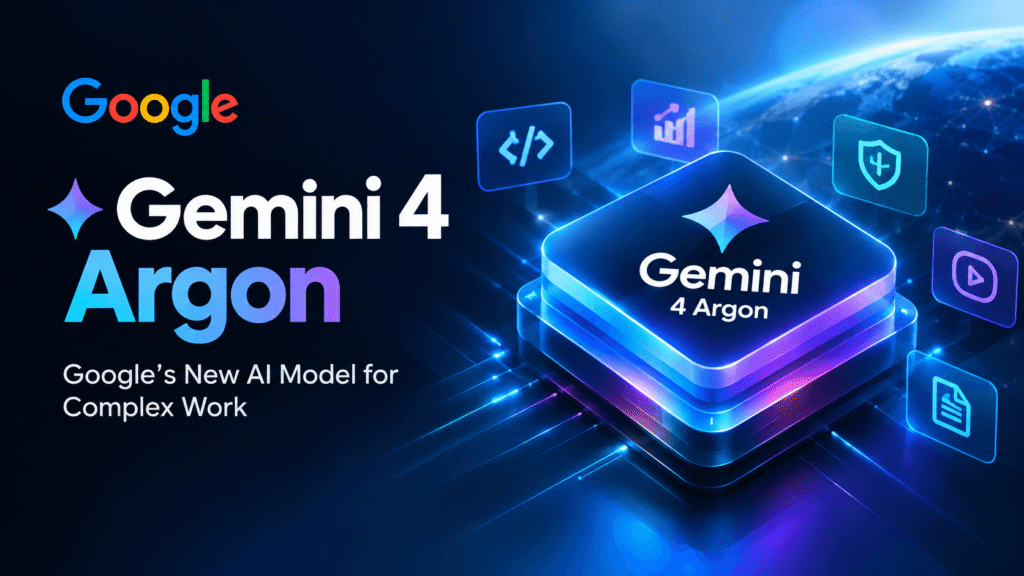
Google’s Gemini 4 Argon is a frontier AI model designed for complex reasoning, advanced coding, research and enterprise workflows.
Although it is not a November 15 launch, it remains one of Google’s important models for understanding the next generation of generative AI.
Google introduced Argon on September 30, 2026, and expanded availability to developers, businesses and eligible consumers on October 13. blog.google+1
What are the main Gemini 4 Argon features?
| Feature | What it can do |
|---|---|
| Advanced reasoning | Handle complex, multi-step problems |
| 1-million-token context | Work with large amounts of information |
| Advanced coding | Debug, optimise and migrate software |
| Financial analysis | Support research and financial workflows |
| Legal research | Analyse documents and assist with drafting |
| Cybersecurity | Identify vulnerabilities and help develop fixes |
| Visual understanding | Analyse charts, images and visual information |
| Long-video analysis | Identify important details across videos |
| Business automation | Execute complex workflows through connected tools |
What can Gemini 4 Argon do in real-world applications?
Software engineering: Argon can help developers understand large codebases, investigate errors, optimise software and support code migrations.
Business research: It can analyse documents, research financial information and organise complex data into useful reports.
Cybersecurity: It can support vulnerability research, code analysis and defensive security workflows.
Creative work: Its visual understanding and connected tools can help produce presentations, interactive applications and visual projects.
Scientific research: It can help researchers analyse large datasets, investigate scientific questions and develop computational solutions.
Google reports that Argon scored 51.3% on Zapier’s AutomationBench, which evaluates end-to-end automation across business functions. This is a Google-reported benchmark result, not a guarantee that every business workflow will achieve the same performance. blog.google
For the complete breakdown, read our existing guide:
Gemini 4 Argon: Google’s New AI Model for Complex Work.
How to use AI for business automation in 2026
AI business automation is moving beyond simple chatbots and repetitive scripts.
In 2026, businesses can use AI agents to research information, process documents, manage customer requests, analyse business data and coordinate workflows across multiple applications.
The combination of models such as Gemini 4 Argon, DeepSeek APIs and multi-agent systems is creating new possibilities for business automation.
1. Automate customer support
AI assistants can respond to frequently asked questions, explain products, retrieve relevant information and help customers navigate services.
Businesses can use AI agents to handle routine requests while forwarding complex cases to human support teams.
2. Automate marketing and content creation
AI can help businesses:
- Research keywords and competitors.
- Generate article outlines.
- Draft social media content.
- Analyse campaign performance.
- Prepare marketing reports.
- Organise content calendars.
Human review remains important for accuracy, brand voice and originality.
3. Automate document processing
Businesses often receive invoices, contracts, reports and customer documents.
AI-powered OCR and document-processing systems can extract relevant information, organise records and send information into existing business workflows.
DeepSeek’s expanded API capabilities are particularly relevant to developers building these applications.
4. Automate sales and lead management
AI agents can help businesses research potential customers, organise leads, prepare follow-up messages and update CRM records.
With appropriate permissions, they can also coordinate activities between sales and marketing applications.
5. Build multi-agent business workflows
Businesses can use specialised agents for different responsibilities.
For example:
Example: AI-powered business automation
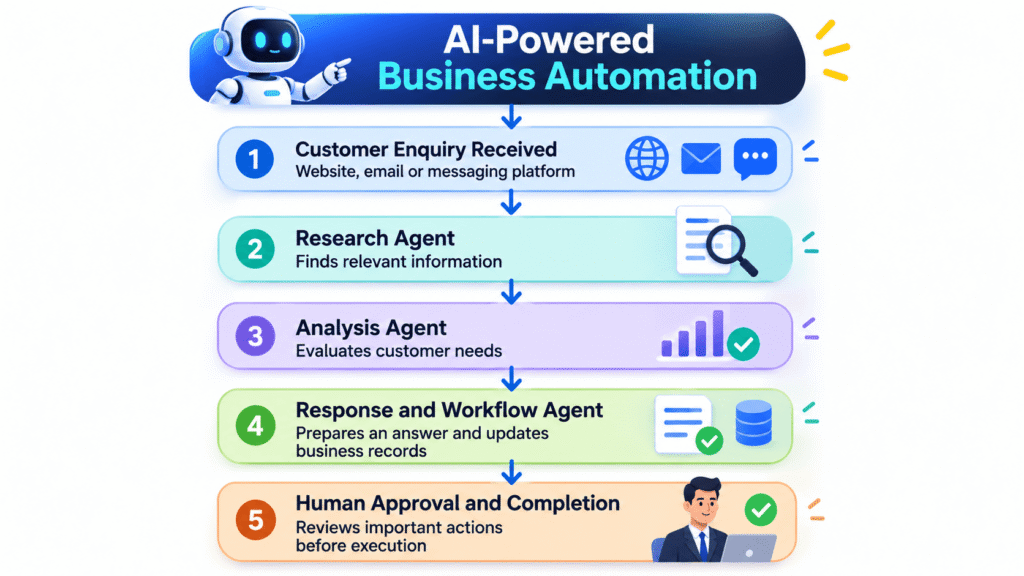
This approach can reduce repetitive work and help teams manage complicated processes.
However, businesses should begin with clearly defined workflows, limited permissions and measurable performance targets rather than giving AI agents unrestricted access.
What are the features of GPT-5?
Although OpenAI has since introduced newer models, GPT-5 remains an important milestone in the development of modern generative AI.
OpenAI introduced GPT-5 in August 2025, highlighting improvements in reasoning, coding, writing and answer reliability.
Key GPT-5 capabilities
- Advanced reasoning: More capable problem-solving for complex questions.
- Coding: Helps write, debug and improve software.
- Writing: Supports professional writing, editing and creative tasks.
- Better accuracy: Designed to reduce incorrect or fabricated answers compared with earlier models.
- Voice improvements: More natural conversational experiences.
- Study Mode: Supports learning through explanations and guided problem-solving.
- Application connections: Supports workflows involving connected services such as Gmail and Google Calendar.
Source: OpenAI – GPT-5 is here. OpenAI
GPT-5 helped establish a stronger foundation for reasoning-based AI assistants. Newer models have continued expanding these capabilities towards autonomous workflows, coding agents and advanced business applications.
What is the future of generative AI?
The future of generative AI will likely be defined by five major developments.
1. AI agents will become more autonomous
AI assistants will increasingly be able to complete multi-step tasks instead of simply answering questions.
2. Multi-agent systems will transform research and business
Different agents will collaborate on specialised activities, verify results and coordinate complex workflows.
3. Multimodal AI will become more powerful
AI systems will increasingly understand and generate text, images, audio, video and interactive visual experiences together.
4. Physical AI and robotics will expand
AI will increasingly operate in factories, warehouses, healthcare environments and other physical settings.
Our coverage of Google Genie 4 and its AI world-model capabilities explores another important direction in this development.
5. Security and trust will become essential
As AI gains access to business applications, financial information and critical systems, privacy, permissions, transparency and cybersecurity will become central to successful deployment.
The companies that combine useful AI capabilities with reliability and trust will have an important advantage.
What these AI developments mean for businesses and technology
The latest developments reveal three major shifts.
First, AI is becoming more action-oriented. OpenAI’s Wallet and Google’s Gemini integrations show how AI assistants are moving towards completing practical tasks.
Second, AI is becoming more collaborative. Google’s multi-agent research and DeepSeek’s expanded developer capabilities demonstrate how different tools and agents can work together.
Third, businesses need infrastructure, security and governance. LangChain’s funding and developments in AI cybersecurity show that deploying AI at scale requires more than choosing a powerful model.
For businesses, the opportunity is significant, but successful adoption will depend on selecting appropriate workflows, protecting sensitive data and measuring actual results.
Frequently asked questions about today’s AI news
1. What are the biggest AI developments on November 15, 2026?
The major developments covered in this edition include Google’s Antigravity multi-agent research, OpenAI’s ChatGPT Wallet, Google’s Gemini and Google Wallet integration, DeepSeek’s expanded APIs and LangChain’s $300 million funding round. Their original announcements were dated November 13.
2. How is cybersecurity AI being improved?
AI cybersecurity is improving through automated vulnerability detection, security testing, threat analysis, patch generation and continuous monitoring. Advanced models such as GPT-6 Cyber are also being designed to perform authorised security research while following strict access boundaries.
3. What are the capabilities and features of Google’s Gemini 4 Argon AI model?
Gemini 4 Argon supports advanced reasoning, coding, financial and legal research, cybersecurity workflows, visual understanding and complex business automation. Google also provides a 1-million-token context window.
4. How can businesses use AI for automation in 2026?
Businesses can use AI to automate customer support, document processing, marketing, sales operations, financial analysis and reporting. Multi-agent systems can coordinate several specialised tasks with human approval for important actions.
5. What are the features of GPT-5?
GPT-5 introduced improvements in reasoning, coding, writing, accuracy, voice interactions and guided learning. It helped establish the foundation for more capable AI assistants and agentic workflows.
6. What can Gemini 4 Argon do?
Gemini 4 Argon can help with complex coding tasks, software migration, document research, financial analysis, legal workflows, cybersecurity research and visual content analysis. It can also work with connected tools to support business automation.
7. What is the future of generative AI?
Generative AI is moving towards autonomous agents, multi-agent collaboration, multimodal applications, physical robotics, personalised assistants and more advanced business automation. Security and responsible deployment will remain essential.
