
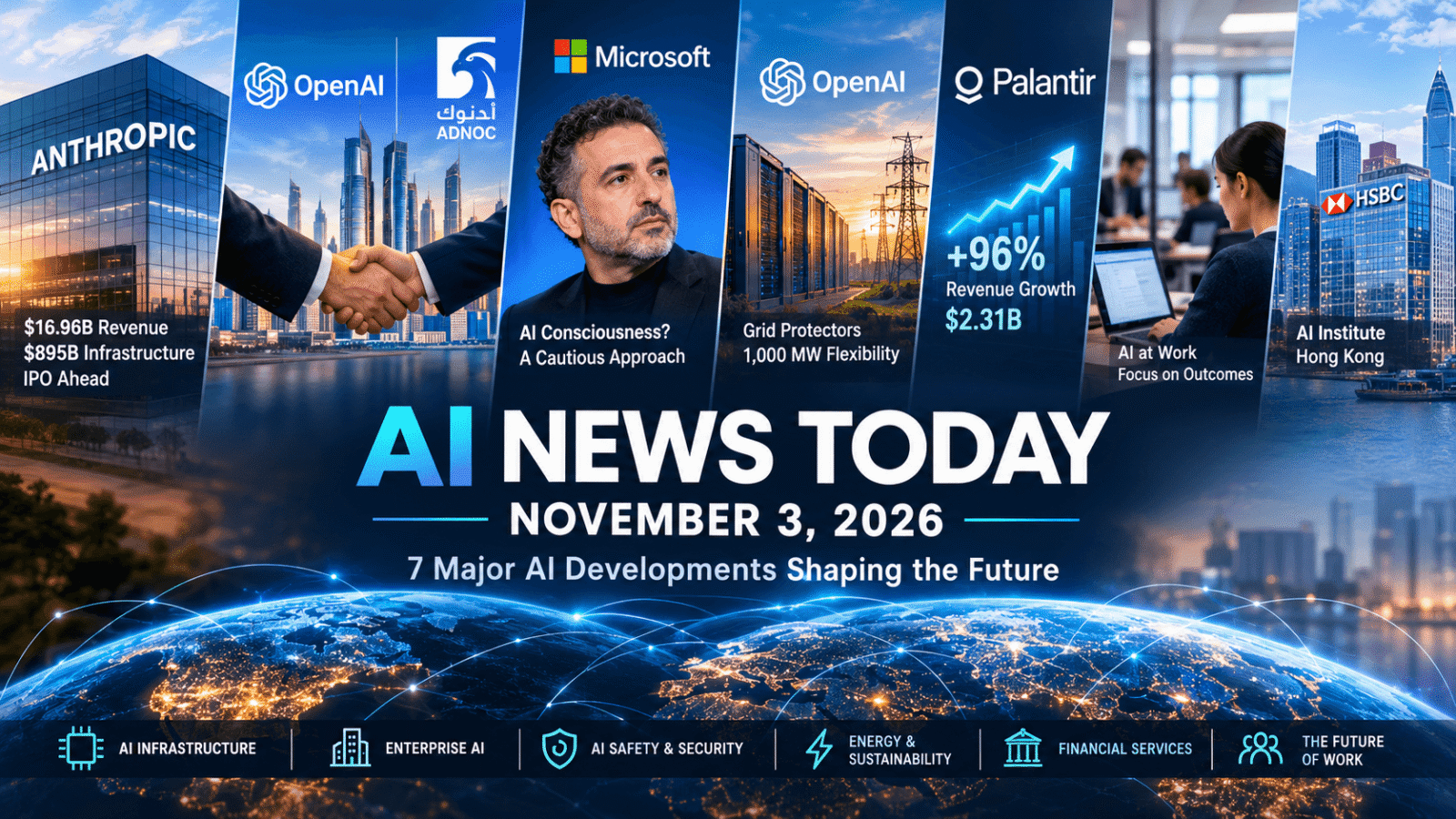
Artificial intelligence continues to reshape the global technology industry, from billion-dollar investments and enterprise automation to energy infrastructure and AI safety. On November 3, 2026, several important developments are attracting attention across the AI industry.
Anthropic has revealed enormous infrastructure commitments in its latest IPO filing, OpenAI is expanding its presence in the Middle East through a partnership with ADNOC, and Microsoft AI CEO Mustafa Suleyman has reignited the debate about artificial consciousness.
Meanwhile, OpenAI is exploring ways to reduce pressure on electricity grids from AI data centers, Palantir is reporting exceptional commercial AI growth, and HSBC is investing in a new AI and emerging technology institute in Hong Kong.
These developments highlight an important change: artificial intelligence is moving beyond experimental chatbots and becoming a major part of business operations, financial services, energy systems and global infrastructure.
Here are seven major AI news stories you should know about today.
1. Anthropic Reports $16.96 Billion Quarterly Revenue as IPO Plans Advance
Anthropic, the company behind Claude AI, has disclosed impressive financial growth alongside significant infrastructure spending in an updated filing ahead of its expected initial public offering (IPO).
According to its latest financial disclosure, Anthropic generated approximately $16.96 billion in third-quarter 2026 revenue, representing 47% growth compared with the previous quarter.
However, the company also reported a net loss of approximately $23.29 billion for the quarter.
One of the most important details in the filing is Anthropic’s infrastructure commitment, which totals approximately $895.4 billion. Around $69.8 billion is expected to be spent over the next 12 months.
These commitments highlight how expensive it has become to develop, train and operate advanced AI models.
Why Anthropic’s IPO matters
Anthropic is competing with major AI companies, including OpenAI and Google, in the race to develop increasingly capable AI systems.
Its financial performance demonstrates the commercial demand for Claude, particularly among businesses using AI for coding, research, automation and complex workflows.
However, its enormous infrastructure commitments also raise questions about financing, long-term profitability and the sustainability of AI investment.
The potential IPO could become a major milestone for the AI industry, giving investors a closer look at the economics of frontier AI development.
Read more: Reuters – Anthropic’s quarterly revenue and IPO filing

2. OpenAI Partners with ADNOC to Bring Advanced AI into Abu Dhabi’s Energy Industry
OpenAI is expanding its enterprise AI ambitions in the Middle East through a new partnership involving Abu Dhabi National Oil Company (ADNOC) and AI company G42.
Announced during ADIPEC 2026 in Abu Dhabi, the agreement aims to integrate advanced OpenAI technology into ADNOC’s operations.
ADNOC is expected to become the first energy company to deploy OpenAI’s Frontier technology.
One of the key opportunities is improving complex planning across thousands of oil wells. AI could help reduce planning processes that traditionally take months to a matter of hours.
How AI could transform the energy industry
Energy companies manage enormous amounts of operational information, equipment data and engineering requirements.
Advanced AI systems can help organizations:
- Analyze operational information more efficiently.
- Support complex engineering decisions.
- Improve production planning.
- Identify opportunities to optimize operations.
- Automate information-intensive workflows.
For the UAE, this partnership also supports its broader ambition to become an international center for artificial intelligence.
The agreement demonstrates how AI adoption is expanding into industries that traditionally depend on specialized engineering and large-scale physical infrastructure.
Why it matters: The next phase of AI competition will not be limited to consumer chatbots. Energy, manufacturing, healthcare and other industrial sectors could become major markets for enterprise AI.
Related coverage: OpenAI and ADNOC partnership coverage – Times of India
3. Microsoft AI CEO Mustafa Suleyman Warns Against Creating Conscious AI
The debate about artificial intelligence consciousness has become increasingly important as AI systems develop more human-like conversational abilities.
Microsoft AI CEO Mustafa Suleyman has reiterated that today’s AI systems are not conscious and do not possess subjective experiences or the ability to suffer.
He argues that AI developers should avoid deliberately creating systems that behave as though they have independent consciousness or human-like welfare needs.
Suleyman has also suggested that if credible evidence of AI consciousness emerges, the industry should disclose it publicly and carefully reconsider development.
Can artificial intelligence become conscious?
Current AI systems can generate convincing conversations, recognize patterns, process information and simulate emotional responses.
However, these capabilities do not establish that a system has subjective experiences or consciousness.
There is still no scientific consensus that today’s commercial AI models are conscious.
The discussion raises several important questions:
- Should advanced AI systems ever receive legal or moral rights?
- How should researchers investigate possible machine consciousness?
- Could human-like AI behavior create misleading expectations?
- What responsibilities should AI developers have?
Why it matters: As AI becomes more sophisticated, responsible development will require more than performance improvements. Transparency, human oversight and safety will remain essential.
Source: Los Angeles Times – Microsoft AI CEO warns against conscious machines
4. OpenAI Introduces Grid Protectors to Address AI Data Center Electricity Demand
The rapid growth of artificial intelligence is creating another major challenge: electricity consumption.
Large AI data centers require substantial computing power to train and operate advanced models. As companies expand their infrastructure, pressure on local electricity networks is becoming an increasingly important issue.
On November 2, OpenAI announced its Grid Protectors Program, an initiative designed to help electricity grids during periods of high demand.
The company plans to pilot the program at its proposed data center campus in Effingham County, Georgia.
Under its agreement with Georgia Power, the project includes up to 1,000 megawatts of flexible demand response. OpenAI says this is equivalent to the average electricity demand of approximately 700,000 households.
How will Grid Protectors work?
The program aims to make AI data centers more flexible electricity users.
When electricity demand increases or the grid experiences pressure, participating facilities could reduce their power consumption.
OpenAI also plans to explore on-site power generation, energy storage, batteries and power controls.
The company says it will work with utilities, regulators and policymakers to establish arrangements that reflect local electricity needs.
However, demand flexibility cannot replace investment in new electricity generation and transmission infrastructure.
Why it matters: The future of AI depends not only on better chips and models but also on reliable and affordable energy. Data center operators will increasingly need to demonstrate how their infrastructure can coexist with local communities.
Official source: OpenAI – Introducing the Grid Protectors Program
5. Palantir Reports 96% Revenue Growth as Enterprise AI Demand Accelerates
Palantir Technologies has reported strong third-quarter financial results, highlighting the growing commercial demand for AI-powered enterprise software.
According to its November 2 earnings announcement, the company generated approximately $2.31 billion in revenue for the third quarter of 2026, representing 96% year-over-year growth.
One particularly important development was that Palantir’s US commercial revenue exceeded its US government revenue for the first time.
Key financial figures include:
- Total quarterly revenue: $2.313 billion.
- US commercial revenue: $984 million.
- US government revenue: $953 million.
- US commercial revenue growth: 148% year over year.
- Total revenue growth: 96% year over year.
Why Palantir’s growth matters
Palantir provides software that helps organizations integrate data, analyze information and support complex operational decisions.
Its Artificial Intelligence Platform (AIP) allows businesses to connect AI models with enterprise data and workflows.
The company’s latest results suggest that organizations are increasingly moving beyond small AI experiments and adopting AI for practical business applications.
Industries such as manufacturing, logistics, finance and government can use enterprise AI to improve decision-making and operational efficiency.
Why it matters: Commercial AI adoption is becoming a major source of growth for technology companies. Businesses are increasingly interested in measurable outcomes rather than simply experimenting with generative AI.
Official source: Palantir – Q3 2026 Financial Results
6. Companies Face Challenges as Employees Are Required to Use AI at Work
Artificial intelligence is changing how employees work, but forcing people to use AI tools does not necessarily improve productivity.
A recent report published by The Washington Post highlights concerns about companies requiring employees to use AI, tracking usage and setting targets based on platform activity or token consumption.
The central issue is that AI usage does not automatically translate into better work.
An employee might use an AI tool hundreds of times without producing meaningful business results. Another employee might use AI only a few times but save several hours through effective automation.
Why mandatory AI adoption can backfire
Organizations should focus on outcomes instead of measuring how frequently employees interact with AI systems.
Some important considerations include:
- AI training should match employees’ actual responsibilities.
- Companies should measure work quality and productivity.
- Employees should have opportunities to experiment with useful AI tools.
- AI adoption should support employees rather than simply monitor them.
- Human judgment should remain important in critical decisions.
AI can help businesses reduce repetitive work, improve research and accelerate content creation. However, successful implementation requires employee participation and proper training.
Why it matters: The future workplace will likely involve collaboration between humans and AI systems. Companies that build practical AI skills may achieve better results than organizations that simply impose usage targets.
Source: The Washington Post – Why mandating AI use in the workplace can backfire
7. HSBC Announces AI and Emerging Technology Institute in Hong Kong
HSBC has announced plans to establish a global AI and Emerging Technology Institute in Hong Kong, strengthening its investment in artificial intelligence and financial technology.
The announcement was made on November 2, 2026, during Hong Kong FinTech Week.
The institute will be based in Hong Kong’s Northern Metropolis and is expected to begin operations in early 2027.
HSBC has selected the Hong Kong University of Science and Technology (HKUST) as its anchor academic partner.
What will the HSBC AI Institute focus on?
The institute will initially explore several important technology areas:
- AI education and employee upskilling.
- AI safety and responsible deployment.
- AI-powered fraud detection.
- Engineering optimization.
- Post-quantum cryptography.
- Blockchain technology.
One important focus is preparing financial institutions for new fraud risks in an increasingly agentic AI environment.
As AI agents become more capable of carrying out tasks and interacting with digital systems, banks will need stronger security and monitoring capabilities.
Why it matters: Financial institutions are investing in AI not only to improve customer experiences but also to strengthen cybersecurity, fraud detection and internal operations.
The HSBC initiative also highlights Hong Kong’s ambition to remain a leading international financial and technology center.
Official source: HSBC – Announces AI and Emerging Technology Institute
What Do These Seven AI Developments Mean for the Future of Artificial Intelligence?
The latest AI developments reveal three important industry trends.
1. AI infrastructure is becoming a major investment priority
Anthropic’s enormous infrastructure commitments and OpenAI’s electricity initiatives show that AI development requires substantial computing resources.
The companies building the next generation of AI systems will need access to advanced chips, data centers, energy and financing.
For more information about the infrastructure behind advanced AI, read our coverage of NVIDIA GTC Berlin 2026 and its five major AI announcements.
2. Enterprise AI is moving into real-world industries
The OpenAI-ADNOC agreement, Palantir’s commercial growth and HSBC’s new institute demonstrate that AI is becoming an important business technology.
Organizations are exploring applications across energy, finance, engineering, cybersecurity and enterprise automation.
Businesses are now looking for AI solutions that can deliver measurable results.
3. AI safety and security remain essential
The discussion about artificial consciousness and the growing use of AI agents highlight the importance of responsible development.
Organizations must also prepare for new cybersecurity risks as AI becomes more integrated into business systems.
Read our related analysis: How AI Is Changing Cybersecurity and Fighting Cyber Threats.
You can also explore our previous roundup covering Claude security incidents, the OpenAI and Google Cloud partnership, and other AI industry changes.
Frequently Asked Questions About AI News Today
1. What are the biggest AI news stories on November 3, 2026?
The major developments include Anthropic’s latest IPO financial disclosures, OpenAI’s partnership with ADNOC, Microsoft’s AI consciousness debate, OpenAI’s Grid Protectors Program, Palantir’s strong revenue growth, workplace AI adoption challenges and HSBC’s new AI institute.
2. Why is Anthropic’s IPO important for the AI industry?
Anthropic’s potential IPO could provide investors with greater visibility into the financial performance and infrastructure costs of a leading AI company. Its latest filing reveals strong revenue growth alongside substantial computing commitments.
3. What is OpenAI’s partnership with ADNOC about?
The partnership involving OpenAI, ADNOC and G42 aims to integrate advanced AI technology into energy operations, helping improve planning and operational decision-making.
4. What is OpenAI’s Grid Protectors Program?
It is an initiative designed to help electricity grids manage periods of high demand by making future AI data centers more flexible in their electricity consumption. Its Georgia pilot includes up to 1,000 megawatts of flexible demand response.
5. Is artificial intelligence conscious?
There is currently no established scientific evidence that today’s commercial AI systems possess subjective consciousness or human-like experiences. The question remains an active topic of scientific and ethical debate.
6. How is AI changing businesses in 2026?
Businesses are using AI for automation, research, data analysis, fraud detection, engineering, customer services and complex operational workflows. Enterprise adoption is increasingly focused on measurable productivity and business outcomes.
7. Why are banks investing in artificial intelligence?
Banks are investing in AI to improve fraud detection, customer services, operational efficiency, cybersecurity and financial data analysis. AI safety is also becoming important as agentic systems become more widely used.
Final Thoughts
November 2026 is demonstrating how quickly artificial intelligence is becoming part of the global economy.
Anthropic’s IPO preparations highlight the financial scale of the AI industry, OpenAI’s Middle East partnership demonstrates the expansion of industrial AI, and Palantir’s results show growing enterprise demand.
At the same time, electricity consumption, workplace adoption and AI safety remain important challenges that technology companies must address.
For businesses, developers and technology professionals, the message is clear: the next stage of AI will be shaped not only by more powerful models but also by infrastructure, real-world applications, responsible development and measurable business value.
Stay connected with AI Edge Insights for the latest artificial intelligence news, industry developments, expert insights and global AI event coverage.
