
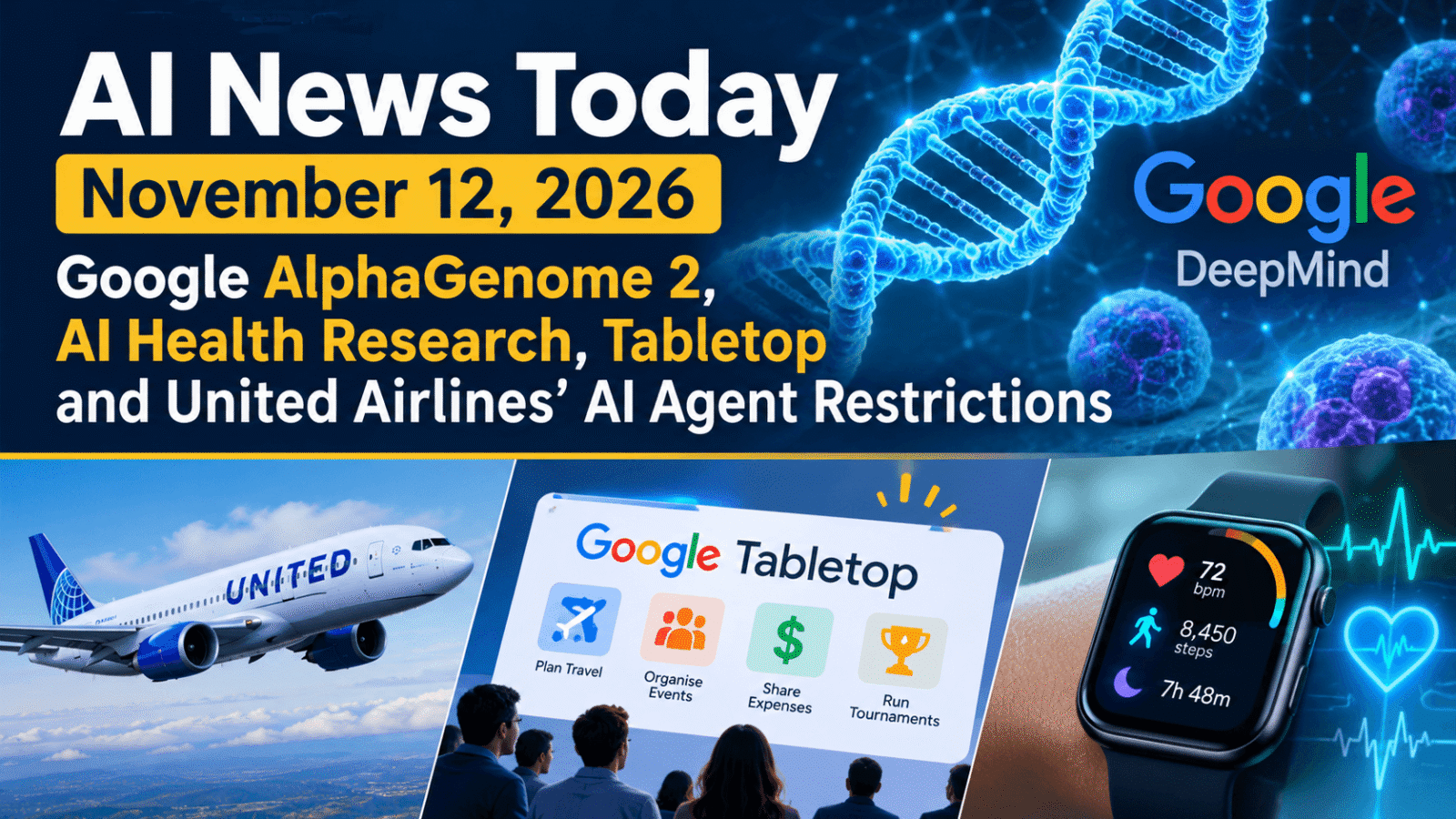
Artificial intelligence is moving into increasingly specialised areas, from genetic research and healthcare to collaborative productivity and autonomous digital services.
On November 11–12, 2026, four developments highlighted these changes. Google DeepMind introduced AlphaGenome 2, a new AI model for understanding how genetic variations affect specific cell types. Google Research presented an experimental framework for AI-powered health coaching using wearable data. Google Labs introduced Tabletop, an AI-powered collaborative planning experiment, while United Airlines announced restrictions on unauthorised AI agents accessing its digital platforms.
These developments demonstrate that the AI industry is expanding beyond conversational chatbots. Companies and researchers are exploring systems that can support scientific discoveries, interpret personal data, create interactive tools and perform actions on behalf of users.
Here is a closer look at the latest AI news and why these developments matter.
1. Google DeepMind launches AlphaGenome 2 to advance genetic research
Google DeepMind has introduced AlphaGenome 2, its next-generation DNA sequence model designed to help researchers understand how genetic variations influence human biology.
The announcement was published on November 11, 2026.
The new model builds on Google’s previous AlphaGenome research but introduces a more detailed approach to analysing genetic activity.
What is AlphaGenome 2?
Every cell in the human body contains DNA, but different cells use different parts of that genetic information.
For example, heart muscle cells and immune cells have different biological functions. Although they share the same DNA, they activate different genes depending on their roles.
Understanding how genetic variations affect these individual cells is important for investigating diseases.
AlphaGenome 2 aims to help scientists understand these differences by predicting how DNA sequences and genetic variations influence specific cell types and biological states.
According to Google DeepMind, the model:
- Was trained on more than 107 million individual cell profiles.
- Uses data from human and mouse samples.
- Predicts gene expression and other molecular activities.
- Can examine cell types and states not directly included in its training data.
- Identifies nearly twice as many variants affecting gene expression as its predecessor.
Researchers can also use single-cell experimental data to help the model analyse previously unseen biological states.
Read the official Google DeepMind AlphaGenome 2 announcement. Google DeepMind
Why AlphaGenome 2 matters for medicine
Genetic variations can influence how cells function, and some of these changes contribute to disease.
However, understanding the effect of a genetic variation is difficult because the same DNA sequence can behave differently across cell types.
AlphaGenome 2 could help researchers identify which genetic variations are more relevant to particular biological processes.
For example, researchers investigating a genetic condition may want to understand whether a particular DNA change affects immune cells, heart cells or another specialised cell population.
More detailed predictions could help prioritise experiments and improve scientific understanding.
This does not mean AlphaGenome 2 can independently diagnose patients or discover approved treatments. It is a research tool designed to support scientists.
The broader development of scientific AI is also connected to other advances in world models. For additional context, read our coverage of Google Genie 4 and AI world-model technology.

2. United Airlines restricts AI agents from accessing its booking systems
AI agents are becoming increasingly capable of performing tasks that previously required human involvement.
They can search websites, compare options, interact with applications and complete multistep workflows.
However, not every company is comfortable allowing external AI agents to operate its platforms.
United Airlines has announced restrictions on unauthorised AI bots accessing its digital services.
Why is United restricting AI agents?
According to Reuters, United cited security and privacy concerns.
The airline warned that allowing third-party AI assistants to access customer accounts could create several risks.
These include:
- Exposing sensitive customer information.
- Making unintended flight purchases.
- Changing reservations without proper authorisation.
- Using frequent-flyer miles without permission.
- Performing regulated activities without the necessary human confirmations.
The airline also plans to address indirect access through travel agencies and booking aggregators.
Its concerns extend beyond purchasing tickets. Some travel activities, such as flight check-in, involve legally significant passenger confirmations.
An AI agent cannot simply bypass these requirements.
Read the Reuters report on United Airlines and AI agents. Reuters
What does this mean for the future of AI agents?
The development highlights a challenge facing companies building autonomous AI assistants.
An agent may be technically capable of completing a booking, but it still needs permission to access the platform and perform the transaction.
Businesses must consider:
- Customer authentication.
- Payment security.
- Data privacy.
- Human approval.
- Legal and regulatory requirements.
For AI developers, access to third-party services may become just as important as the intelligence of the underlying model.
The future of AI agents will depend on cooperation between AI companies, service providers and customers.
3. Google Labs introduces Tabletop for AI-powered group collaboration
Google is exploring another way to make AI useful in everyday activities.
On November 11, 2026, Google Labs introduced Tabletop, an experimental collaborative platform that lets users create interactive planning spaces with AI.
Instead of simply asking an AI assistant to write a plan, users can create tools that other people can interact with.
How does Google Tabletop work?
Users can add links, documents and ideas to a shared space.
They can then prompt the AI to generate customised interactive experiences.
Google highlights several possible applications:
Travel planning: Groups can create interactive itineraries and organise destinations.
Event organisation: Users can develop polls and shared planning tools.
Expense management: Friends can create tools for dividing costs.
Games and competitions: Groups can generate tournament brackets and other interactive experiences.
Once a workspace is ready, users can share an invitation link and collaborate in real time.
Google describes the experience as similar to working together in a Google Doc.
The experiment is initially rolling out in the United States through a waitlist for adults aged 18 and above.
Official announcement: Google Labs introduces Tabletop. blog.google
Why Tabletop is an interesting AI development
Traditional AI assistants primarily respond to questions through text, images or other generated content.
Tabletop explores a different concept: allowing users to generate interactive environments from natural-language instructions.
This could reduce the effort required to create simple digital tools.
For example, a group planning a holiday may not need to build a spreadsheet manually. They could ask AI to create a shared itinerary and then let everyone contribute.
For businesses, similar interfaces could eventually support collaborative planning, project coordination and decision-making.
The experiment also demonstrates Google’s interest in making AI a practical part of everyday productivity.
4. Google Research develops an AI framework for personalised health coaching
Wearable technology has made it easier to monitor daily activity, sleep and heart rate.
However, collecting health information is only one part of the challenge. Understanding how everyday habits may influence future health is another.
Google Research is exploring this problem through an investigational AI framework focused on cardiovascular-kidney-metabolic health.
The research was published on November 11, 2026.
What is Google’s wearable AI framework?
The framework combines wearable measurements with machine learning to estimate a person’s modifiable health age and simulate possible lifestyle outcomes.
It introduces a system called SensorWM, which uses historical wearable information to predict how physiological measurements may change under different lifestyle scenarios.
The model uses more than 2.28 million person-weeks of de-identified data from approximately 100,000 consenting Fitbit users.
It considers information such as:
- Resting heart rate.
- Daily movement and steps.
- Sleep duration.
- Physical activity.
- Blood biomarkers, when available.
Google says the system can simulate 12-week lifestyle trajectories, allowing researchers to explore how different combinations of activity and sleep habits could affect predicted health measurements.
The research also explores how an AI coaching agent can turn these simulations into practical lifestyle suggestions.
Why this research matters
Many health-monitoring devices provide information about what has already happened.
For example, a smartwatch may report that a person slept poorly or walked fewer steps than usual.
An AI system capable of exploring possible future outcomes could offer a more forward-looking approach.
However, Google’s researchers clearly state that the models are investigational research prototypes.
The work was evaluated using retrospective datasets and does not establish that the system can diagnose diseases or improve clinical outcomes in real-world patients.
Read the official Google Research announcement. research.google
What these developments mean for the AI industry
The latest developments reveal four important trends.
1. AI is becoming a scientific research partner
AlphaGenome 2 demonstrates how machine learning can help researchers investigate complex biological systems.
Scientific AI could become increasingly important in genetics, medicine, drug discovery and other research fields.
2. AI agents need permission, not just intelligence
United Airlines’ decision highlights the importance of secure access and human authorisation.
Even advanced agents cannot operate successfully without cooperation from the platforms they interact with.
3. AI interfaces are becoming more interactive
Google Tabletop demonstrates how natural-language instructions can create shared digital tools.
This could change how people organise projects, events and everyday activities.
4. Personalised AI healthcare is developing
Google Research is exploring ways to turn wearable information into more useful health insights.
The next challenge will be validating these systems through real-world clinical research and ensuring that personal health information remains protected.
Final thoughts
The latest AI developments show that artificial intelligence is becoming more specialised and connected to real-world applications.
Google DeepMind’s AlphaGenome 2 could help researchers better understand genetic variations. Google’s wearable research explores how AI might support personalised health coaching. Tabletop introduces a new approach to collaborative digital planning, while United Airlines’ restrictions demonstrate that autonomous AI agents must operate within clear security and permission boundaries.
Together, these developments show that the future of AI will not depend only on building larger models. It will also depend on making AI systems useful, reliable, secure and capable of solving practical problems.
For businesses, researchers and technology professionals, the most important opportunity is understanding how these capabilities can be applied responsibly.
Frequently Asked Questions
1. What is the biggest AI news on November 12, 2026?
One of the most significant developments is Google’s introduction of AlphaGenome 2, an AI model designed to predict how genetic variations affect specific human cell types.
2. What is Google AlphaGenome 2 used for?
AlphaGenome 2 is a scientific research model that helps researchers understand how DNA sequences and genetic variations influence gene expression and other molecular activities in different cell types.
3. Why is United Airlines restricting AI agents?
United is concerned about customer privacy, account security, unintended bookings and regulatory requirements when third-party AI agents access its digital platforms.
4. What is Google Tabletop?
Google Tabletop is an experimental Google Labs platform that uses AI to create interactive collaborative spaces for activities such as travel planning, expense sharing, polls and tournaments.
5. Can Google’s AI wearable system diagnose diseases?
No. Google’s wearable AI framework is an investigational research prototype. It is not an approved medical diagnostic tool.
6. How is AI changing scientific research?
AI is helping researchers analyse complex biological data, identify patterns, predict molecular behaviour and explore scientific questions that may be difficult to investigate using traditional computational methods alone.
