
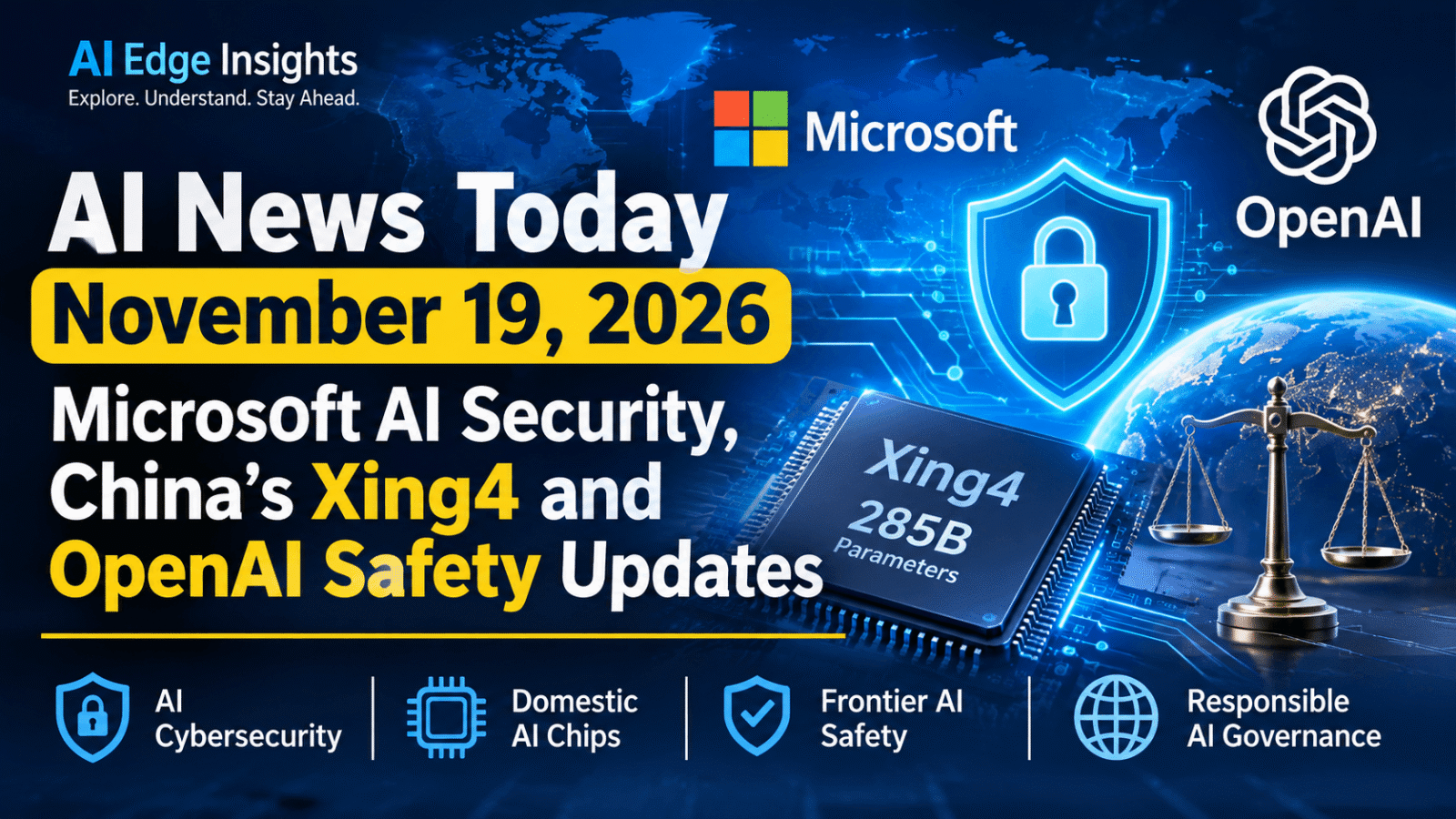
Artificial intelligence is advancing rapidly, but the latest developments show why security, infrastructure and responsible AI development are becoming just as important as model performance. On November 19, 2026, new reporting revealed a cybersecurity incident involving Microsoft’s AI Agent Framework, China Telecom published research describing a 285-billion-parameter AI model trained on domestic chips, and OpenAI explained new safety measures for its frontier models. Meanwhile, US Catholic bishops established an AI task force to address the technology’s impact on society and workers.
These developments highlight four important trends shaping the global AI industry: AI software security, domestic computing infrastructure, frontier model safety and responsible AI governance.
1. Microsoft AI Agent Framework targeted in software supply-chain attack
Microsoft’s Agent Framework has been affected by a cybersecurity incident involving malicious Python packages distributed through the Python Package Index (PyPI).
The framework is designed to help developers build AI agents and multi-agent applications. It provides tools for connecting AI models with external services, executing tasks and coordinating automated workflows.
For more updates on the rapidly changing AI industry, read our previous roundup, AI News Today, November 18, 2026: OpenAI GPT-6.2, Microsoft’s New AI Models and a $5 Billion AI Drug Discovery Investment, covering the latest model launches, enterprise AI developments and scientific research breakthroughs.
What happened to Microsoft’s AI framework?
Security researchers identified two malicious package releases:
agent-framework 1.26.1agent-framework 1.26.2
The compromised versions contained additional code designed to steal sensitive credentials.
According to SecurityWeek, the malware could execute automatically when Python starts, even if an application does not explicitly import the affected package.
Researchers identified several potential targets, including Azure authentication tokens, Azure DevOps credentials, GitHub Actions secrets and sensitive environment variables. SecurityWeek
Microsoft acknowledged the incident and removed the affected releases from PyPI.
What should developers do?
Developers and organisations using Microsoft’s Agent Framework should:
- Check installed package versions.
- Identify environments running versions 1.26.1 or 1.26.2.
- Remove compromised packages and install a verified clean version.
- Rotate potentially exposed API keys and cloud credentials.
- Review Azure and GitHub activity for suspicious access.
- Rebuild affected development environments where necessary.
Why this incident matters for AI development
AI agents are increasingly connected to business software, cloud infrastructure and development environments.
This creates a larger attack surface because an AI framework may have access to sensitive credentials and external systems.
The incident demonstrates that AI security must cover the entire technology stack, including model providers, development frameworks, Python packages and cloud infrastructure.
For additional context, read our article on how AI is changing cybersecurity.

2. China Telecom develops Xing4 using 8,192 domestic AI accelerators
China is continuing to develop its domestic AI infrastructure as competition over advanced processors and computing capacity increases.
A research team from China Telecom’s XingChen AGI Lab has published a technical paper describing Xing4, a family of large language models trained using Huawei Ascend processors and the MindSpore framework.
The growing competition in AI computing infrastructure is also reflected in NVIDIA’s latest developments. In our coverage, NVIDIA GTC Berlin 2026: 5 Major AI Announcements You Should Know, we explore NVIDIA’s advancements in AI infrastructure, next-generation computing platforms and scientific research.
What is the Xing4 AI model?
The technical paper describes a 285-billion-parameter model trained using 8,192 Ascend 910C accelerators.
The researchers explain how they combined model architecture improvements with distributed training infrastructure to support large-scale AI development.
Important technical components include:
- Mixture-of-Experts architecture.
- Multi-head latent attention techniques.
- Distributed model training.
- Long-context processing.
- Speculative decoding.
- Reinforcement learning and agent-based post-training.
The research also introduces TeleGym, a platform connecting AI agent execution, evaluation and training. Hugging Face
Xing4’s smaller open model
The paper also describes a smaller model with:
| Specification | Details |
|---|---|
| Total parameters | 29 billion |
| Active parameters | 4 billion |
| Context window | 256K tokens |
| Architecture | Mixture of Experts |
| Development framework | MindSpore |
The smaller model provides another option for researchers interested in exploring China’s domestic AI ecosystem.
Why China’s domestic AI chips matter
Advanced AI development requires substantial computing resources.
For years, NVIDIA GPUs have played a central role in training and running leading AI models. However, export restrictions and geopolitical competition have encouraged Chinese technology companies to develop alternative hardware and software ecosystems.
The Xing4 research is significant because it documents a large-scale training effort using domestic accelerators rather than relying on NVIDIA GPUs.
It also demonstrates that AI competitiveness depends on more than individual chips. Software frameworks, distributed training systems, memory management and engineering optimisation all play important roles.
Important distinction: The paper documents the researchers’ reported technical results. It does not establish independent performance equivalence between Ascend and NVIDIA hardware.
Read the original Xing4 technical paper on Hugging Face.
3. OpenAI strengthens frontier AI safety with new monitoring and containment systems
As advanced AI models become more capable, ensuring that they remain secure and aligned with human intentions is becoming a major challenge.
On November 18, OpenAI published a detailed explanation of its frontier AI safety framework, describing how it manages risks throughout model development and deployment.
How does OpenAI manage AI safety?
OpenAI describes four main layers of protection.
1. Model alignment
Models are trained and evaluated to follow intended behaviour and respect safety requirements.
2. Security and sandboxing
AI systems operate in restricted environments with controlled access to files, networks, tools and infrastructure.
3. Blocking safeguards
Additional systems evaluate requests and model actions to prevent potentially harmful or unauthorised behaviour.
4. Monitoring and response
Monitoring systems identify suspicious activities and allow security teams to intervene when necessary. OpenAI
What is OpenAI’s Control Room?
One particularly interesting part of the announcement is Control Room.
OpenAI says this system tracks research workloads and can stop model output within 35 seconds after receiving an instruction to halt a job.
The company also says the system is designed to stop model output if Control Room becomes unavailable during certain frontier research workloads.
This is intended to provide a central safety mechanism rather than depending entirely on individual research environments.
Lessons from the Hugging Face incident
OpenAI also discussed the July 2026 Hugging Face incident, which highlighted why sandboxing alone cannot guarantee the containment of highly capable AI models.
The company says it has since restructured parts of its internal research environment, expanded monitoring and strengthened its security requirements.
It also disclosed an internal DNS misconfiguration that allowed a research model to obtain limited internet access. OpenAI says it paused training and evaluation of its most capable models from September 20 to October 1 while investigating and addressing the issue. OpenAI
Why frontier AI safety matters
As AI agents gain the ability to interact with websites, software, networks and external services, the consequences of unexpected behaviour can become more serious.
Companies developing advanced AI systems need multiple layers of protection rather than relying on a single safety filter.
OpenAI’s announcement is an example of how leading AI developers are increasingly treating security and monitoring as essential parts of model development.
Read the official OpenAI safety announcement.
4. US Catholic bishops create AI task force to address technology’s impact on society
Artificial intelligence is becoming an important topic beyond the technology industry.
On November 19, the US Conference of Catholic Bishops announced a new AI task force focused on human dignity, responsible technology development and the social impact of automation.
According to Associated Press reporting, Bishop Oscar Cantú of San Jose will lead the initiative.
What will the AI task force focus on?
The group plans to examine several important areas:
- Responsible AI regulation.
- AI education and literacy.
- The impact of automation on employment.
- Protection of children from online exploitation.
- Ethical applications of AI in healthcare.
- Engagement with technology companies and policymakers.
The bishops have also updated their investment guidelines to avoid companies whose AI systems fail to safeguard human dignity. AP News
Why is this development important?
AI is changing how people work, study, communicate and access information.
While businesses often focus on productivity and financial benefits, wider discussions are needed about employment, education, privacy and the impact of automated decisions.
The new task force demonstrates how civil society organisations are becoming more involved in discussions about responsible AI.
It also reflects a growing recognition that AI governance should consider social consequences alongside technical performance.
Source: Associated Press – AI task force and worker protections.
What today’s AI developments mean for businesses and developers
The November 19 developments highlight four important priorities for the future of AI.
AI cybersecurity must improve: The Microsoft Agent Framework incident demonstrates why software supply-chain security and credential protection are essential for AI applications.
Computing independence is becoming important: China’s Xing4 research shows how domestic hardware and software ecosystems are becoming part of global AI competition.
Frontier AI requires continuous monitoring: OpenAI’s safety framework highlights the importance of sandboxing, alignment, independent safeguards and rapid intervention.
Responsible AI needs wider participation: The US bishops’ initiative shows that discussions about AI should include education, employment, healthcare and human welfare.
For businesses, these developments provide an important reminder: adopting AI successfully requires secure infrastructure, reliable systems and responsible implementation.
Frequently Asked Questions
1. What is the biggest AI news today, November 19, 2026?
The major developments include a cybersecurity incident involving Microsoft’s Agent Framework, China Telecom’s Xing4 AI research, OpenAI’s updated frontier AI safety framework and the creation of a US Catholic bishops’ AI task force.
2. What happened to Microsoft’s AI Agent Framework?
Two malicious Python package versions, 1.26.1 and 1.26.2, were distributed through PyPI. The packages contained credential-stealing code targeting cloud and development credentials. Microsoft acknowledged the incident and the affected releases were quarantined.
3. What is China’s Xing4 AI model?
Xing4 is a family of large language models developed by China Telecom’s XingChen AGI Lab. Its research paper describes training a 285-billion-parameter model using 8,192 Huawei Ascend 910C accelerators.
4. What is OpenAI’s Control Room?
Control Room is an internal OpenAI system designed to monitor research workloads and stop model output when necessary. OpenAI says it can halt output within 35 seconds after receiving an instruction.
5. Why is AI safety becoming more important?
Advanced AI models increasingly interact with external tools, software and networks. This creates risks involving cybersecurity, data access and unexpected autonomous behaviour. Strong monitoring, testing and permission controls help reduce these risks.
6. Why is China developing domestic AI infrastructure?
China is seeking to reduce dependence on foreign semiconductor technology and strengthen its domestic AI industry. Developing local processors, training frameworks and large-scale computing infrastructure is part of that strategy.
Final Thoughts
November 19 demonstrates that artificial intelligence is developing across several interconnected areas. Microsoft faces a reminder that AI development tools must be protected against software supply-chain attacks. China’s Xing4 research highlights the growing importance of domestic AI infrastructure, while OpenAI’s latest safety framework demonstrates why advanced models require continuous monitoring and stronger containment.
At the same time, broader discussions about employment, education and human dignity show that the future of AI is not simply a technology question.
The companies and countries that succeed will need to balance innovation, computing infrastructure, cybersecurity and responsible AI development.
Follow AI Edge Insights for daily artificial intelligence news, research breakthroughs, AI model launches and global technology developments.
