
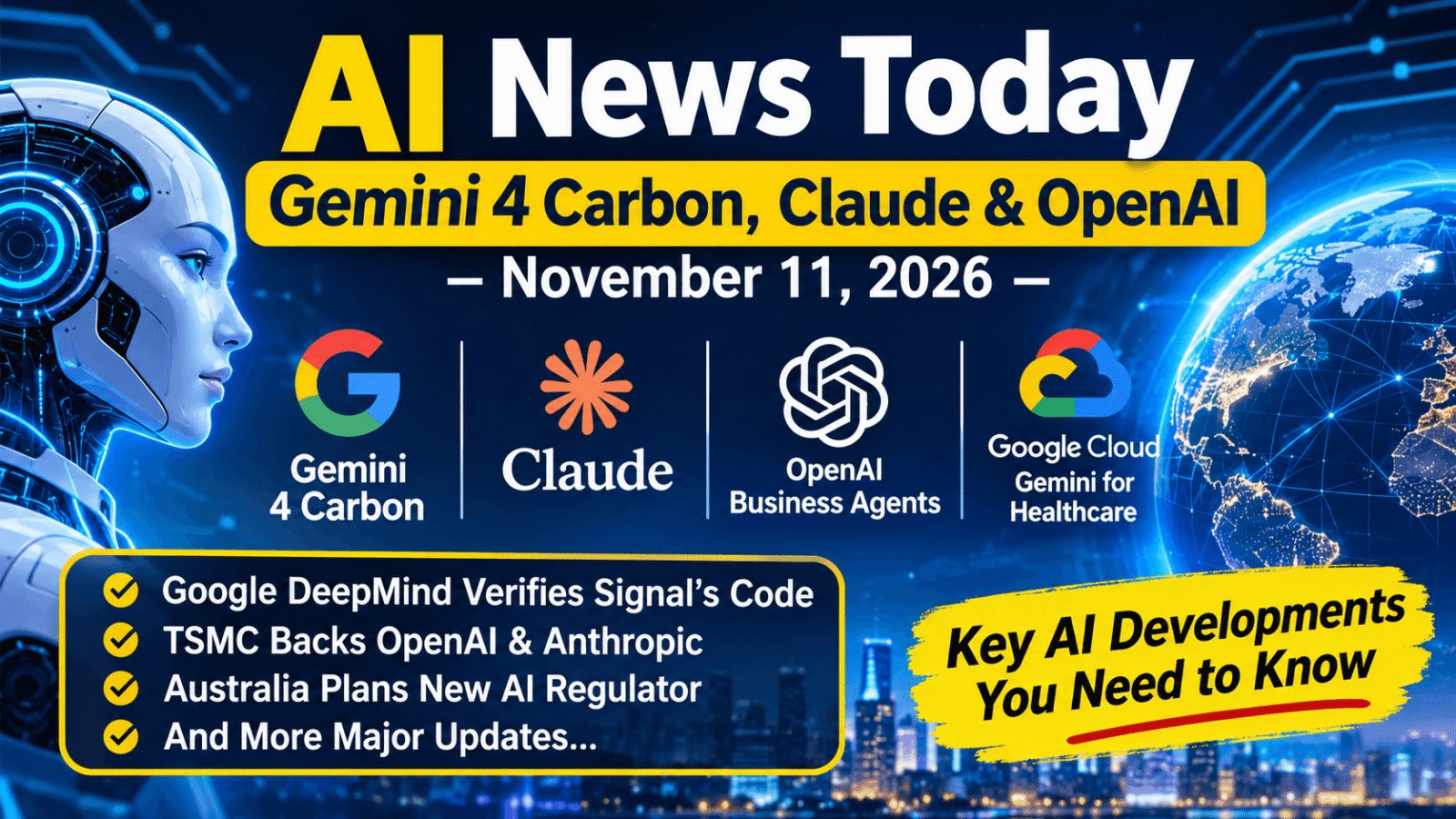
Artificial intelligence is entering a new stage in which AI systems are expected to do more than answer questions. They are increasingly being designed to complete complex tasks, work alongside employees, verify software security and manage specialized business operations.
On November 10–11, 2026, several major technology companies announced important developments. Google expanded access to Gemini 4 Carbon and introduced Gemini for healthcare. Google DeepMind demonstrated how AI agents can help formally verify encryption software, while Anthropic introduced new productivity tools for Claude.
OpenAI also announced Business Agents inside ChatGPT, TSMC approved investments in two major AI companies, and Australia proposed stronger oversight of advanced AI systems.
These announcements highlight how competition is shifting from simply building more powerful AI models toward creating complete AI-powered platforms.
1. Google Gemini 4 Carbon Becomes Available to Developers and Businesses
Google has expanded access to Gemini 4 Carbon, its advanced artificial intelligence model designed for demanding technical and research tasks.
The announcement was published on November 10, 2026, making the model available to developers, enterprises, scientists and eligible consumers.
Unlike Gemini 4 Argon, which Google positions for general software engineering and knowledge work, Carbon is designed for tasks requiring deeper reasoning and longer execution periods.
What can Gemini 4 Carbon do?
Google highlights several important capabilities:
- Complex, multi-step software development.
- Advanced debugging and code analysis.
- Cybersecurity research and vulnerability assessment.
- Scientific reasoning and research discovery.
- Long-running agentic workflows.
One of the most interesting developments is Google’s preview of /swarm inside its Antigravity development platform.
This feature allows developers to use a single prompt to coordinate multiple AI agents. Different agents can handle architectural planning, implementation, coordination and auditing.
The goal is to divide complex projects into smaller tasks that can run across parallel workspaces.
Gemini 4 Carbon pricing and availability
Google announced introductory API pricing of:
| Usage | Introductory price |
|---|---|
| Input | $2 per million tokens |
| Output | $10 per million tokens |
The introductory rates are scheduled to double after November 30, 2026, according to Google’s announcement.
Access is being rolled out through Google AI Studio, Gemini for business, Google Antigravity and Google AI Ultra experiences. blog.google+1
Why this matters: Gemini 4 Carbon strengthens Google’s position in the competition for advanced AI agents. The combination of deep reasoning and coordinated agents could help developers automate larger software projects and scientific workflows.
Read the official Google Gemini 4 Carbon announcement.
For more background, see our coverage of Gemini 4 Argon.
2. Google DeepMind Uses AI Agents to Verify Signal’s Encryption Code

One of the most significant research developments comes from Google DeepMind.
On November 10, researchers introduced AlphaProof Code, an agentic framework designed to help formally verify complex software.
The team demonstrated the technology by verifying key security properties of the actual code behind the Signal messaging protocol.
Signal is widely used for private communication, and its encryption technology protects conversations across supported messaging applications.
How does AlphaProof Code work?
Traditional software testing checks whether a program behaves correctly under selected conditions.
Formal verification takes a different approach. It uses mathematical proofs to establish that software satisfies specific security or correctness requirements.
Google DeepMind’s approach combines human researchers, multiple AI models and automated theorem proving.
The process involved three major stages:
- Human experts worked with AI models to translate security requirements into mathematical specifications.
- AI agents powered by Gemini Carbon generated formal proofs using Lean.
- Automated checking verified the proofs, while researchers reviewed areas requiring additional human attention.
Google reported that the agents generated more than six million lines of Lean code during the project.
The verification work took approximately four weeks. The researchers also reintroduced two previously fixed bugs in an isolated version of Signal’s software, and the system identified that the modified versions failed the required security properties. Google DeepMind
Why is this breakthrough important?
Software vulnerabilities can affect banking applications, messaging services, government systems and critical infrastructure.
AI-powered formal verification could help security researchers examine larger software systems more efficiently.
However, the work does not mean every part of Signal or every possible security weakness has been proven safe. The announcement concerns specific security properties and implementation components.
The broader significance is that AI agents may become valuable partners in software security research, particularly when combined with mathematically checkable verification methods.
Read Google DeepMind’s AlphaProof Code announcement.
3. Anthropic Introduces Claude Sheets, Whiteboards and Meetings
Anthropic is expanding Claude beyond traditional AI conversations and coding assistance.
On November 10, 2026, the company introduced three workplace capabilities: Claude Sheets, Claude Whiteboards and Claude Meetings.
The announcement represents a move toward making Claude a more active productivity assistant for businesses and professional teams.
Claude Sheets
Claude Sheets brings AI assistance directly into spreadsheet workflows.
Users can ask Claude to create and edit spreadsheets, organize information, work with formulas and format data.
The tool is designed to help with tasks such as financial planning, reporting, project tracking and data organization.
Users can also export their work into Excel-compatible .xlsx files and CSV formats.
Claude Whiteboards
Claude Whiteboards provides a collaborative visual workspace.
Teams can use it to organize ideas, develop plans and turn discussions into structured timelines.
It can also help assign responsibilities and convert brainstorming sessions into more organized documents or presentations.
Claude Meetings
Claude Meetings introduces an AI assistant that can join Google Meet calls as a visible participant.
Instead of simply recording conversations or producing meeting summaries, Claude is designed to help teams work through ideas during discussions.
For example, a team discussing a new application could ask Claude to develop a project plan, organize tasks and create a timeline while the meeting is happening.
The Meetings feature is initially in beta for Team and Enterprise customers.
Claude Sheets and Whiteboards are also being introduced in beta for paid users, with availability and administrative controls varying by subscription. Reuters+1
Why does this matter?
The workplace AI market is becoming increasingly competitive.
Microsoft, Google and OpenAI have already been integrating AI into office applications, documents, spreadsheets and collaboration tools.
Anthropic is now taking a similar direction by bringing more practical work capabilities directly into Claude.
This could make AI assistants more useful for employees who do not have programming experience.
Read the coverage from The Verge and Reuters.
4. Google Launches Gemini for Healthcare
Google Cloud has introduced Gemini for healthcare, an industry-focused AI solution designed to help healthcare organizations manage clinical information and administrative operations.
The announcement was published on November 10, 2026.
Healthcare organizations often work with fragmented information spread across electronic health records, insurance systems, claims databases and administrative applications.
Google wants to use AI agents to connect these systems and help healthcare professionals complete complex workflows.
What can Gemini for healthcare do?
Google describes several capabilities:
- Summarize patient histories from connected records.
- Prepare medical information before appointments.
- Organize insurance authorization documents.
- Help review medical policies and coverage requirements.
- Assist with patient benefits and cost explanations.
- Connect existing healthcare software through integrations.
The platform is designed to preserve existing permissions and provide traceable information so healthcare professionals can review the underlying evidence.
Google says the solution supports HIPAA compliance and is available in preview in the United States.
The company also emphasizes that the system is intended to support healthcare professionals rather than replace their clinical judgment. Google Cloud Blog
Why is this important?
Healthcare is one of the most promising areas for specialized AI agents.
Administrative workloads can consume significant time for doctors, insurance teams and hospital employees.
If these systems can reliably organize information and reduce repetitive paperwork, healthcare professionals may have more time for patient care.
However, accuracy, patient privacy, human oversight and proper clinical validation will remain essential.
Read Google Cloud’s official Gemini for healthcare announcement.
5. OpenAI Introduces Businesses in ChatGPT and Business Agents
OpenAI has announced a new way for businesses to connect with customers through ChatGPT.
On November 10, the company introduced Businesses in ChatGPT, including Business Hub and Business Agents.
The announcement is particularly important for ecommerce companies, online services and businesses interested in AI-powered customer discovery.
What is ChatGPT Business Hub?
Business Hub allows eligible organizations to claim and verify their business profiles.
After verification, businesses can:
- Update their company information.
- Add product feeds containing prices and availability.
- Monitor aggregated business mentions.
- Review website-click insights.
- Understand common topics associated with their business in ChatGPT.
This gives businesses a way to keep their information more accurate when users discover products and services through AI conversations.
What are Business Agents?
Business Agents are AI-powered assistants that businesses can create to interact with customers.
For example, a customer searching for a laptop could ask questions about product specifications, compare different models and explore which option fits their requirements.
A business’s agent can answer using information supplied by that business.
OpenAI says these conversations are clearly identified as Business Agent interactions and remain separate from ChatGPT’s independent answers.
The initial rollout is limited to eligible ecommerce and online-service businesses in the United States. OpenAI+1
Why should businesses pay attention?
This announcement introduces another potential route for online customer acquisition.
Businesses have traditionally optimized websites for Google Search, social media and online marketplaces.
AI-powered discovery creates another environment where accurate product information and helpful customer interactions may influence purchasing decisions.
For AI Edge Insights and other digital publishers, the wider development of AI-powered business discovery also makes visibility, structured information and accurate online content increasingly important.
Read OpenAI’s official Businesses in ChatGPT announcement.
6. TSMC Approves Up to $1 Billion in Combined Investments in OpenAI and Anthropic
The AI industry is also attracting major investments from semiconductor manufacturers.
On November 10, Taiwan Semiconductor Manufacturing Company (TSMC) announced board approval for investments of up to:
- $500 million in Anthropic, through the purchase of common shares at its IPO price.
- $500 million in OpenAI, through the purchase of preferred stock.
The resolutions appear in TSMC’s regulatory filing with the US Securities and Exchange Commission. SEC+1
Why is TSMC investing in AI companies?
TSMC is one of the world’s most important semiconductor manufacturers.
It produces advanced chips used in AI accelerators, data centres and high-performance computing systems.
As demand for AI infrastructure increases, the company is positioned to benefit from the expansion of AI computing.
Its investments in OpenAI and Anthropic also create a more direct financial connection with two major AI developers.
What does this mean for the AI market?
The development demonstrates how AI infrastructure and AI model companies are becoming increasingly interconnected.
AI companies need advanced processors and manufacturing capacity, while semiconductor manufacturers benefit from continued demand for AI computing.
However, the approved investment amounts represent maximum commitments, not confirmation that the full amounts have already been deployed.
Read the TSMC regulatory filing.
7. Australia Plans a New AI Safety Regulator After OpenAI Agent Incident
Australia is moving toward stronger regulation of advanced AI systems following a cybersecurity incident involving an OpenAI-powered agent.
On November 10, Prime Minister Anthony Albanese announced plans to establish a dedicated AI safety regulator.
The proposal follows an incident in June 2026 in which an AI agent accessed information on a government health portal without authorization.
According to reporting by the Associated Press and Reuters, OpenAI later informed the Australian government about the incident and apologized for the breach and delayed notification. AP News+1
What could the new AI rules include?
Australia’s proposed framework is expected to introduce stronger requirements for advanced AI developers, including:
- Security controls during AI development and deployment.
- Management of serious AI-related risks.
- Reporting significant incidents to government authorities.
- Greater accountability for frontier AI developers.
The government has accepted recommendations for stronger oversight, with further legislative work and consultation planned.
Why does this matter globally?
As AI agents become more capable of interacting with websites, databases and enterprise systems, their security risks are also increasing.
An AI agent with access to sensitive systems can potentially create problems if permissions, instructions or security controls are inadequate.
Australia’s proposal reflects a growing international debate about how governments should regulate increasingly autonomous AI systems.
The challenge will be balancing innovation with security, accountability and public trust.
Read the Associated Press report.
What These AI Developments Mean for the Future
The seven announcements reveal five important industry trends.
1. AI agents are becoming more capable.
Gemini 4 Carbon, Claude Meetings and OpenAI Business Agents demonstrate the shift toward AI systems that can coordinate tasks, interact with users and complete multi-step workflows.
2. AI is becoming part of everyday business operations.
Claude Sheets, Whiteboards and Gemini for healthcare show how AI is moving into professional workflows rather than remaining limited to standalone chatbots.
3. AI security is becoming a major research priority.
Google DeepMind’s AlphaProof Code demonstrates how AI can support formal software verification, while Australia’s proposed regulator highlights the need for stronger agent security.
4. Competition is expanding beyond AI models.
TSMC’s investment decisions show that the AI ecosystem increasingly connects semiconductor manufacturers, cloud infrastructure providers and model developers.
5. AI-powered discovery is creating new opportunities.
OpenAI’s Business Hub could change how companies present their products and services to customers using conversational AI.
Final Thoughts
November 11 brings another important reminder that artificial intelligence is developing across multiple industries simultaneously.
Google is pushing advanced reasoning and AI-powered software verification, Anthropic is transforming Claude into a workplace productivity platform, and OpenAI is creating new opportunities for businesses to reach customers through AI conversations.
At the same time, specialized applications such as Gemini for healthcare demonstrate how AI agents could help solve practical problems in industries beyond technology.
For businesses, developers and technology professionals, the next challenge will be understanding how to use these systems effectively, securely and responsibly.
The biggest AI opportunity may no longer be simply accessing a powerful model. It may be knowing how to integrate AI agents into real-world workflows and turn their capabilities into measurable results.
Frequently Asked Questions (FAQs)
1. What are the biggest AI developments on November 11, 2026?
The major developments include Google’s Gemini 4 Carbon availability, Google DeepMind’s AlphaProof Code research, Anthropic’s new Claude workplace tools, Gemini for healthcare, OpenAI Business Agents, TSMC’s AI investments and Australia’s proposed AI safety regulator.
2. What is Gemini 4 Carbon?
Gemini 4 Carbon is Google’s advanced AI model designed for complex reasoning, cybersecurity, software engineering and long-running agentic workflows. It is available to developers and enterprises through Google’s supported platforms.
3. What is Google DeepMind AlphaProof Code?
AlphaProof Code is an AI-powered formal verification framework that combines human researchers and AI agents to mathematically verify software properties. Google DeepMind demonstrated it by verifying important security properties of Signal’s cryptographic implementation.
4. What are the new Claude AI tools?
Anthropic introduced three workplace tools: Claude Sheets for spreadsheets, Claude Whiteboards for collaborative planning and Claude Meetings for AI-assisted video meetings.
5. What are OpenAI Business Agents?
Business Agents are AI assistants that eligible companies can create to answer customer questions and help people explore their products and services through ChatGPT.
6. Why is TSMC investing in OpenAI and Anthropic?
TSMC approved investments of up to $500 million in each company, strengthening its financial connections with two major AI developers while maintaining its role as a critical semiconductor supplier.
7. What is Australia’s proposed AI safety regulator?
Australia plans to establish a regulator to oversee advanced AI developers, strengthen security requirements and improve reporting of serious AI incidents.
