
Artificial intelligence has become one of the most important technologies shaping the global economy, business, national security, and scientific research. In 2026, the United States and China are competing to develop more powerful AI models, advanced computer chips, intelligent systems, and large scale AI infrastructure.
The United States has established a strong position through companies such as OpenAI, Google, Microsoft, Anthropic, NVIDIA, Meta, and xAI. Meanwhile, China is rapidly developing its own AI ecosystem through companies including DeepSeek, Alibaba, Baidu, Huawei, ByteDance, and Moonshot AI.
Both countries have made significant progress, but their approaches are different. American companies are investing heavily in advanced AI models and computing infrastructure, while Chinese companies are focusing on cost-efficient models, open-weight technology, domestic semiconductor development, and widespread AI adoption.
Elon Musk’s xAI and its Grok models have also become important participants in this competition.
So, who is leading the AI race in 2026? The answer depends on how we measure progress. Let’s compare both countries using available research, industry developments, and verified information.
1. USA vs China in AI: An Overview
The United States and China are competing across several important areas of artificial intelligence, including computing power, AI models, semiconductor manufacturing, research, investment, and commercial adoption.
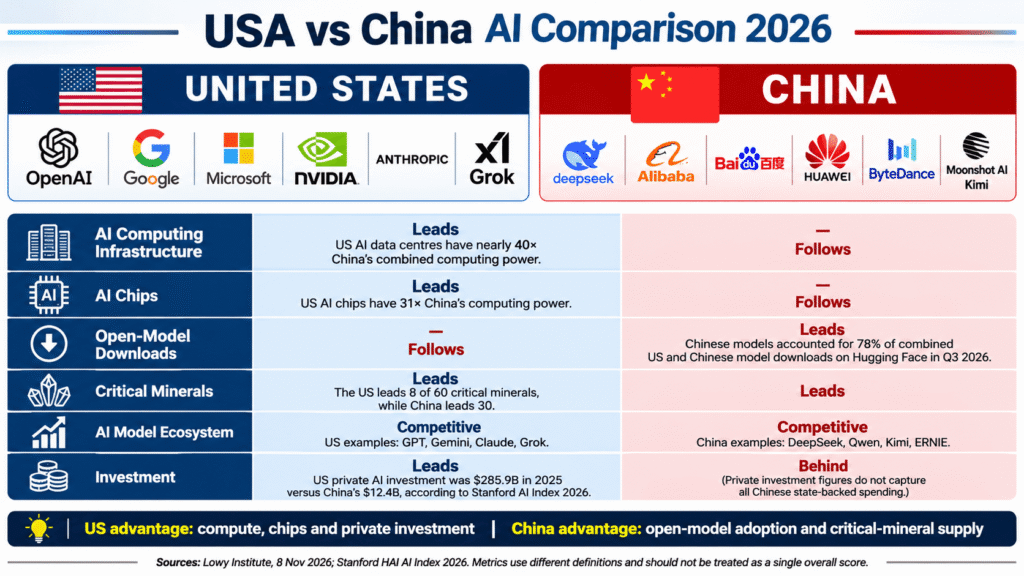
According to an analysis published by the Lowy Institute on November 8, 2026, the United States currently holds an overall advantage in AI capabilities, particularly in computing infrastructure and frontier models.
However, China has important advantages in critical mineral production and the development of popular open AI models.
The research also highlights that the gap between the two countries is not the same across every category.
USA vs China AI Comparison 2026
| AI Category | United States | China |
|---|---|---|
| Leading AI Companies | OpenAI, Google, xAI, Anthropic, Meta | DeepSeek, Alibaba, Baidu, Huawei, ByteDance |
| Advanced AI Models | GPT, Gemini, Claude, Grok | DeepSeek, Qwen, Kimi, GLM |
| AI Chips | NVIDIA, AMD | Huawei and domestic chip developers |
| AI Infrastructure | Large-scale data centers and GPU clusters | Expanding domestic computing infrastructure |
| Open AI Models | Several open-weight initiatives | Strong open-weight ecosystem |
| AI Investment | Major private-sector investment | Significant government and private investment |
| Critical Minerals | Relies on international supply chains | Strong production position |
| AI Research | Strong frontier-model research | Strong research and patent activity |
Important: Neither country leads every category. Their advantages depend on the technology and measurement being considered.
Source: Lowy Institute – China, the United States, and the Race for AI Dominance.
2. United States: Leading in Advanced AI Models and Computing Power
The United States has built a powerful AI ecosystem supported by technology companies, research institutions, venture capital, semiconductor companies, and cloud infrastructure providers.
Some of the most influential American AI companies include:
- OpenAI: Developer of the GPT family of AI models.
- Gemini Google: Develops Gemini and invests in AI research and computing infrastructure.
- Anthropic: Developer of Claude AI, focusing on advanced reasoning, coding, and AI safety.
- NVIDIA: Supplies advanced GPUs and computing platforms used to train and operate AI models.
- Meta: Develops Llama and other AI technologies.
- Microsoft: Provides cloud infrastructure and AI services through Azure.
- xAI: Founded by Elon Musk, developing Grok and large-scale AI computing infrastructure.
America’s Advantage in AI Infrastructure
One of the biggest advantages of the United States is its computing infrastructure.
Advanced AI models require enormous computing resources, including GPUs, memory, electricity, networking equipment, and data centers.
NVIDIA remains a major supplier of AI accelerators, while Microsoft, Google, Amazon, and other technology companies are investing billions of dollars in infrastructure.
According to the November 2026 Lowy Institute analysis, US AI data centers have nearly 40 times China’s combined computing power, while US AI chips have approximately 31 times the computing power measured in its comparison.
These figures highlight the current infrastructure advantage, although they do not mean that every American AI model is automatically better than every Chinese model.
For more information about NVIDIA’s latest developments, read our coverage:
NVIDIA GTC Berlin 2026: 5 Major AI Announcements You Should Know.
3. China: Building Powerful and Cost-Efficient AI Technology
China has become one of the most important competitors in the global AI industry.
Instead of depending entirely on foreign technology, Chinese companies are developing domestic AI models, semiconductor technologies, cloud infrastructure, and AI-powered applications.
Some major Chinese AI developers include:
- DeepSeek: Known for developing competitive AI models with a focus on efficiency and accessibility.
- Alibaba: Develops the Qwen AI model family and enterprise AI solutions.
- Baidu: Develops ERNIE and AI-powered services.
- Huawei: Invests in domestic AI chips and computing infrastructure.
- ByteDance: Develops AI products, recommendation systems, and video-generation technologies.
- Moonshot AI: Develops the Kimi family of AI models.
DeepSeek and China’s Growing AI Capabilities
DeepSeek became an important example of China’s ability to compete in advanced AI development.
Its earlier models attracted international attention by demonstrating that competitive AI systems could be developed with a strong focus on computing efficiency and lower operating costs.
In 2026, China’s AI industry has continued expanding beyond DeepSeek.
Companies such as Alibaba, Moonshot AI, and Z.ai have introduced new models and technologies targeting different AI applications.
China’s strategy also includes developing domestic alternatives to advanced semiconductor technology.
Huawei is an important part of this effort, particularly through its Ascend AI computing products.
However, China still faces challenges in accessing and manufacturing some of the world’s most advanced semiconductor technologies.
Read more: Reuters – DeepSeek and Huawei’s AI chip collaboration.

4. Elon Musk and xAI: America’s Important AI Competitor
Elon Musk is an important figure in the global artificial intelligence industry.
Through xAI, Musk is competing in the development of advanced AI models, computing infrastructure, and intelligent applications.
The company’s flagship AI product is Grok, which is integrated into the X ecosystem and offered through its AI services.
What Is xAI Building?
xAI is investing in several areas:
- Advanced Grok AI models.
- Large-scale AI training infrastructure.
- AI reasoning and agent capabilities.
- AI-powered applications.
- High-performance computing systems.
One of its most important infrastructure projects is Colossus, a large AI supercomputer facility in Memphis, Tennessee.
According to xAI’s published infrastructure information, Colossus was initially built around NVIDIA GPU technology, with the company reporting an expansion to 200,000 H100 GPUs.
In January 2026, xAI also announced a $20 billion Series E funding round, with participation from several major investors, including NVIDIA and Cisco Investments.
These developments demonstrate how private companies and entrepreneurs are contributing to America’s AI infrastructure.
Why Does Elon Musk Matter in the USA vs China AI Competition?
Musk’s involvement adds another important competitor to the American AI industry.
While OpenAI, Google, and Anthropic are developing their own AI ecosystems, xAI is building an alternative through Grok and large-scale computing resources.
His investments also demonstrate the importance of computing power, access to hardware, and infrastructure in developing advanced AI systems.
For more developments, read our article:
Top 5 Grok AI News in October 2026: Major Updates You Should Know.
5. AI Chips: NVIDIA vs Huawei and China’s Semiconductor Industry
Semiconductors are among the most important components of modern artificial intelligence.
AI chips process the enormous amounts of information required to train and operate advanced models.
The United States has an important advantage through NVIDIA and its broader semiconductor ecosystem.
NVIDIA GPUs are widely used by AI research laboratories, cloud providers, and technology companies.
China, meanwhile, is investing in domestic alternatives, including Huawei’s Ascend processors.
US export controls have restricted China’s access to certain advanced semiconductor technologies and manufacturing equipment.
These restrictions have encouraged Chinese companies to explore domestic chip production and alternative computing architectures.
In October 2026, China also proposed adding 23 AI-related technologies to its export-control framework as part of a broader proposal covering 40 technologies.
This demonstrates that technology restrictions are not limited to one country.
External sources:
6. AI Investment and Government Strategies
Both countries recognize artificial intelligence as a strategically important technology.
The United States has outlined its AI development priorities through its national AI Action Plan.
The plan focuses on three major areas:
- Accelerating AI innovation.
- Building American AI infrastructure.
- Expanding international AI partnerships and security.
American technology companies are also making substantial private investments in AI data centers, cloud platforms, and semiconductor infrastructure.
China is following a different but equally important strategy.
Its approach includes developing domestic technology, increasing AI adoption across industries, supporting local semiconductor production, and strengthening its position in global AI markets.
Both governments are also concerned about national security, technology independence, and the economic implications of AI.
External reading: America’s AI Action Plan.
7. Critical Minerals: China’s Important Advantage
AI development does not depend only on software and computer chips.
It also requires physical resources, including copper, lithium, rare earth elements, gallium, and other critical minerals.
China has a significant position in the production and processing of several materials required by modern technology supply chains.
The November 2026 Lowy Institute analysis found that China leads production of 30 out of 60 minerals identified by the United States as critical to its economic and national security interests. The United States leads in eight.
This creates an important difference between the two countries.
While the United States has a major advantage in advanced computing infrastructure, China has significant influence over important parts of the materials supply chain.
This means that both countries have strategic advantages that the other cannot easily replace.
8. What Does the USA vs China AI Competition Mean for the World?
The competition between these two countries will affect businesses, governments, developers, researchers, and everyday AI users.
Several important developments are worth watching.
More affordable AI tools: Competition between American and Chinese developers could make advanced AI services more affordable.
Faster technological development: Rivalry encourages companies to improve model performance, computing efficiency, and AI applications.
Global technology supply chains: Semiconductor restrictions and mineral supply challenges could affect technology manufacturing worldwide.
AI regulations and security: Both countries will influence international discussions about AI safety, privacy, cybersecurity, and responsible development.
Opportunities for other countries: Countries outside the United States and China can benefit by developing their own AI infrastructure, research capabilities, and technology partnerships.
For additional industry developments, explore:
9. Who Is Winning the AI Race in 2026?
There is no single answer because the competition includes several different areas.
Based on the latest available comparative research, the United States currently has an overall advantage in frontier AI capabilities, computing infrastructure, and the international adoption of its leading AI services.
China, however, has developed a competitive AI ecosystem with strong open-weight models, cost-efficient technology, domestic semiconductor initiatives, and critical mineral advantages.
Elon Musk’s xAI, alongside companies such as OpenAI, Google, Anthropic, and NVIDIA, continues to strengthen America’s private-sector AI ecosystem.
Meanwhile, DeepSeek, Alibaba, Huawei, and other Chinese developers are expanding China’s technological capabilities.
The future outcome will depend on more than the performance of individual AI models. Semiconductor manufacturing, energy availability, research, investment, commercial adoption, and international cooperation will all play important roles.
The most accurate conclusion is that the United States currently leads in several key measures of advanced AI capability, while China remains a powerful competitor with distinct strengths. The competition is ongoing, and neither country has an uncontested advantage across the entire AI industry.
Frequently Asked Questions (FAQs)
1. Is the USA ahead of China in AI in 2026?
The United States currently leads in several important areas, including advanced AI computing infrastructure and frontier model capabilities. However, China is competitive in open-weight AI models, cost efficiency, and critical mineral production.
2. Which country has better AI models, USA or China?
American companies currently have an overall advantage in leading frontier models. Chinese companies such as DeepSeek, Alibaba, and Moonshot AI are also developing competitive models, particularly in efficiency and open-weight technology.
3. What is Elon Musk’s role in the AI race?
Elon Musk leads xAI, the company behind Grok. Its investments in AI models and large-scale computing infrastructure make it an important competitor in the American AI industry.
4. Is DeepSeek better than ChatGPT?
It depends on the task, model version, pricing, reasoning performance, and other requirements. Both platforms have different strengths, and their performance should be evaluated using current independent benchmarks.
5. Why is NVIDIA important in the AI competition?
NVIDIA develops GPUs and software platforms widely used to train and operate advanced AI systems. Its computing technology is an important part of the American AI infrastructure advantage.
6. Can China overtake the USA in AI?
China could potentially close the remaining gaps through improvements in domestic semiconductor manufacturing, research, computing infrastructure, and AI adoption. However, predicting which country will lead in the future is uncertain.
7. How will the USA vs China AI competition affect businesses?
Businesses could benefit from more affordable AI services, improved automation, better AI applications, and increased competition among technology providers. However, supply-chain restrictions and differences in technology regulations may create additional challenges.
Final Thoughts
The USA vs China AI competition is not simply a contest between two countries. It is a broader competition involving technology companies, semiconductor manufacturers, researchers, governments, and international markets.
The United States has established a strong position in advanced AI models and computing infrastructure. China has demonstrated its ability to develop competitive AI systems, strengthen domestic technology production, and expand AI adoption.
With Elon Musk’s xAI, OpenAI, Google, DeepSeek, Alibaba, and other major companies investing in the future, the global AI industry is likely to experience further changes.
For businesses and AI users, the most important outcome may not be which country wins, but how this competition makes artificial intelligence more accessible, efficient, reliable, and useful worldwide.
