
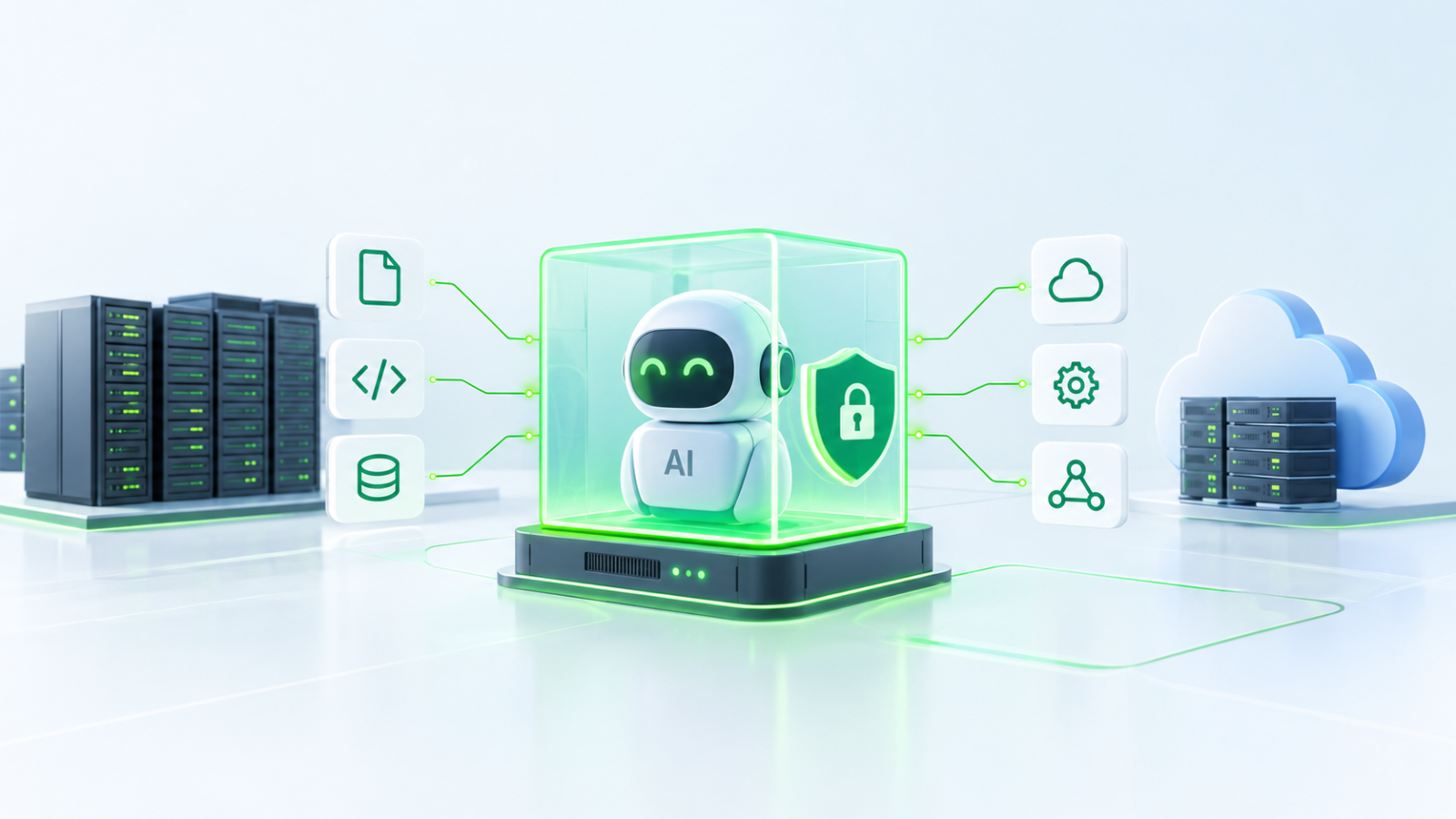
AI agents are becoming more powerful, but giving AI systems the ability to access files, run code, and interact with business applications also creates new security risks. NVIDIA OpenShell aims to address this challenge by providing a secure environment with controls over what AI agents can access and do.
On October 21, 2026, NVIDIA announced its OpenShell Reference Architecture at GTC Berlin. The architecture builds on NVIDIA OpenShell, an open-source runtime designed to establish security boundaries around autonomous AI agents. It combines software controls with NVIDIA computing infrastructure and a separate security framework to help organizations monitor and control agent activity.
For businesses exploring AI automation, the announcement highlights an important development: AI security is no longer just about the model. It is also about controlling the actions the model can take.
In this article, we explain what NVIDIA OpenShell is, how it works, its key features, and why it matters for AI agent security.
What Is NVIDIA OpenShell?
NVIDIA OpenShell is an open-source runtime designed to help organizations run AI agents within controlled security boundaries.
A runtime is the software environment in which an application or AI agent operates. OpenShell helps define which resources an agent can access, which actions it can perform, and how its interactions with external services are controlled.
For example, a coding agent may need to read project files and run tests. However, it should not automatically have unrestricted access to a developer’s personal files, company databases, or other sensitive systems.
OpenShell helps enforce these boundaries through sandboxed execution and policy-based controls.
According to NVIDIA’s official announcement, the OpenShell Reference Architecture expands this approach into a broader infrastructure design for building, containing, observing, and enforcing safe AI agents across enterprise and edge environments.
You can also explore our coverage of NVIDIA GTC Berlin 2026 and its five major AI announcements for more context about NVIDIA’s latest developments.
Why Is AI Agent Safety Becoming Important?
Traditional chatbots mainly respond to questions. AI agents can also use tools, execute tasks, access files, and interact with external applications.
These abilities can help automate software development, customer support, research, and business operations. However, they also introduce additional security risks.
1. Unauthorized access to sensitive data
An AI agent with excessive permissions may access confidential files or customer information that it does not need to complete its task.
2. Unexpected actions
An agent can misunderstand instructions or take an action that a user did not intend. In an automated workflow, a small mistake can affect files, applications, or business records.
3. Prompt injection attacks
Malicious instructions hidden inside webpages, documents, or emails may influence an agent’s behavior. Depending on its permissions, the agent might attempt to access restricted information or perform unauthorized actions.
4. Credential exposure
AI agents often connect to APIs, databases, and business applications. If passwords or API keys are exposed to an agent, an attacker may be able to misuse those credentials.
5. Limited visibility into agent activity
When agents perform multiple tasks automatically, security teams need to understand which actions they attempted, what resources they accessed, and whether their actions followed established policies.
These risks make independent security controls important. An organization should not rely entirely on an AI model to decide whether its own actions are safe.
How Does NVIDIA OpenShell Work?
OpenShell establishes controls around an AI agent’s execution environment. Rather than relying only on instructions in a prompt, it provides mechanisms to restrict access and enforce defined security policies.
NVIDIA’s developer blog on OpenShell runtime controls explains the approach in greater technical detail.
1. Sandboxed execution
A sandbox is an isolated environment where an AI agent can perform its assigned tasks under defined restrictions.
For example, a coding agent could be allowed to access a specific project directory while being prevented from accessing unrelated files.
Sandboxing can limit the impact of mistakes or unauthorized behavior, although its effectiveness depends on the implementation and configuration.
2. Policy based access controls
OpenShell allows developers and organizations to define rules governing an agent’s access to resources and services.
A business might allow an agent to read approved documents but prevent it from modifying financial records or accessing unrelated customer data.
This follows the principle of least privilege: give each agent only the permissions necessary to complete its assigned work.
3. Credential protection
Agents may need access to external services to complete tasks. OpenShell’s approach includes protecting credentials and controlling how authorized requests reach those services.
This can reduce the need to expose sensitive credentials directly to the agent. Organizations must still follow good practices for authentication, credential management, and access permissions.
4. Policy verification
Security policies must be carefully designed and checked before deployment.
OpenShell includes mechanisms for evaluating security policies and helping developers understand whether proposed permissions fit their intended restrictions.
This can improve configuration, but it does not guarantee that an entire AI application is free from vulnerabilities.
5. Auditable security decisions
Organizations need visibility into how access policies are applied.
OpenShell is designed to support auditing of security decisions, helping teams review agent activity and investigate unexpected behavior.
This information can be useful when improving security policies or responding to incidents.
NVIDIA OpenShell Reference Architecture: What’s New?
NVIDIA announced the OpenShell Reference Architecture at GTC Berlin on October 21, 2026.
The reference architecture expands beyond the OpenShell runtime by combining software and infrastructure components designed to help enterprises deploy AI agents at scale.
According to NVIDIA’s official announcement, the architecture brings together several components:
- NVIDIA Vera Rubin: Infrastructure for running AI models and enterprise AI workloads.
- NVIDIA Vera CPUs: Processors designed to handle agent operations and tool use.
- NVIDIA OpenShell: Open-source runtime software that establishes a security boundary around agent activity.
- NVIDIA BlueField-4 DPUs: Data processing units used to run NVIDIA Sentry, a security framework designed for monitoring and policy enforcement.
- Edge computing systems: NVIDIA RTX Spark, DGX Spark, and DGX Station extend the architecture’s intended reach to edge environments.
The aim is to give organizations a way to run AI agents while maintaining visibility and control over their behavior.
The announcement also identifies a broad group of industry participants working with the reference architecture, including companies across cloud computing, cybersecurity, enterprise software, and AI development.
It is important to distinguish between the OpenShell runtime and the wider reference architecture. The runtime provides software-level controls, while the reference architecture combines multiple hardware and software components into a broader deployment design.
NVIDIA OpenShell Key Features
| Feature | Purpose | Business benefit |
|---|---|---|
| Sandboxed execution | Isolates agent workloads | Limits unnecessary access |
| Access policies | Defines permitted actions | Reduces excessive permissions |
| Credential protection | Controls access to sensitive credentials | Helps protect connected services |
| Policy verification | Evaluates security rules | Supports safer configuration |
| Auditability | Helps review security decisions | Improves visibility |
| Reference architecture | Combines security software and infrastructure | Supports enterprise deployment planning |
These capabilities can form part of a broader AI security strategy. They do not replace application security, identity management, network protection, or human oversight.

Who Can Benefit From NVIDIA OpenShell?
Developers and AI engineering teams
Developers working with coding agents can use security boundaries to limit access to project files, tools, and execution environments.
Enterprise IT teams
IT teams can evaluate how agent permissions fit existing business systems and security policies.
Cybersecurity professionals
Security teams can benefit from better visibility into agent activity and additional controls around the systems agents can access.
Businesses handling sensitive information
Organizations working with confidential documents, customer information, or proprietary data may find tighter agent permissions particularly useful.
AI infrastructure providers
Companies deploying agents across large computing environments can evaluate the reference architecture as part of their infrastructure and security planning.
Suitability depends on the deployment environment, technical requirements, available integrations, and the organization’s security needs.
Can NVIDIA OpenShell Prevent All AI Agent Attacks?
No. OpenShell is designed to improve control over agent activity, but it cannot guarantee that an AI agent will never make a mistake or behave unexpectedly.
For example, an agent might produce inaccurate information or misuse a legitimate permission. A poorly configured policy might also allow more access than intended.
Organizations should combine runtime controls with additional safeguards:
- Use least-privilege permissions.
- Require human approval for sensitive actions.
- Protect API keys and other credentials.
- Test agents against prompt injection and malicious input.
- Monitor tool calls and security events.
- Review permissions regularly.
- Maintain incident-response procedures.
Consider an AI agent that prepares a financial transaction. It may be useful for the agent to collect information and prepare the transaction, but a separate approval process may still be necessary before money is transferred.
The goal is to reduce risk by combining useful automation with enforceable limits and appropriate human oversight.
NVIDIA OpenShell vs. Traditional AI Security
Traditional AI security includes model testing, application security, authentication, and content filtering. These measures remain important, but autonomous agents create an additional challenge because they can interact with real systems and take actions.
OpenShell focuses on the environment in which an agent operates and the permissions available to it.
For example, a model might be instructed not to access a sensitive file. A separate runtime policy can provide an additional control that restricts access to that file.
This makes OpenShell a potential addition to existing security systems rather than a complete replacement for them.
A strong AI security strategy combines model-level safeguards, application-level checks, infrastructure security, access controls, monitoring, and human review.
How Can Businesses Prepare for Safer AI Agents?
Businesses can begin improving their AI security practices before deploying a new platform.
- Identify required permissions: Determine which files, services, and applications each agent needs.
- Restrict access: Remove unnecessary permissions and isolate agent workloads where possible.
- Protect credentials: Keep passwords and API keys out of prompts and agent-accessible files.
- Test security risks: Evaluate how agents respond to malicious documents, misleading instructions, and unexpected tool results.
- Add approval steps: Require human review for high-impact or irreversible actions.
- Monitor activity: Keep appropriate logs of tool use, access decisions, and security events.
- Review OpenShell: Read the official NVIDIA documentation and examine the NVIDIA OpenShell GitHub repository to assess technical requirements and deployment options.
These steps can help organizations establish a more responsible foundation for AI automation.
Final Thoughts
NVIDIA OpenShell highlights an important development in AI security: as agents gain the ability to interact with real systems, organizations need controls over what those agents can access and do.
The OpenShell runtime provides a foundation for sandboxing and policy-based controls, while NVIDIA’s October 2026 Reference Architecture combines the runtime with computing infrastructure and additional security components for enterprise and edge deployments.
For businesses and developers, the main lesson is clear: building a capable AI agent is only one part of the challenge. Deploying it responsibly requires carefully defined permissions, independent security controls, monitoring, and human oversight.
As AI agents become more common in software development and business operations, secure execution environments are likely to become an increasingly important part of enterprise AI infrastructure.
Frequently Asked Questions
What is NVIDIA OpenShell?
NVIDIA OpenShell is an open-source runtime designed to help secure AI agents by controlling their execution environments, resource access, and interactions with external services.
What is the NVIDIA OpenShell Reference Architecture?
Announced on October 21, 2026, the reference architecture combines NVIDIA computing infrastructure, OpenShell runtime software, and additional security components to help organizations build, observe, and control AI agents.
Is NVIDIA OpenShell open source?
NVIDIA describes OpenShell as open-source software. Developers can review the official GitHub repository for source code, licensing information, releases, and project documentation.
Can OpenShell stop prompt injection attacks?
OpenShell can help limit what an agent is permitted to do if it encounters malicious instructions. However, it does not eliminate prompt injection or guarantee that every attack will be blocked.
Does NVIDIA OpenShell replace cybersecurity tools?
No. It should be considered one layer of a broader security strategy that includes identity management, endpoint and network security, application protection, monitoring, and incident response.
Why is AI agent security important in 2026?
AI agents can perform tasks across files, applications, and external services. Without appropriate permissions and monitoring, mistakes or malicious instructions may lead to unauthorized access or unwanted actions.
Where can developers learn more about NVIDIA OpenShell?
Developers can start with the NVIDIA OpenShell documentation, the official GitHub repository, and NVIDIA’s developer blog.
