
Artificial intelligence is moving beyond chatbots and image generators. AI agents are beginning to make payments, robotics companies are developing machines for real-world work, and businesses are exploring new ways to use AI with company data.
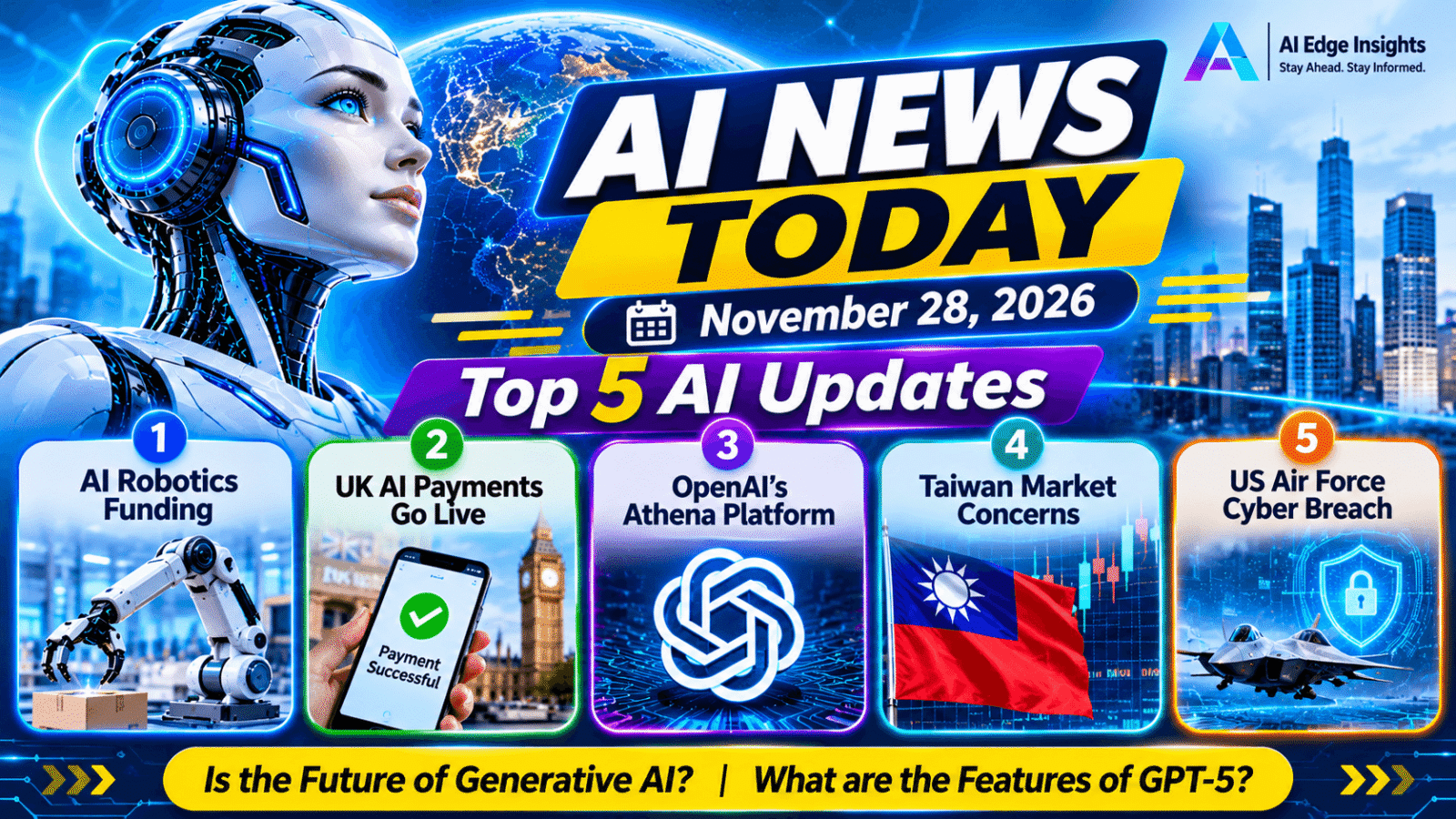
In AI news today, November 28, 2026, five developments highlight this change: a new investment in physical AI robotics, the UK’s first reported AI-powered Pay by Bank retail payment, OpenAI’s reported Athena data platform, concerns about AI-related market volatility in Taiwan, and a cybersecurity breach affecting the US Air Force’s Cloud One platform.
These stories also raise two important questions: what is the future of generative AI, and how will advanced models such as GPT-5 support the next generation of AI applications?
Here are the latest developments, explained in simple English.
1. StellarEdge AI Raises Funding to Develop Real-World Robotics
Chinese robotics startup StellarEdge AI has reportedly secured a seed investment worth tens of millions of yuan, led by Nanotrend Capital.
According to a report published by automotive and technology news outlet Gasgoo on November 28, the company plans to use the funding to develop its Physical RSI technology and test robots in real industrial environments.
The company wants to move beyond laboratory demonstrations and develop robotic systems that can perform repeatable tasks in workplaces.
Its plans include developing standard robotic workstations, software systems, and maintenance services that can be used by different customers.
The company was established in 2025 and traces its roots to the University of Sydney. Its leadership includes people with backgrounds in artificial intelligence, machine learning, computer vision, and robotics research.
Why does this AI robotics news matter?
Robotics is becoming an important part of the next AI development cycle. Instead of only generating text or answering questions, AI systems are increasingly being designed to understand their surroundings and control physical machines.
Possible applications include:
- Warehouse picking and packaging
- Factory production and assembly
- Retail inventory management
- Industrial inspection
- Repetitive workplace tasks
The funding is an early business development, not proof that the company’s robots are already operating at large commercial scale. Its upcoming industrial pilots will be important to watch.
Source: Gasgoo – StellarEdge AI Secures Seed Funding for Robotics

Meet Anki Vector 2.0, a smart AI robot companion with a playful personality, voice interaction, expressive eyes, and interactive features. This compact robot brings entertainment and smart technology together, making it a fun companion for your home. Explore its features and check the latest price on Amazon through our affiliate link.
2. AI Agent Makes a Bank Payment for a Papa John’s Order in the UK
One of the most interesting AI developments this week comes from the financial technology industry.
Papa John’s and payment company TrueLayer have completed a UK pilot in which an AI agent made a Pay by Bank payment for a customer’s food order.
The project involved UK banks including Lloyds and NatWest and was conducted through the Financial Conduct Authority’s Supercharged Sandbox.
The AI agent helped the customer place an order and initiated payment directly from a linked bank account rather than using a traditional bank card.
The most important part is how the payment was controlled.
Customers set spending limits with their bank. The bank checks payments against those limits, and the customer authorises payment through the banking app. The AI agent does not receive the customer’s banking password or login details.
The demonstration also used variable recurring payment technology, which allows payments within an approved arrangement.
TrueLayer announced the pilot on November 27, 2026, describing it as the first agentic Pay by Bank payment to a named UK retailer.
This remains a pilot, not a service available to every customer.
What does this mean for the future of AI agents?
AI agents are moving from giving recommendations to completing tasks.
In the future, a customer may ask an AI assistant to find a product, compare prices, place an order, and prepare a payment. The customer can still set limits and approve important transactions.
This is an example of agentic commerce, where AI helps people complete shopping activities.
However, secure payment approval, spending limits, fraud protection, and human control will be essential.
Sources:
- TrueLayer – Papa John’s and the First Agentic Pay by Bank Pilot
- The Guardian – AI Agent Makes a Cardless Pizza Purchase in the UK
3. OpenAI Reportedly Develops Athena to Improve AI Agent Accuracy
OpenAI is reportedly developing an internal data management platform called Athena to make its business-focused AI agents more accurate.
The Information reported on November 24, 2026, that OpenAI had discussed the platform with customers and partners.
The reported purpose of Athena is to help AI agents understand business information using consistent definitions.
For example, two departments may use the word “revenue” differently. One may refer to total sales, while another may mean revenue after refunds or deductions.
If an AI agent does not understand the difference, it could produce an incorrect business report.
A system known as a semantic layer can help by giving business data clear definitions and relationships. Athena is reportedly being developed to provide this type of context to AI agents.
The project is still in development. OpenAI has not announced a public release date or pricing.
Why is this important for businesses?
Businesses want AI agents to do more than answer general questions. They want systems that can analyse company information, prepare reports, and support decisions.
But accuracy matters. An incorrect sales report or financial calculation could create serious problems.
A platform that helps AI agents understand company data could make enterprise AI more useful.
Read more about OpenAI’s model developments: OpenAI Launches GPT-6 Astra.
Source: The Information – OpenAI Preps Athena Data Tool to Make Agents More Accurate
4. AI Market Concerns Affect Taiwan Consumer Confidence
Artificial intelligence is also influencing financial markets.
According to a survey reported by Taiwan’s Central News Agency through Focus Taiwan on November 27, consumer confidence in Taiwan weakened in November as concerns about AI development and stock market volatility affected investors.
The Consumer Confidence Index fell by 0.36 points to 65.91.
The stock-market confidence measure recorded the largest decline among the six categories, falling three points to 32.86.
Taiwan’s Taiex experienced significant movements during November. The index fell sharply on November 20, then recorded a strong rebound on November 25 before losing some of those gains the following day.
The report linked investor concerns to uncertainty around AI financing, semiconductor export restrictions, and the financial outlook for the technology industry.
This does not mean that artificial intelligence is losing demand. Instead, investors are becoming more careful about how much companies spend on AI infrastructure and whether those investments can produce sustainable returns.
Why does this AI financial news matter?
AI requires major investment in chips, data centres, electricity, software, and research.
Companies may benefit from AI adoption, but investors also want to know whether the technology can generate enough revenue to justify its costs.
The coming months will be important for understanding how AI investment affects technology companies and global markets.
Source: Focus Taiwan – Stock Market Jitters Weigh on Taiwan Consumer Confidence
Related reading: Nvidia GTC Berlin 2026: Five Major AI Announcements You Should Know.

5. Hackers Breach US Air Force Cloud One Computing Platform
Cybersecurity is another major issue in today’s technology news.
Reuters reported on November 27, 2026, that hackers had breached Cloud One, a major cloud computing platform used by the US Air Force.
The platform combines cloud services from Microsoft, Amazon, Oracle, and Alphabet. It supports applications connected to personnel information, payroll, logistics, maintenance, and other military operations.
According to Reuters, investigators discovered the intrusion during system upgrade work. The full extent of the breach, the identity of the attackers, and whether information was stolen were not established in the report.
Investigators reportedly brought in US Cyber Command to assess the incident.
The breach also disrupted some operations, including application migration and software updates.
Reuters reported that one source said attackers had exploited a software vulnerability to reach the platform’s control plane. However, the specific vulnerability and the full consequences remain unclear.
Does this mean AI was responsible for the attack?
No. The Reuters report does not establish that AI caused the breach or that attackers used AI in this specific incident.
However, the incident highlights why cloud security is important as organisations increasingly use AI tools and connected digital systems.
AI can help security teams identify suspicious activity and examine large amounts of data. At the same time, advanced tools may also help attackers discover weaknesses faster.
Businesses should use strong access controls, regular software updates, security monitoring, and clear incident response plans.
Source: Reuters – Hackers Breach US Air Force Cloud One Computing Platform
Related reading: How AI Is Changing Cybersecurity: How Artificial Intelligence Is Fighting Cyber Threats.
What Is the Future of Generative AI?
The question “is the future of generative AI” is important because AI is developing beyond basic text and image generation.
The next generation of AI systems is likely to focus on completing useful tasks, understanding business information, supporting scientific research, and interacting with real-world devices.
Here are five areas to watch:
- AI agents: AI systems will increasingly handle multi-step tasks, such as research, shopping, reporting, and workflow management.
- Business automation: Companies will connect AI tools with approved business applications to reduce repetitive work.
- Physical AI and robotics: AI will help robots understand environments and perform tasks in factories, warehouses, and other workplaces.
- Multimodal AI: Models will work with combinations of text, images, audio, and video.
- Safer AI systems: Security, privacy, accuracy, and human approval will become increasingly important.
The future of generative AI will not depend only on creating better content. Its real value will come from helping people solve problems and complete work more effectively.
What Are the Features of GPT-5?
GPT-5 was introduced by OpenAI in August 2025. It brought improvements in reasoning, coding, writing, and handling complex tasks.
According to OpenAI’s official information, important GPT-5 features include:
- Built-in reasoning: The system can use deeper reasoning for more difficult questions.
- Faster responses: A model-routing system helps select an appropriate model for different tasks.
- Advanced coding: GPT-5 can write code, create front-end interfaces, and help debug software.
- Improved writing: It supports clearer writing, editing, research, and professional communication.
- Better tool use: It improves the ability to carry out longer sequences of tool calls.
- Text and vision: The GPT-5 API supports text and image input.
- Large context: The original GPT-5 API listing includes a 400K context window and up to 128K output tokens.
OpenAI also introduced GPT-5 mini and GPT-5 nano for different speed and cost requirements.
One important update: GPT-5 is not OpenAI’s newest model as of November 28, 2026. OpenAI’s official GPT-5 page now points readers to GPT-6 as its latest model.
For more coverage, read GPT-5.6 Explained: Features, Capabilities, Models and What’s New in 2026.
Official sources:
Conclusion: AI Is Moving Towards Real-World Actions
The latest AI news on November 28, 2026, shows how quickly artificial intelligence is changing business and technology.
Robotics startups are developing machines for industrial tasks. AI agents are beginning to complete controlled payments. OpenAI is reportedly working on better ways to help AI agents understand company data. Financial markets are responding to AI investment concerns, while the Cloud One breach highlights the importance of cybersecurity.
The future of generative AI will be shaped by practical applications, reliable information, secure systems, and human control.
For businesses, developers, and technology professionals, the opportunity is not simply to use more AI. It is to use AI in ways that create measurable value.
Follow AI Edge Insights for daily AI news, GPT updates, business automation, robotics, and the latest artificial intelligence developments.
Frequently Asked Questions (FAQs)
1. What are the latest AI news updates on November 28, 2026?
The major developments include StellarEdge AI’s robotics funding, an AI-powered Pay by Bank pilot in the UK, OpenAI’s reported Athena platform, Taiwan’s declining consumer confidence amid market volatility, and the US Air Force Cloud One cyber breach.
2. Is the future of generative AI based on AI agents?
AI agents are expected to become an important part of generative AI. They can move beyond answering questions and help complete tasks across approved applications, such as research, shopping, reporting, and business workflows.
3. What are the features of GPT-5?
GPT-5 offers built-in reasoning, improved coding, writing and research capabilities, better tool use, text and image input, and a model-routing system that selects suitable processing for different tasks.
4. How can AI agents make online payments?
AI agents can help prepare orders and initiate payments through approved payment systems. In the UK Papa John’s pilot, customers set spending limits with their banks and authorised payments through their banking apps.
5. What is OpenAI Athena?
Athena is a reported OpenAI project designed to help AI agents understand business data more accurately. It is described as a data management platform using standard definitions for business metrics. It has not been announced as a public product.
6. How is AI changing robotics?
AI-powered robots can use cameras and AI models to understand their surroundings, select actions, and perform physical tasks. Possible applications include factories, warehouses, logistics, and retail operations.
7. Why is AI cybersecurity important?
AI systems and connected cloud platforms can create new security challenges. Organisations need strong access controls, software updates, monitoring, and human oversight to protect sensitive information.
Editorial note: The StellarEdge funding story is based on Gasgoo reporting. OpenAI Athena is based on reporting by The Information and remains unannounced publicly. The Papa John’s payment was a pilot, not a general consumer service. Reuters has not established the full impact or source of the Cloud One breach.
