
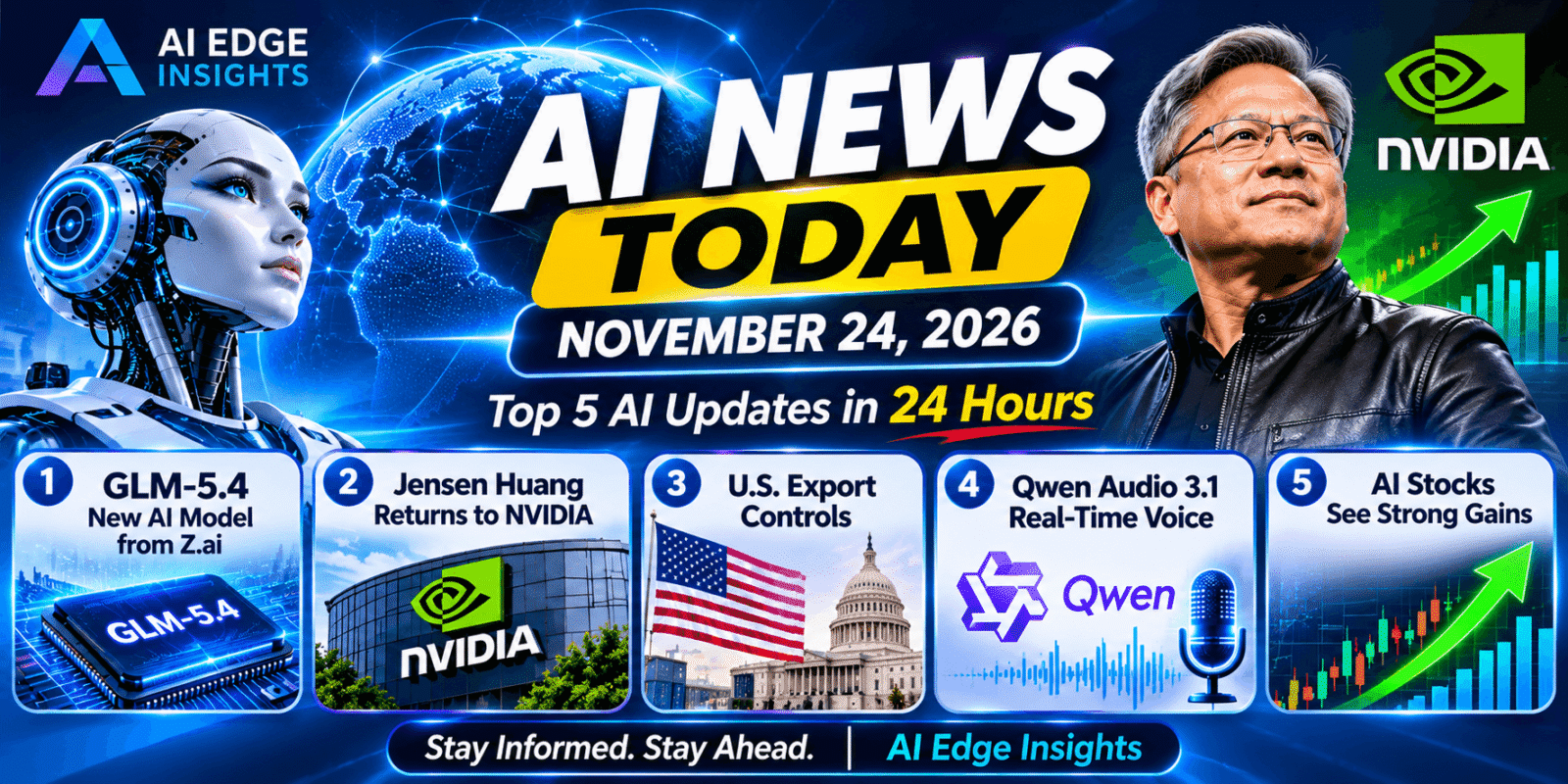
AI news today, November 24, 2026, brings major developments from China’s AI industry and the global semiconductor market. Z.ai has introduced GLM-5.4 with a new Loop Transformer architecture, while NVIDIA has officially reinstated Jensen Huang as its CEO after an unexpected board reversal.
The latest developments also include a new US export-control action involving a Singapore-based company connected to the NVIDIA controversy, Alibaba’s Qwen Audio 3.1 update, and a strong market reaction to Huang’s return.
Here are five important AI and technology stories to know today.
1. Z.ai Releases GLM-5.4 With Vision and a New Loop Transformer Architecture
One of the biggest AI model updates is the release of GLM-5.4 by Z.ai, also known as Zhipu AI.
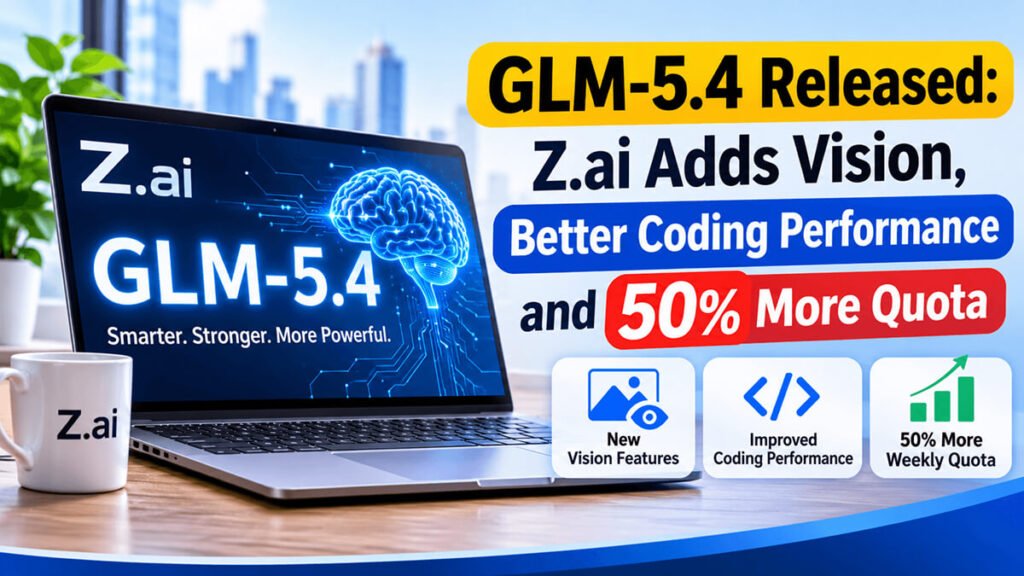
Announced on November 23, GLM-5.4 is the company’s first flagship model built around its Loop Transformer architecture. The model is now available to GLM Coding Plan subscribers through Z.ai’s coding products.
Unlike a conventional model architecture that processes its layers once during a forward pass, the Loop Transformer approach reuses existing layers to create additional reasoning depth.
Z.ai says GLM-5.4 loops through 28 GLM-5 layers twice. The approach is designed to improve performance on complex tasks without simply increasing the number of model parameters.
What are the main GLM-5.4 features?
- Visual understanding: The model adds vision capabilities, allowing developers to provide images and screenshots alongside coding tasks.
- Advanced coding: Z.ai is targeting more complex software development and longer coding workflows.
- Generalized coding: The company highlights applications beyond traditional software, including video, games, 3D shaders, and CAD modelling.
- Loop Transformer: Reuses model layers to support deeper reasoning.
- Coding Plan access: GLM-5.4 is available to GLM Coding Plan users, with a reported 50% increase in weekly usage quota compared with GLM-5.3 for eligible plans.
There are still some limitations. Z.ai has not published a complete official benchmark comparison for GLM-5.4. API access is expected after a safety evaluation, while open model weights are planned after additional safety hardening.
This means developers should test the model on their own coding projects before making decisions based on performance claims.
For a deeper explanation of the release, read our full coverage: GLM-5.4 Released: Features, Vision and Coding Performance.
External source: TestingCatalog – Z.ai launches GLM-5.4.
2. Jensen Huang Is Reinstated as NVIDIA CEO After 11 Days
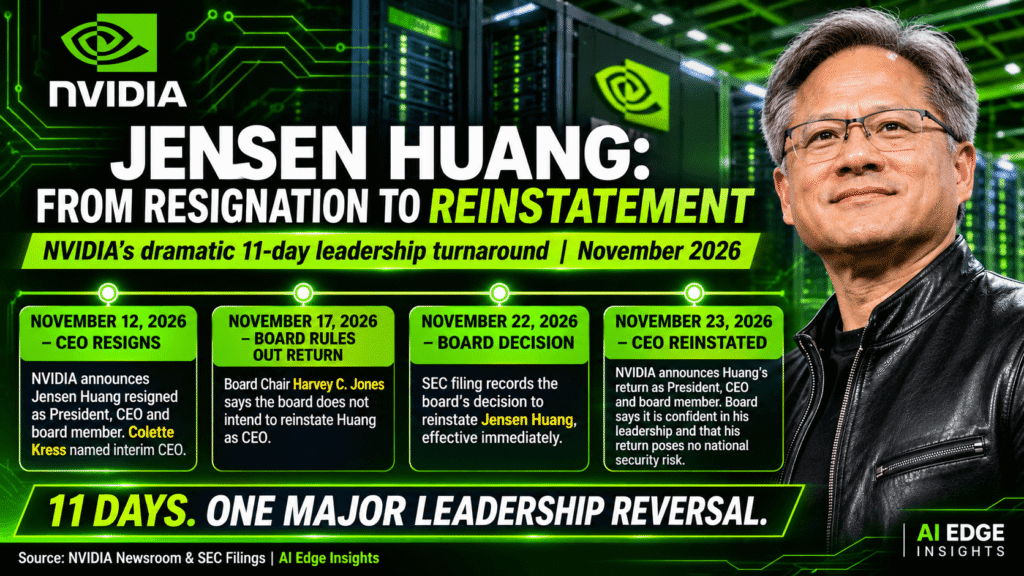
In one of the biggest technology leadership stories, NVIDIA announced on November 23 that Jensen Huang has been reinstated as President and CEO, following the board’s earlier decision to remove him from the position.
The company’s board voted unanimously to bring Huang back after discussions and meetings. NVIDIA said the board received input from senior US government officials and was confident that his reinstatement did not create a national security risk.
Huang’s return follows an extraordinary period for the company. The board had announced his departure on November 12, with CFO Colette Kress taking on interim leadership responsibilities.
NVIDIA’s latest announcement confirms that Kress will continue as Executive Vice President and Chief Financial Officer.
Why did NVIDIA bring Jensen Huang back?
NVIDIA’s board said it had regained confidence in Huang’s ability to lead the company. However, the wider controversy is not fully resolved.
The company confirmed that an independent investigation into reports that Huang was targeted by a foreign intelligence effort will continue. NVIDIA has also established a National Security and Export Control Committee and said it is searching for a new Chief Compliance Officer.
The decision is important because NVIDIA plays a central role in the global AI industry. Its processors and computing platforms support major AI models, cloud infrastructure, research laboratories, and enterprise applications.
A change in leadership at NVIDIA can therefore affect more than one company. It can influence investor confidence, technology partnerships, and expectations across the AI infrastructure market.
Read our detailed report: Jensen Huang Reinstated as NVIDIA CEO: Board Reverses Decision After 11 Days.
Official source: NVIDIA – Board Reinstates Jensen Huang.
3. US Adds Megaspeed to Export-Control Blacklist in NVIDIA-Related Case
Another major development emerged on November 24, when the United States added Singapore-based Megaspeed International and six other Southeast Asian companies to its export-control Entity List.
The action was announced by the US Bureau of Industry and Security. Megaspeed is connected to an alleged spying controversy involving NVIDIA, according to reporting by Al Jazeera.
The decision is significant because companies on the Entity List face restrictions on receiving certain US-origin goods, software, and technology without the required authorisation.
Why does this matter for the AI industry?
AI development depends on a global supply chain. Advanced processors, semiconductor equipment, data-centre components, and networking technologies often cross international borders.
Export-control restrictions can affect:
- Access to advanced computing hardware.
- International semiconductor supply chains.
- AI data-centre construction.
- Technology partnerships between companies.
- Compliance requirements for chip manufacturers and distributors.
The action also shows how AI infrastructure has become connected to national security and international trade policy.
For NVIDIA and other semiconductor companies, export compliance is becoming an increasingly important part of doing business globally.
External source: Al Jazeera – US adds Megaspeed to trade blacklist as NVIDIA’s Huang returns as CEO.
4. Alibaba Updates Qwen Audio 3.1 With Real-Time Voice Capabilities
Alibaba’s Qwen ecosystem has also received an important update.
According to Alibaba’s model changelog, Qwen Audio 3.1 Live was listed on November 23. The model is designed to support real-time voice conversations.
One notable capability is its ability to keep communicating with users while another application or background model handles a task. It can then speak the result when the task is complete.
This type of interaction could make AI assistants more useful in everyday applications.
What could real-time AI voice mean for users?
Real-time voice systems can support:
- More natural conversations with AI assistants.
- Voice-based customer support.
- Interactive productivity applications.
- Spoken responses from background AI tasks.
- Hands-free interaction with digital tools.
The update reflects a broader shift in AI development. Companies are moving beyond text-only chatbots and building systems that can interact through voice, images, and other forms of input.
For developers, the important question will be how well these systems handle interruptions, response speed, accuracy, and complex conversations in real-world applications.
External source: Qwen Cloud – Official Model Changelog.
5. NVIDIA’s Return Triggers a Strong Market Reaction
Jensen Huang’s reinstatement also produced a significant reaction in financial markets.
According to Associated Press reporting, NVIDIA shares rose approximately 31.5% on Monday following the announcement. The S&P 500 gained 4.7%, while the Nasdaq rose 6.5%.
AI-related companies and businesses connected to data-centre construction also experienced gains.
The market reaction highlights the importance investors place on NVIDIA’s leadership. Huang is closely associated with the company’s AI strategy and its position in the global semiconductor industry.
However, the rally does not mean every concern has disappeared.
Investors are still watching several issues, including:
- NVIDIA’s ongoing investigations.
- Export restrictions affecting advanced chips.
- The cost of building AI infrastructure.
- Questions about AI investment returns.
- The long-term sustainability of AI-related valuations.
The key takeaway is that investor confidence can change quickly when major leadership and regulatory developments affect a company at the centre of the AI industry.
External source: Associated Press – NVIDIA’s comeback bet: Why Jensen Huang’s return calmed markets, for now.
What Do Today’s AI News Stories Mean for the Future?
The latest developments show that the AI industry is entering a more competitive and complex stage.
GLM-5.4 highlights how AI developers are experimenting with new architectures and visual coding capabilities. NVIDIA’s leadership story demonstrates how important executive decisions can be for the wider technology market.
At the same time, export-control restrictions show that AI hardware is now a major issue in international trade and national security.
Alibaba’s Qwen Audio 3.1 update points towards more natural voice-based AI assistants, while the market reaction to NVIDIA’s news demonstrates the financial importance of AI infrastructure.
For businesses and developers, the next stage of AI will not be determined by model performance alone. Reliability, accessibility, security, pricing, and practical value will also matter.

Frequently Asked Questions (FAQs)
1. What is GLM-5.4?
GLM-5.4 is a new AI model from Z.ai, also known as Zhipu AI. It introduces a Loop Transformer architecture, vision capabilities, and improvements aimed at complex coding and other development tasks.
2. Is GLM-5.4 available to the public?
GLM-5.4 is currently available to GLM Coding Plan subscribers through Z.ai’s products. API access is expected after a safety evaluation, and open weights are planned after further safety hardening.
3. Why was Jensen Huang reinstated as NVIDIA CEO?
NVIDIA’s board voted unanimously to reinstate Huang after discussions and meetings. The company said the board was satisfied with his leadership and had received input from senior US government officials.
4. What is the US export-control action involving Megaspeed?
The US added Megaspeed International and six other Southeast Asian companies to its Entity List. The action creates restrictions on access to certain US-origin technology and products without authorisation.
5. What is Qwen Audio 3.1 Live?
Qwen Audio 3.1 Live is a real-time voice conversation model from Alibaba’s Qwen ecosystem. It is designed to let users continue speaking with an AI assistant while background tasks are being processed.
Final Thoughts
November 24, 2026, brings important developments across AI models, semiconductor leadership, voice technology, and international trade.
GLM-5.4 is an interesting step in the evolution of AI coding models. Jensen Huang’s return to NVIDIA has attracted global attention, while the Megaspeed export-control action shows how closely AI technology is connected to national security.
As competition between AI companies continues, developers, businesses, and investors will need to follow not only new model releases but also the decisions shaping the global AI ecosystem.
Follow AI Edge Insights for daily AI news, model releases, technology updates, and industry analysis.
