
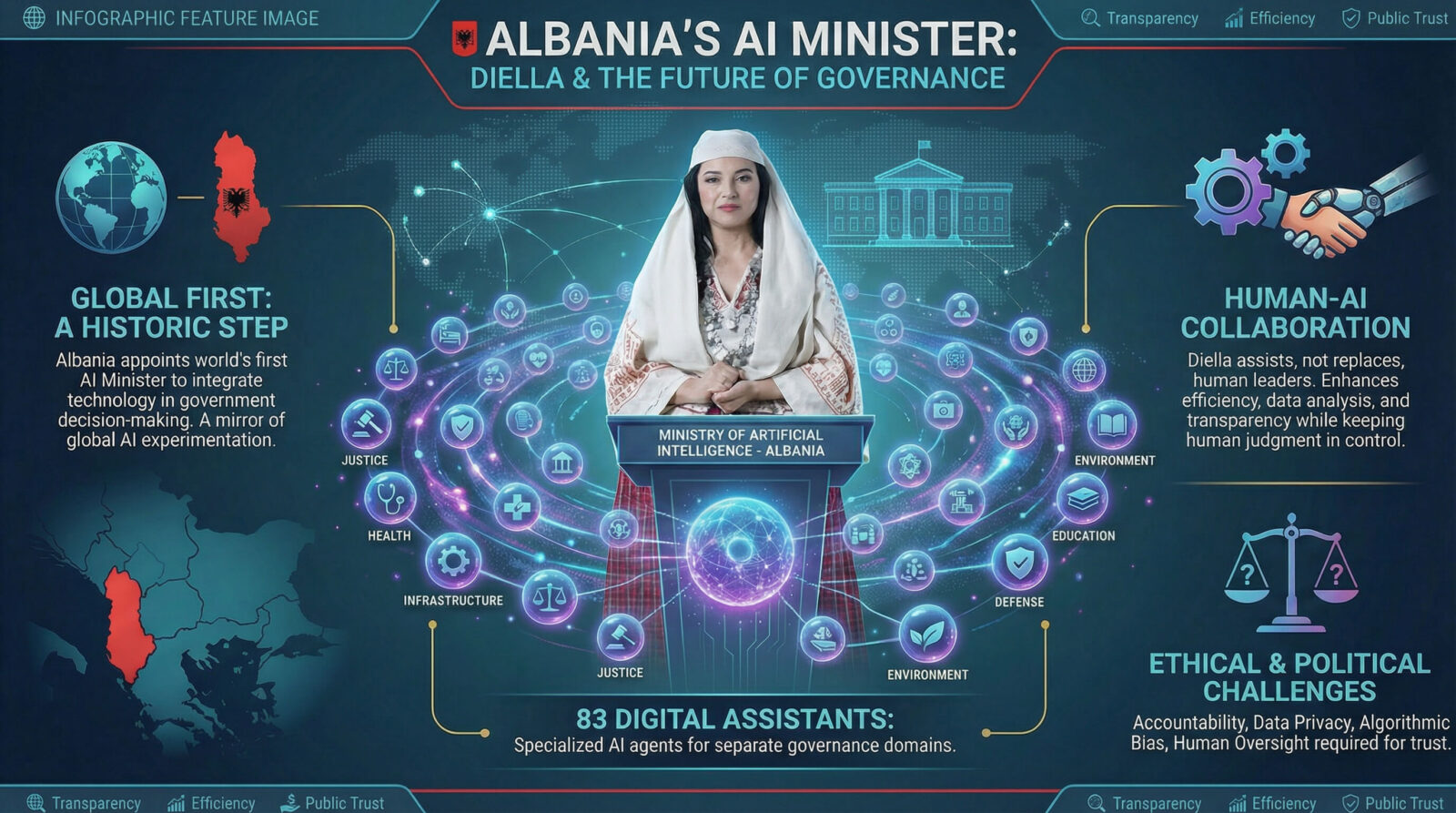
Albania captivated international news by appointing an artificial intelligence minister, a first. The appointment of digital minister Diella is a daring move to apply artificial intelligence in government decision-making. What is even more intriguing about this step is the symbolic concept that Diella is pregnant with 83 digital assistants, each of which is to serve a separate domain of governance.
This announcement is not a technological experiment. It is a mirror of the fact that governments worldwide are experimenting with AI to enhance transparency, efficiency and public service. Artificial intelligence is gradually becoming a part of the work of the contemporary state, whether in data management or policy development. The move by Albania demonstrates that AI is no longer confined to assisting governments on the margins of their operations – it is now starting to make a more visible appearance within governments.
How Albania Became the First Country to Appoint an AI Minister
Albania’s path towards appointing an AI minister did not occur in a single day. In recent years, the nation has been investing heavily in digital systems to enhance the way government services are delivered. Most of the government services have already been transferred to the Internet, and citizens can now easily access documents, file requests, and contact the state institutions.
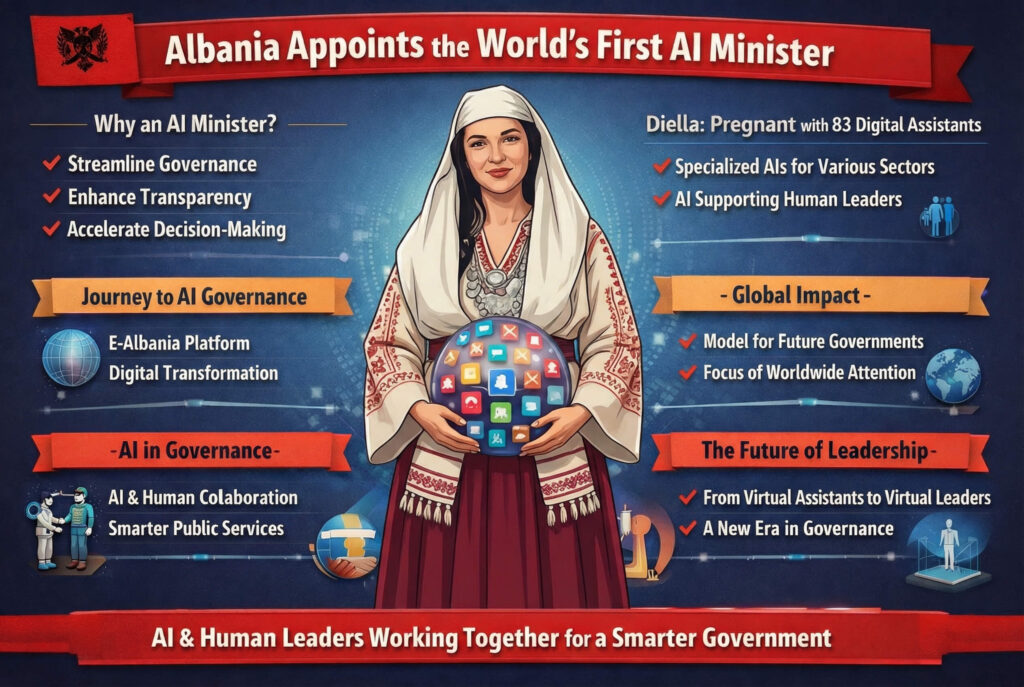
Prime Minister Edi Rama AI initiative has been an influential advocate of applying technology to streamline governance. Digital tools have been implemented under his leadership to minimise paperwork, enhance transparency, and accelerate decision-making. Platforms such as e-Albania were instrumental in this change as they automated most of the daily government processes.
In these regards, introducing Diella, the first AI Minister Albania in the world, seems a logical continuation. It is the long-term vision of the country to integrate human leadership and technology in order to create a smarter and more efficient government.
The AI Minister Diella: Role, Capabilities, and Vision
Diella’s position as an AI minister is intended to assist the government rather than to substitute for human leaders. The system assists in handling large volumes of data, drafting policies, and communicating among various government departments. Through the speed of information analysis, Diella can assist officials in making better and more timely decisions.
The suggestion that Diella is pregnant with 83 digital assistants is one of the most discussed ideas about it. It is an iconic way to demonstrate how AI can grow and scale across various fields of governance. Any digital assistant can be specialised in a given task, e.g., legislative support, data analysis, or the improvement of public services.
Diella AI Minister intends to streamline the work of the government by integrating it with parliamentary systems and transparency tools. The vision in the long term is the use of AI in government as a stable support system that enhances decision-making but keeps the human factor in full control.
Why the World Is Watching Albania’s AI Governance Experiment
Albania’s decision to establish an AI minister has been widely noted worldwide. The way this experiment turns out will draw close attention from governments, tech experts, and media outlets. The concept of applying artificial intelligence in governance to this extent is novel, and most nations are eager to understand what they can learn about it.
Such a step might impact future government policies in other parts of the world, such as Europe, Asia, and the Middle East, where the digital transformation is already in focus. The model in Albania is worth consideration as countries seek smarter means of managing public services and policy-making. It demonstrates that AI leadership does not displace human decision-makers but can assist them.
This trend is also larger in terms of the future of AI governance, as seen in the global interest. From smart cities to artificial intelligence’s governing the populace, governments are discussing the potential of technology to enhance transparency, efficiency, and citizen trust, and now Albania is taking the lead in that discussion.
Ethical and Political Challenges of Appointing an AI Minister
Although the appointment of Diella as as AI Minister is historic, it gives rise to significant ethical and political concerns. Accountability is one of the key issues: if an AI system aids in making high stakes decisions, who is ultimately responsible? It is also important to have human control to prevent errors or abuse.
Algorithms, biases and data privacy are also major issues. The AI systems are based on massive datasets, and any misconduct or gaps would influence the impartiality of government practices. It must be transparent enough to allow the citizens to know how they are making decisions and trust the process.
Finding a compromise between innovation and responsibility is a fine line to walk. Governments must work out transparent structures of AI ethics in the political sphere such that AI contributes to better governance without compromising human judgment and democracy. This cautious strategy can help build trust in AI-based government.
From Virtual Assistants to Virtual Leaders: The Future of AI Governance
The appointment of Diellaas as AI Minister is a new beginning to the way governments may be run in future. AI is no longer just a tool for automating simple tasks; it is now assisting with complex decision-making and policy development. This trend may create more efficient and data-driven governments across the globe.
Other nations, such as South Korea and the UAE, are already considering the sovereign AI infrastructure, which indicates that AI in governance is not specific to Albania only. With the increasing capabilities of AI systems, the concept of AI leadership may become more global, with digital ministers’ assistance to legislators, the administration of state-level services, and greater transparency enhanced.
The experiment of Albania can teach other countries how AI can help the government in a safe and effective way. It is possible that in the future, additional AI systems embedded in executive functions will create a new era in which humans and AI collaborate to enhance governance and public confidence.
Conclusion
The promotion of Diella AI Minister in Albania is more than a technological experiment; it is a historic event in the history of government. It demonstrates how artificial intelligence can transform from being a supportive tool to an active participant in the work of the government, collaborating with humans to make improved decisions.
This breakthrough is an indicator of a larger trend in the future of AI regulation. Human judgement can be enhanced with the speed and analytical power of AI to achieve transparency, efficiency, and trust in the countries.
This trend aligns with breakthroughs like Google DeepMind’s multimodal AI, which highlight how rapidly evolving AI technologies are shaping modern policy making and digital leadership.
