
Parents are increasingly using artificial intelligence (AI) to edit photos, improve image quality and save money. However, experts are warning families to think carefully before uploading children’s school photographs to AI tools, particularly when removing watermarks from professional photos.
Although AI photo editors can be useful, uploading a child’s identifiable image to an online service may create privacy risks. Parents should understand how images are stored, processed and potentially used before sharing them.
Why Are Parents Using AI to Remove School Photo Watermarks?
Professional school photographs can be expensive, leading some parents to use AI tools to remove watermarks from preview images rather than purchase the original photos.
However, watermarks often protect a photographer’s work. Removing them without permission may violate copyright or the photographer’s terms of use.
There is also a privacy concern: parents may be sending their children’s photographs to third-party platforms without understanding what happens to those images afterwards.
What Happens When You Upload a Child’s Photo to AI?
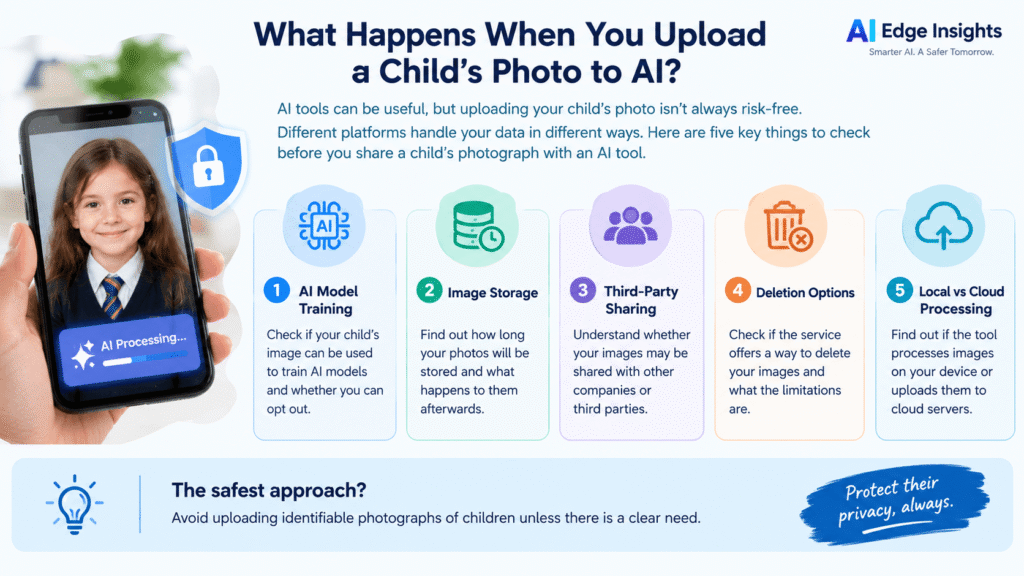
Different AI platforms have different privacy policies. Some may retain uploaded images, while certain services may use eligible content to improve their models, depending on their policies and user settings.
Parents should check:
- Whether uploaded images can be used for AI training.
- How long photographs are stored.
- Whether images are shared with third parties.
- Whether the service offers deletion options.
- Whether the tool processes images locally or uploads them to cloud servers.
For example, OpenAI’s ChatGPT data controls explain how users can manage whether their conversations are used to improve models. However, disabling model training does not automatically delete saved conversations or remove every privacy risk.
The safest approach is to avoid uploading identifiable photographs of children unless there is a clear need.
Can AI Photo Editing Put Children’s Privacy at Risk?
Photographs can reveal more than a child’s appearance. School uniforms, badges, classroom backgrounds and visible names may help identify a child or their school.
Some image files may also contain metadata, such as the date a photograph was taken or location information, depending on the device and how the image was processed.
Once an image is shared with an external service, its handling depends on that provider’s policies and security measures. Potential risks include unauthorised access, data breaches and misuse of photographs.
The Internet Watch Foundation’s October 2026 report highlights the growing problem of AI-generated child sexual abuse imagery. The organisation reported assessing 6,310 AI generated images meeting the UK legal definition of child sexual abuse during the first half of 2026, exceeding its total for all of 2025.
This does not mean that every photograph uploaded to AI will be misused. It shows why protecting children’s images and understanding the risks of AI manipulation are important.
For more information about protecting digital systems and personal information, read our guide to how artificial intelligence is changing cybersecurity.
How Can Parents Protect Children’s Photos?
Families do not need to avoid AI completely. They should simply use it carefully and make informed decisions.
Here are five practical steps:
- Review privacy settings: Check whether uploaded content can be used for model training and what controls are available.
- Avoid unnecessary uploads: Use a non-identifying image or an offline editing tool when possible.
- Remove identifying details: Avoid photographs showing school badges, full names, addresses or other sensitive information.
- Check image metadata: Remove unnecessary location information where possible, remembering that visible details can still identify a child.
- Respect photographers’ rights: Purchase school photographs or ask for permission instead of removing watermarks without authorisation.
Choosing a tool that genuinely processes images on your own device can reduce the need to upload photographs to an external server. However, check how the application works rather than assuming that every editing app is offline.
Should Parents Stop Using AI Photo Editors?
No. AI can provide useful editing features and save time. The important thing is to understand the privacy implications before sharing personal information.
Parents should choose services with clear privacy policies, avoid unnecessary uploads and consider whether the benefits justify the risks. Schools and photographers can also help by providing clear guidance and affordable photo packages.

Frequently Asked Questions
Is it safe to upload children’s photos to AI?
It depends on the platform and its privacy practices. Avoid uploading identifiable images unnecessarily and review the provider’s storage, training and deletion policies.
Can AI tools use uploaded photos for training?
Some platforms may use eligible content to improve their models, depending on their terms and settings. Check the specific service before uploading images.
Does removing photo metadata protect a child completely?
No. It may remove certain location or device details, but visible school uniforms, badges and backgrounds can still reveal identifying information.
Is removing a school photo watermark legal?
It depends on copyright ownership, the photographer’s terms and applicable law. Purchasing the photograph or requesting permission is the safer option.
Final Thoughts
Using AI to remove a school photo watermark may appear to be an easy way to save money, but parents should consider both copyright and privacy.
Before uploading a child’s photograph, check the platform’s privacy settings, remove unnecessary identifying details and consider safer alternatives. A few moments of caution can help protect children’s digital privacy without giving up the benefits of AI.
