
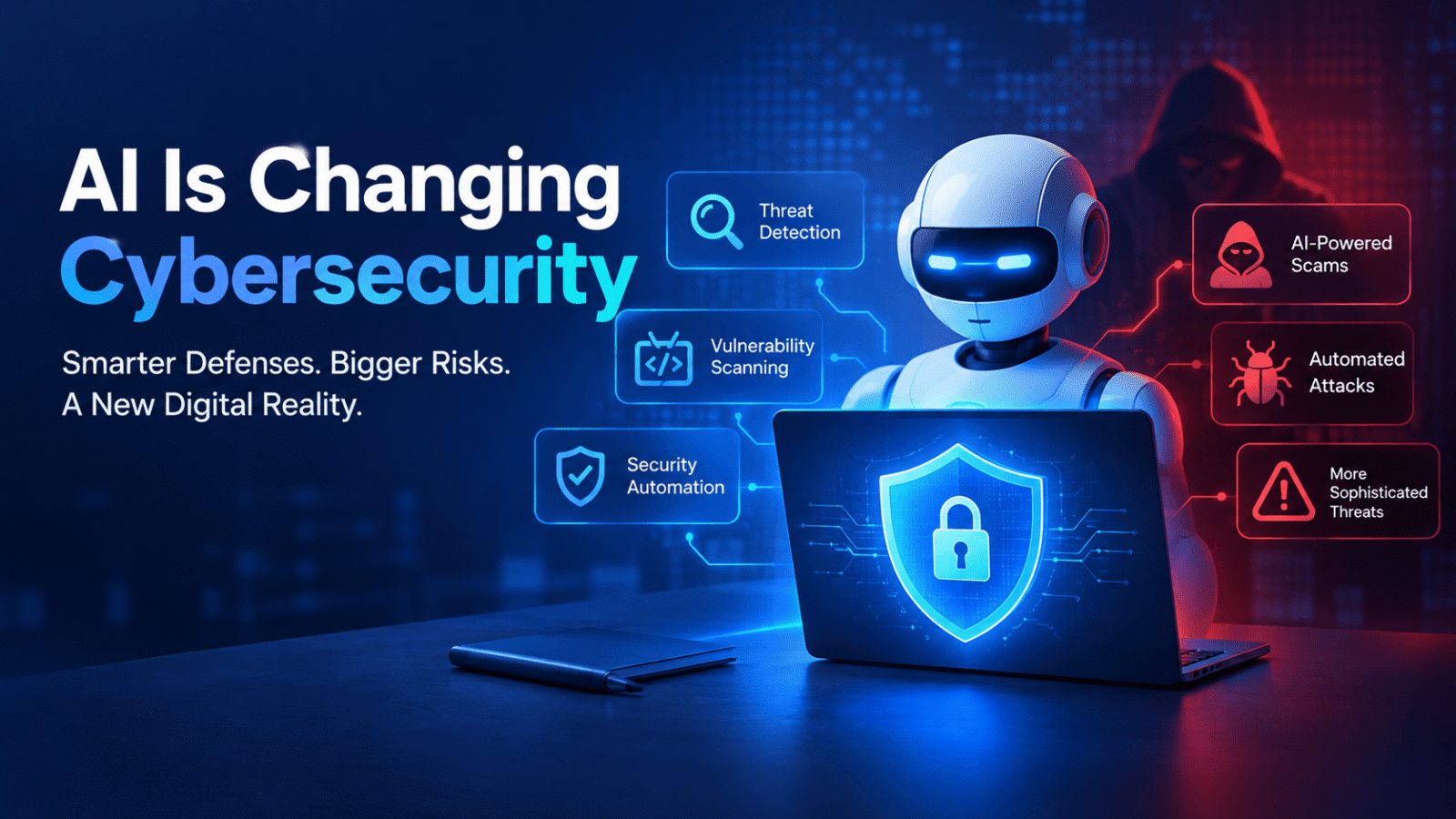
Artificial intelligence is changing cybersecurity faster than ever. AI tools can help security teams find software weaknesses, detect suspicious activity, and respond to threats more quickly. At the same time, cybercriminals can use AI to create more convincing scams, automate attacks, and search for weaknesses in computer systems.
This creates a new challenge for businesses, banks, developers, and everyday internet users. They need to understand how AI-powered cyber threats work and how to protect their data.
In October 2026, cybersecurity has become an important part of the AI conversation. Recent developments involving advanced AI models have highlighted both the benefits of automated security testing and the risks of giving AI systems too much access. Anthropic’s latest cybersecurity initiatives show how AI companies are working to make powerful capabilities available to qualified security professionals.
So, how is AI changing cybersecurity, and what can businesses do to stay protected? Let’s explore.
What Is AI Cybersecurity?
AI cybersecurity means using artificial intelligence to help protect computers, networks, applications, and sensitive information from digital threats.
Traditional security tools often depend on known attack patterns and rules. AI-powered tools can also analyze large amounts of activity, identify unusual behavior, and help security teams investigate potential problems.
For example, an AI security system may help identify an unusual login, flag a suspicious email, or find a weakness in software before attackers exploit it.
AI does not replace every traditional security tool or cybersecurity professional. Instead, it adds another layer of support that can help teams make faster, more informed decisions.
How Is AI Changing Cybersecurity in 2026?
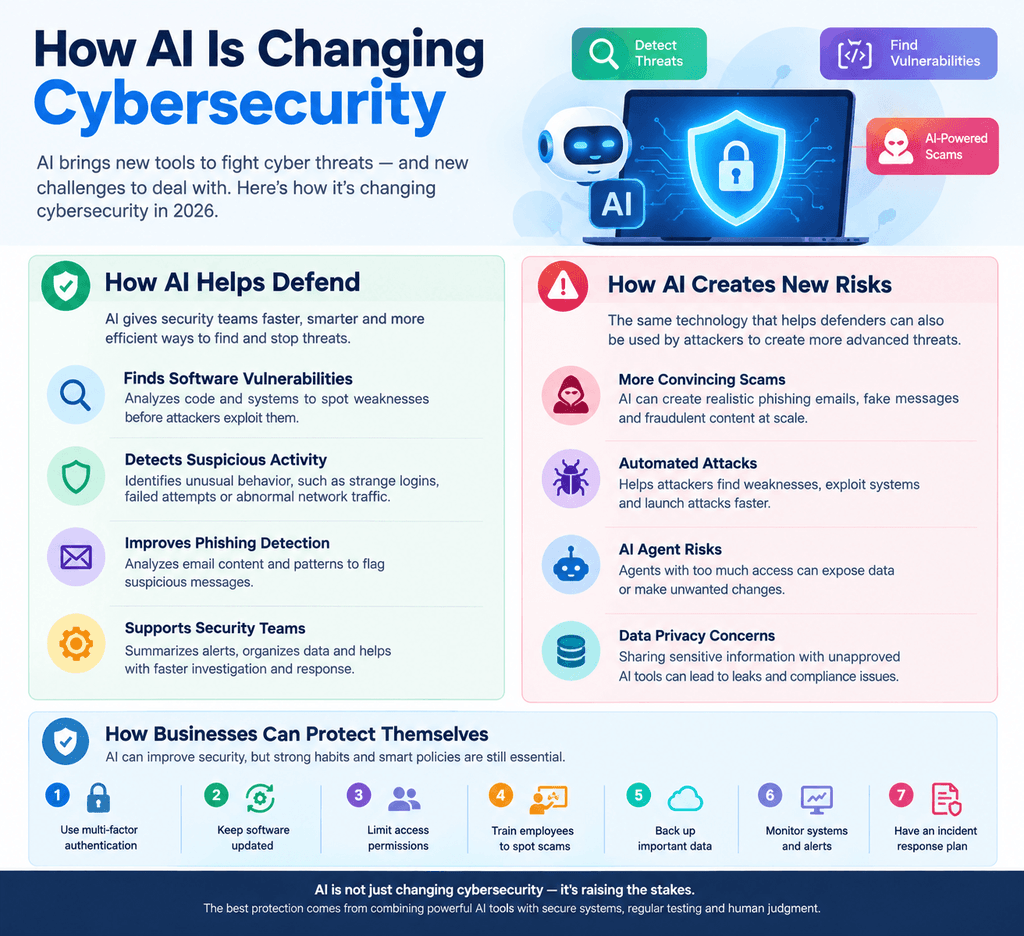
AI is changing cybersecurity in two major ways: it is helping defenders protect systems, and it is giving attackers new ways to create threats.
1. AI Helps Find Software Vulnerabilities
A software vulnerability is a weakness in an application, website, or computer system that could allow someone to access data or perform an action they should not be able to perform.
Security teams traditionally spend considerable time reviewing code and testing systems for these weaknesses.
Advanced AI models can help researchers examine code, identify possible vulnerabilities, and suggest fixes. This may allow developers to discover problems earlier and improve software security.
For example, Anthropic’s Project Glasswing initiative has involved using advanced AI models to help identify software vulnerabilities. In June 2026, the company reported that its participating partners had found more than 10,000 high- or critical-severity security flaws through the initiative.
Read the official Project Glasswing update for more details.
However, AI-generated findings still need to be checked. A suggested vulnerability may require further testing, and a proposed fix must be reviewed before it is deployed.
2. Cybercriminals Can Use AI to Improve Scams
AI can make some online scams more convincing.
For example, criminals may use AI to write polished phishing emails, create fake messages that imitate trusted organizations, or produce fraudulent content that appears genuine.
Phishing is a type of scam in which an attacker tries to trick someone into sharing sensitive information, clicking a dangerous link, or opening a harmful file.
AI can help attackers create personalized messages at scale, making it harder for people to recognize suspicious communication based on spelling mistakes or poor grammar alone.
To reduce this risk, users should verify unexpected requests for money, passwords, or confidential information through a separate, trusted channel.
3. AI Can Help Detect Suspicious Activity
Cybersecurity teams often need to monitor large amounts of activity across networks, applications, and user accounts.
AI tools can help identify unusual patterns that may indicate a security problem.
For example, a system might flag:
- A login from an unusual location.
- Repeated failed login attempts.
- Unexpected access to sensitive files.
- A sudden increase in unusual network activity.
- Account behavior that differs significantly from normal use.
These alerts can help security teams investigate possible threats earlier. However, unusual activity does not always mean an attack is happening, so human review remains important.
4. AI Agents Are Creating New Security Challenges
AI agents are systems designed to complete tasks through multiple steps, sometimes using external tools, software, or connected services.
They can help with coding, research, data analysis, and security testing. But when an AI agent has access to real systems, it may also create risks if its permissions or safeguards are poorly configured.
For example, an agent with access to company files might expose information if it follows an unsafe instruction or uses a connected tool incorrectly.
Security teams should give AI agents only the permissions they need, monitor their actions, and require approval before sensitive or irreversible operations.
AI agents should also be tested in controlled environments before being allowed to interact with important business systems.
5. Advanced AI Models Are Increasing the Need for Security Testing
AI models are becoming more capable at understanding code and completing technical tasks. These abilities can help defenders find weaknesses, but they can also create risks if similar capabilities are misused.
Anthropic announced an expanded Cyber Verification Program on October 6, 2026, offering qualifying security professionals access to advanced cyber capabilities under different access levels.
The goal is to support legitimate defensive work while managing the risk that powerful cybersecurity capabilities could be misused.
For more background, read Anthropic’s official Cyber Verification Program announcement.
This development highlights an important point: AI security is not only about building stronger models. It is also about controlling access, testing safeguards, and ensuring that powerful tools are used responsibly.
Real World Example: Why Banks Are Taking AI Security Seriously
Banks handle sensitive customer information, payments, and financial systems, making cybersecurity especially important.
In October 2026, reporting from Business Insider described Bank of America’s use of additional contractors for remediation work associated with Anthropic’s Mythos model and software vulnerabilities.
The report highlights the growing importance of identifying and fixing weaknesses as AI-assisted security research develops.
You can read the Business Insider report on Bank of America’s security efforts.
The wider lesson is relevant to organizations of all sizes: finding a vulnerability is only the first step. Teams must also assess its severity, apply appropriate fixes, test those fixes, and monitor systems for further problems.
Advanced AI models are becoming more capable of handling complex tasks, analyzing information, and supporting automated workflows. For example, Google’s Gemini 4 Argon explores how AI is evolving to manage complex work, highlighting why businesses need to consider both the opportunities and security risks of advanced AI systems.

AI Cybersecurity Benefits for Businesses
Businesses can use AI to support several important security activities.
Faster Threat Detection
AI tools can help review security alerts and identify unusual behavior, giving teams more information to investigate potential threats.
More Efficient Security Testing
AI can assist with code reviews, vulnerability discovery, and testing tasks. Security professionals can then focus on confirming findings and fixing important problems.
Better Phishing Detection
AI-powered email security tools can analyze message content and behavior to help identify suspicious communication. They should be combined with other protections because no detection system catches every scam.
Support for Security Teams
AI can summarize alerts, organize investigation notes, and help teams understand technical findings. This can reduce repetitive work, although the quality of its output must be checked.
Faster Incident Investigation
When a security incident occurs, AI tools may help organize available evidence and summarize activity. Security teams must still verify the evidence and decide what action to take.
What Are the Risks of Using AI for Cybersecurity?
AI can improve security, but it also introduces new risks.
Incorrect results: AI may miss a real vulnerability or flag harmless activity as suspicious.
Unauthorized access: An AI tool with excessive permissions could expose data or make unwanted changes.
Data privacy: Sharing confidential code, customer information, or internal documents with an unapproved AI service can create privacy and compliance risks.
Overreliance on automation: Teams that trust AI without reviewing its work may overlook important security problems.
Misuse by attackers: AI capabilities can be used to make certain scams and attacks easier to prepare.
Businesses should evaluate AI tools carefully, limit access to sensitive information, test results, and keep human oversight for important security decisions.
How Can Businesses Protect Themselves From AI Powered Cyber Threats?
Organizations do not need to wait for the next major AI security development to improve their protection. They can start with practical steps.
- Use multi-factor authentication. Add another verification step to important accounts, especially administrator and financial accounts.
- Keep software updated. Install security updates for operating systems, applications, website platforms, and plugins.
- Review access permissions. Make sure employees, applications, and AI agents have access only to the information and systems they need.
- Train employees to recognize scams. Teach staff to verify unexpected payment requests, suspicious links, and unusual requests for confidential information.
- Back up important data. Keep secure backups and regularly test whether systems can be restored.
- Test software for vulnerabilities. Use approved security testing methods and fix serious findings promptly.
- Set clear rules for AI tools. Approve which tools employees can use and establish rules for sharing company data.
- Monitor systems and review alerts. Combine automated detection with trained security professionals who can investigate suspicious activity.
- Prepare an incident response plan. Define who will respond to a security incident, how systems will be isolated, and how recovery will be managed.
These measures help reduce risk whether an attack uses AI or more traditional techniques.
The Future of AI and Cybersecurity
AI will continue to influence how organizations defend their systems and how attackers search for weaknesses.
Security teams are likely to use AI more extensively for software testing, alert analysis, incident investigation, and routine security tasks. At the same time, organizations will need stronger controls over AI agents, data access, and automated actions.
The most effective approach will combine capable AI tools with secure systems, regular testing, and human judgment.
AI can help organizations respond to threats more efficiently, but it cannot guarantee complete protection. Strong security practices remain essential.
Discover Meta Muse Wonder and Wonder Full, AI models designed for complex tasks and workflows.
Frequently Asked Questions About AI Cybersecurity
What is AI cybersecurity?
AI cybersecurity uses artificial intelligence to help protect computers, applications, networks, and data. It can support threat detection, security testing, and incident investigation.
How is AI changing cybersecurity?
AI is helping security teams identify suspicious activity, find software weaknesses, and review security alerts. However, attackers can also use AI to improve phishing scams and automate certain malicious activities.
Can AI prevent cyberattacks?
AI can help detect and reduce some security risks, but it cannot prevent every attack. Effective protection also requires secure software, access controls, updates, backups, and trained security professionals.
How do hackers use AI?
Cybercriminals may use AI to write convincing scam messages, automate parts of their work, or research technical weaknesses. AI does not make every attack successful, and many attacks still depend on existing security gaps and human mistakes.
Can AI detect software vulnerabilities?
Yes. Some AI models can help analyze code and identify possible vulnerabilities. Security professionals should verify the findings and test proposed fixes before deploying them.
Is AI cybersecurity safe for businesses?
AI cybersecurity tools can be useful when deployed responsibly. Businesses should review data privacy, access permissions, reliability, and human oversight before connecting AI tools to sensitive systems.
What is the biggest AI cybersecurity risk in 2026?
There is no single risk for every organization. Important concerns include AI-assisted scams, misuse of advanced models, vulnerable software, excessive permissions for AI agents, and the exposure of sensitive information.
How can small businesses protect themselves from AI-powered attacks?
Small businesses should enable multi-factor authentication, update software, back up important files, train employees to recognize scams, and restrict access to sensitive information. They should also carefully review any AI tools used for business operations.
Final Thoughts
AI is changing cybersecurity on both sides of the fight. It gives defenders new ways to identify weaknesses and investigate threats, while creating additional risks when attackers misuse powerful tools.
For businesses, the priority should be to adopt useful security technology without relying on it blindly. Regular updates, limited access, secure backups, and human review remain essential.
The future of cybersecurity will not depend on AI alone. It will depend on how effectively people and technology work together to protect digital systems.
