
Meta Muse Wonder and Muse Wonder Full are two new AI models designed to handle complex tasks, coding, research, and professional work. Announced on October 12, 2026, these models focus on helping AI agents remember useful information, stay focused, and complete tasks that require several steps. Meta says they are among its most capable AI models to date.
The launch is an important step in Meta’s effort to compete with leading AI companies, including OpenAI and Anthropic.
But what makes Muse Wonder different, how does Wonder Full work, and what could these new AI models mean for businesses and everyday users? Let’s take a closer look.
What Are Meta Muse Wonder and Wonder Full?
Meta Muse Wonder and Muse Wonder Full are advanced artificial intelligence models developed to support AI agents.
Unlike a basic chatbot that mainly answers questions, an AI agent can help carry out a task through several steps. For example, it may research a topic, organize information, write a report, or help with a coding project.
Meta designed the Muse Wonder family to handle more demanding tasks that require planning, remembering important details, and adjusting when something does not work.
The two models share this goal, but they serve different needs:
- Muse Wonder: Designed to support AI agents with personal and professional tasks.
- Muse Wonder Full: A more advanced model aimed at demanding, multi-step work.
Meta is positioning these models as part of its wider move toward AI assistants that do more than generate text.
What Is New in Meta Muse Wonder?
One of the main goals of Muse Wonder is to make AI agents more useful when working on tasks that take time and involve multiple steps.
Meta highlights two important capabilities: Active Memory and Active Focus.
1. Active Memory: AI That Remembers Useful Information
Active Memory helps an AI agent retain relevant information across conversations.
This matters because users often work on projects that require more than one conversation. They may explain their goals, share background information, and return later to continue the same task.
Without useful memory, an AI assistant may need repeated instructions. With better memory, it can use relevant context to make future interactions more consistent.
Potential examples include:
- Remembering the requirements of an ongoing project.
- Keeping track of coding instructions and previous decisions.
- Using relevant background information when preparing a report.
- Helping users continue work without explaining everything again.
Memory must still be handled carefully. AI systems should protect personal information and allow appropriate controls over what is retained.
2. Active Focus: Better Handling of Difficult Tasks
Active Focus is designed to help AI models continue working when they encounter problems.
For example, a coding task may fail because of an error, or a research task may produce incomplete results. Instead of stopping immediately, an AI agent may try another approach and work toward a better result.
This could make AI agents more helpful for tasks such as:
- Finding and fixing software errors.
- Working through multi-step research.
- Organizing complicated information.
- Supporting professional tasks that require several decisions.
The goal is not simply to produce an answer quickly. It is to help the AI work through a problem more effectively.
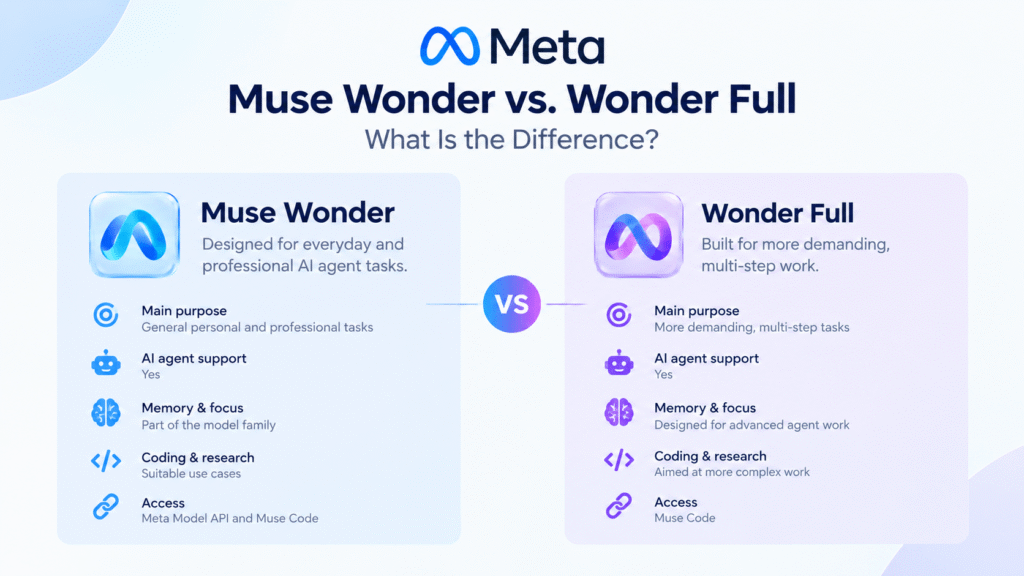
Meta Muse Wonder vs. Wonder Full: What Is the Difference?
The main difference is the level of work each model is designed to handle.
| Feature | Muse Wonder | Muse Wonder Full |
|---|---|---|
| Main purpose | General personal and professional tasks | More demanding, multi-step tasks |
| AI agent support | Yes | Yes |
| Memory and focus capabilities | Part of the model family | Designed for advanced agent work |
| Coding and research | Suitable use cases | Aimed at more complex work |
| Access | Meta Model API and Muse Code, according to reported launch details | Muse Code access, according to reported launch details |
Availability can change, so users should check Meta’s official channels for the latest access requirements.
In simple terms, Muse Wonder is designed to support useful everyday and professional work, while Wonder Full targets tasks that may require deeper reasoning and more sustained effort.
What Can Meta Muse Wonder Do?
The models are designed for work that involves several connected steps. Their potential uses extend across different industries.
AI Coding and Software Development
Developers may use AI agents to understand code, find errors, suggest fixes, and help complete programming tasks.
For example, a developer could ask an AI agent to investigate a bug, review the relevant code, and suggest a solution. The developer would still need to test and review the changes.
Research and Content Work
AI agents can help gather information, organize notes, create outlines, and prepare early drafts.
For content teams, this could mean spending less time on repetitive research and more time checking facts, adding original insights, and improving the final article.
AI-generated content should always be reviewed for accuracy, originality, and source quality before publication.
Business and Office Tasks
Businesses often deal with repetitive work, including document preparation, data organization, and customer support.
An AI agent could help employees prepare summaries, organize information, or work through a defined process. More sensitive actions should require appropriate permissions and human review.
Finance, Law, and Healthcare
Advanced AI agents may also assist professionals with research, document review, and information analysis in fields such as finance, law, and healthcare.
However, these are high stakes areas. AI generated recommendations can be incomplete or incorrect, so qualified professionals must verify important findings before acting on them.
How Do Meta Muse Wonder Models Compare With ChatGPT and Claude?
Meta is entering a competitive market where AI companies are trying to build models that can do more than answer simple questions.
ChatGPT from OpenAI and Claude from Anthropic also support a range of writing, coding, reasoning, and professional tasks, depending on the model and available tools.
The most useful comparison is not just which model sounds smarter. It is how well each model performs on the tasks a person actually needs.
Here are the main factors to compare:
- Coding: Can the model understand a project, identify errors, and suggest working solutions?
- Memory: Can it use relevant information across a longer workflow?
- Reasoning: Can it handle tasks that involve several connected steps?
- Reliability: Does it produce accurate results consistently?
- Price: How much does it cost to complete a typical task?
- Access: Can individuals and businesses use it through a convenient app, API, or coding tool?
Meta’s announcement makes Muse Wonder and Wonder Full new competitors in the AI agent market. However, independent testing on the same tasks is needed before declaring either model the overall winner.
The competition in advanced AI is growing rapidly, with companies focusing on coding, reasoning, and complex tasks. Read our detailed guide to Claude Fable 5.1 and Mythos 5.1: The Next Era of AI Coding Agents to explore Anthropic’s approach to AI powered coding. You can also discover GPT-6 Astra, OpenAI’s Advanced AI Model to learn more about OpenAI’s developments in advanced AI.

Are Meta Muse Wonder and Wonder Full Free?
Access and pricing depend on how Meta distributes each model.
Reported launch information indicates that Muse Wonder is available through Meta’s Model API and Muse Code, while Muse Wonder Full has more limited access through Muse Code.
Developers and businesses should check the official Meta AI website and Meta Newsroom for current availability, usage limits, and pricing.
Do not assume that access through a particular platform means unlimited free use. API charges, subscriptions, or other restrictions may apply.
Why Are These New AI Models Important?
The launch reflects a wider change in artificial intelligence.
Early AI chatbots mainly focused on answering questions, generating text, and helping users brainstorm ideas. Newer AI systems increasingly aim to complete workflows involving planning, tools, memory, and multiple actions.
For businesses, this could help reduce repetitive work and speed up certain processes. For developers, it could provide more capable coding assistance. For individuals, it could lead to assistants that better understand ongoing goals.
Still, stronger AI agents also raise important questions about privacy, security, cost, and human oversight.
An AI system that can take action needs clear limits, secure access to information, and checks before it performs important or irreversible tasks.
What Does Meta Muse Wonder Mean for the Future of AI?
Meta Muse Wonder and Wonder Full show how the AI race is moving toward systems that can help users complete tasks, not just generate answers.
Their focus on memory and continued problem solving could be valuable for software development, research, and business workflows.
However, real world performance will matter more than launch claims. Users should look for independent benchmarks, practical demonstrations, transparent pricing, and clear privacy protections before choosing a model.
For now, the Muse Wonder family is worth watching as Meta expands its AI agent strategy and competes with established AI providers.
Frequently Asked Questions (FAQs)
1. What are Meta Muse Wonder and Wonder Full?
Meta Muse Wonder and Muse Wonder Full are AI models announced in October 2026. They are designed to support personal and professional AI agents, including tasks that require coding, research, and multiple steps.
2. What is the difference between Muse Wonder and Wonder Full?
Muse Wonder is designed for personal and professional agent tasks, while Wonder Full is positioned for more demanding work. Availability and access requirements differ between the models.
3. What is Active Memory in Meta Muse Wonder?
Active Memory is a capability designed to help an AI agent retain relevant information across conversations, making it easier to continue ongoing tasks without repeatedly providing the same context.
4. What is Active Focus?
Active Focus is designed to help an AI agent deal with obstacles by trying alternative approaches when a task does not go as planned.
5. Can Meta Muse Wonder help with coding?
Coding is one of the intended use cases. The models may help developers understand code, investigate errors, and work through programming tasks, but all generated code should be tested.
6. Are Meta Muse Wonder models better than ChatGPT or Claude?
There is no single answer for every task. Performance depends on the model version, the task, the tools available, cost, and reliability. Independent, comparable tests are needed to establish which model performs best in a particular area.
7. Can businesses use Meta Muse Wonder?
The models are designed to support professional work and AI agents. Businesses should confirm current access, pricing, data handling policies, and any usage restrictions before adopting them.
8. Where can I find official information about Meta Muse Wonder?
Visit the Meta Newsroom or Meta AI website for official announcements and product information.
Final Thoughts
Meta Muse Wonder and Muse Wonder Full are part of a growing shift toward AI agents that can remember relevant context and work through more complex tasks.
Their success will depend on how reliably they perform in real world situations, how much they cost, and how safely people can use them.
For anyone following the future of AI, these models are an important development to watch. As more independent results and practical examples become available, users will have a clearer picture of how they compare with ChatGPT, Claude, and other leading AI systems.
