
OpenAI has officially introduced GPT-6 Astra, its newest and most capable AI model, and the company says it represents a major step toward a new era of artificial intelligence.
GPT-6 Astra is OpenAI’s newest flagship AI model, launched September 3, 2026. It is designed for reasoning, coding, computer use, scientific research, cybersecurity and multi-step professional tasks. OpenAI reports 99.9% on ARC-AGI-3 and 98% on FrontierMath Tier 4, making Astra one of the company’s most capable models to date.
Announced on September 3, 2026, GPT-6 Astra is designed to do much more than answer questions or generate text. It can work with computers, write and test software, browse the web, create 3D environments, support scientific research, handle professional tasks, and assist with cybersecurity.
What makes Astra particularly interesting is not just its benchmark scores. The bigger story is that OpenAI wants the model to take action, complete multi-step tasks and make decisions with less human guidance.
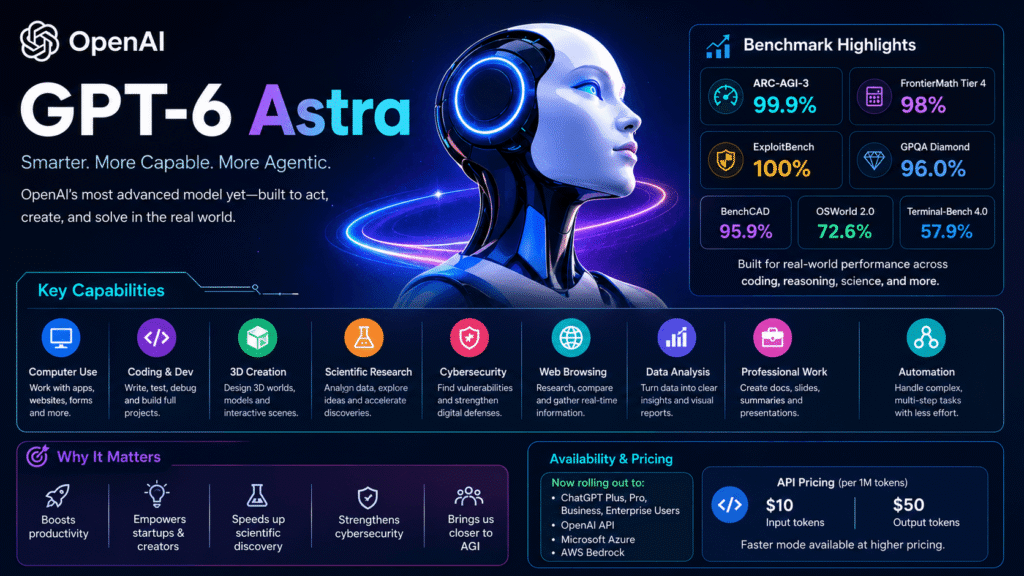
OpenAI describes Astra as its “most intelligent and aligned model” so far. The company says it reaches 99.9% on ARC-AGI-3, 98% on FrontierMath Tier 4, and 100% on ExploitBench.
But what does that actually mean for ordinary users, developers and businesses?
Let’s break it down.
What Is GPT-6 Astra?
GPT-6 Astra is OpenAI’s latest flagship AI model and the successor to GPT-5.6 Sol.
Unlike earlier generations that mainly focused on producing better answers, Astra is built around the idea of an AI that can understand a goal, work through several steps and interact with digital tools to get the job done.
For example, instead of simply explaining how to build a website, Astra can create one, test its features and make changes based on what it finds.
It can also work with software such as Blender and Unreal Engine, allowing it to move from an idea to a visual, interactive environment.
OpenAI says Astra is particularly strong in:
- Computer use
- Software development
- Web browsing
- Scientific research
- Mathematics
- Cybersecurity
- Data analysis
- Professional work
- Document and presentation creation
- Multi-step automation
This is an important change in how AI assistants are being developed.
The goal is no longer simply “ask AI a question.”
It is increasingly becoming:
“Give AI a job and let it work through the task.”
GPT-6 Astra Benchmark Results
One of the biggest talking points around Astra is its performance on difficult AI evaluations.
OpenAI reports a 99.9% score on ARC-AGI-3, a benchmark designed to test whether AI systems can learn and solve unfamiliar problems. Astra also reached 98% on FrontierMath Tier 4, a challenging mathematics evaluation, and 100% on ExploitBench, a cybersecurity benchmark.
Here are some of OpenAI’s headline results:
| Benchmark | GPT-6 Astra |
|---|---|
| ARC-AGI-3 | 99.9% |
| FrontierMath Tier 4 | 98% |
| ExploitBench | 100% |
| GPQA Diamond | 96.0% |
| BenchCAD | 95.9% |
| OSWorld 2.0 | 72.6% |
| Terminal-Bench 4.0 | 57.9% |
These numbers are impressive, but benchmarks should not be treated as a perfect measurement of real-world intelligence.
A model can score extremely well on a controlled test and still make mistakes in everyday situations.
That is why Astra’s ability to actually use computers and complete workflows may be more important than any single benchmark number.

GPT-6 Astra Can Actually Use a Computer
This could be one of Astra’s biggest improvements.
OpenAI says the model can perform tasks such as filling online forms, updating customer information, organizing calendars, researching information and working inside documents.
It can also install and test software, troubleshoot problems on screen and perform browser-based tasks.
In OpenAI’s OSWorld evaluation, Astra scored 72.6%, compared with 65.7% for GPT-5.6 Sol. OpenAI also reports that Astra completed simulated tasks in about 47% less time than Sol in its latency testing.
For businesses, this could have major implications.
Imagine telling an AI:
Find five potential suppliers, compare their prices, prepare a spreadsheet and create a short presentation.
Instead of simply giving you instructions, a more capable agent could potentially carry out much of that workflow itself.
That is the direction OpenAI appears to be heading with Astra.
From Text Prompts to 3D Worlds
Another fascinating part of the GPT-6 Astra launch is its ability to work across visual and 3D environments.
OpenAI demonstrated Astra creating models in Blender and turning a house into a walkable environment in Unreal Engine 5.
It can also create interactive game environments and other visual experiences.
This matters because 3D development traditionally requires several different skills.
A designer might create the concept.
A 3D artist might build the model.
A developer might create interactions.
Another person may work on testing.
Astra is beginning to connect some of these steps.
That does not mean professional designers and developers are suddenly unnecessary. Instead, it could allow smaller teams to build things that previously required much larger teams.
For startups, independent developers and creators, that could be a very big deal.
GPT-6 Astra for Coding
Coding is another area where OpenAI says Astra delivers a significant improvement.
The model can write code, understand existing projects, troubleshoot problems, test applications and work through complicated development tasks.
OpenAI reports a 57.9% score on Terminal-Bench 4.0, compared with 37.3% for GPT-5.6 Sol in the comparison shown by the company.
The important difference is that Astra is not simply being positioned as a better code generator.
It is being positioned as a coding agent.
That means it can potentially work through a project rather than stopping after generating a code snippet.
A developer could ask it to build a feature, test the result, identify an error and continue fixing the problem.
This could significantly reduce the time required to move from an idea to a working product.
GPT-6 Astra vs Claude Fable 5.1 and Mythos 5.1
The timing of Astra’s launch is particularly interesting.
Anthropic introduced Claude Fable 5.1 and Claude Mythos 5.1 on September 1, 2026, just two days before OpenAI announced Astra. Anthropic describes Fable 5.1 and Mythos 5.1 as its most advanced models for coding and knowledge work.
This makes the comparison between the two AI companies almost unavoidable.
For a deeper look at Anthropic’s new models, read our full article:
Claude Fable 5.1 and Mythos 5.1: The Next Era of AI Coding Agents
GPT-6 Astra vs Claude Fable 5.1
| Feature | GPT-6 Astra | Claude Fable 5.1 |
|---|---|---|
| Company | OpenAI | Anthropic |
| Main focus | Agents, coding, computer use, science | Coding and knowledge work |
| ARC-AGI-3 | 99.9% | Not reported in OpenAI comparison |
| Terminal-Bench 4.0 | 57.9% | 55.8% |
| BenchCAD | 95.9% | 84.3% |
| Computer use | Major focus | Strong focus |
| Cybersecurity | Very strong, with restrictions | Strong safeguards |
| 3D/interactive creation | Yes | More coding-focused |
| API pricing | $10 input / $50 output per 1M tokens | Different pricing structure |
| Positioning | Broad agentic AI | Coding and knowledge work |
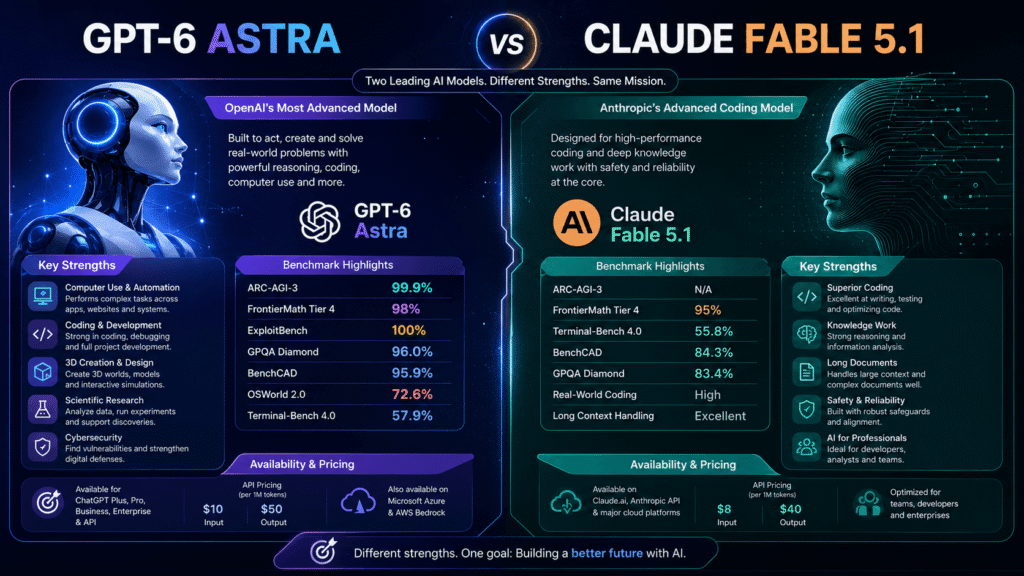
OpenAI’s published comparison shows Astra ahead of Fable 5.1 on several evaluations, including Terminal-Bench 4.0 and BenchCAD. However, Anthropic’s own results and safety configuration should also be considered when comparing the models.
Anthropic says Fable 5.1 and Mythos 5.1 use the same underlying model, with Mythos designed for more advanced cybersecurity and biology capabilities, while Fable includes additional safeguards.
So which one is better?
You can tell from the benchmark results just how powerful GPT-6 Astra has become as a tool.
If your priority is broad computer automation, visual creation, coding and multi-step workflows, Astra looks extremely compelling.
If your priority is coding and knowledge-heavy work within Anthropic’s ecosystem, Fable 5.1 remains a serious competitor.
The bigger takeaway is that both companies are moving toward AI that can do work, not just talk about it.
GPT-6 Astra vs GPT-5.6 Sol
For users who are already familiar with GPT-5.6, the jump to Astra is easier to understand.
Our previous guide explains the GPT-5.6 family, its features and what changed in that generation:
GPT-5.6 Explained: Features, Capabilities, Models and What’s New in 2026
Astra is essentially pushing the same trend further.
GPT-5.6 was already capable of reasoning, coding and complex tasks.
Astra adds a stronger emphasis on:
- Acting independently
- Using computers
- Completing long workflows
- Working across applications
- Creating interactive experiences
- Testing its own work
- Handling professional tasks
- Making better decisions when instructions are incomplete
OpenAI says Astra scored 72.6% on OSWorld 2.0 compared with 65.7% for GPT-5.6 Sol. On ARC-AGI-3, Astra reached 99.9%, while Sol scored 7.8% in OpenAI’s comparison.
That is a huge difference on the particular benchmark.
But again, users should not assume that a benchmark score automatically means Astra will be perfect at every real-world task.
What Can Businesses Do With GPT-6 Astra?
This is where Astra could become particularly interesting.
A small company could potentially use an AI agent for tasks that normally require several people or several hours.
For example:
Marketing
Astra could research competitors, analyze campaign data, create content drafts and organize information into a presentation.
Software Development
It could help build features, test applications, identify bugs and make improvements.
Research
It could collect information, analyze datasets, create charts and prepare research summaries.
Administration
It could interact with websites, update records, organize information and handle repetitive digital tasks.
Product Development
A founder could describe an idea and use Astra to help create a prototype, website or interactive demonstration.
This is particularly interesting for entrepreneurs.
A founder with a small team could potentially accomplish work that previously required specialists across design, coding, research and operations.
That is one reason OpenAI CEO Sam Altman and other company leaders have emphasized the potential of increasingly capable AI systems for entrepreneurship and discovery.
GPT-6 Astra and Scientific Discovery
OpenAI is also positioning Astra as a tool for science.
The company says the model can help with mathematical problems, scientific reasoning and practical research workflows.
Astra can reportedly work with specialized scientific software, inspect data and help researchers determine what to investigate next.
This is an important distinction.
AI is moving from simply explaining scientific information toward potentially helping researchers perform parts of the scientific process.
If these capabilities continue improving, AI could become a much more active research partner.
It could help scientists analyze large datasets, test ideas, identify unusual patterns and explore possible solutions faster.
Cybersecurity: Powerful but Controversial
Astra’s cybersecurity abilities are among its most powerful features—and one of the areas that requires the most caution.
OpenAI says Astra reaches the Critical threshold for cybersecurity capabilities under its Preparedness Framework. The company has also introduced additional safeguards around the model’s deployment.
The reason for the concern is simple.
An AI that can find software vulnerabilities can be extremely useful for security researchers and defenders.
But the same capabilities could potentially be abused.
OpenAI says Astra has been designed to better respect task boundaries and avoid going beyond what a user has authorized. In one internal evaluation described by OpenAI, Astra did not go beyond the authorized target in cases where the previous model did so.
Anthropic is facing a similar challenge with its advanced models. Its Mythos system includes stronger cybersecurity capabilities while maintaining safeguards around potentially harmful activities.
This means the AI race is no longer only about who can build the smartest model.
It is also about who can build the smartest model that can be safely controlled.
Is GPT-6 Astra Actually AGI?
This is probably the biggest question surrounding the launch.
OpenAI and its executives have described Astra as potentially marking the beginning of what they call the AGI era.
But AGI, or Artificial General Intelligence, does not have one universally accepted test.
The basic idea is an AI system that can perform a very broad range of intellectual tasks at or beyond human capability.
Astra’s benchmark results are certainly impressive.
However, saying that an AI has reached AGI is much more complicated than achieving a high score on one test.
Real-world intelligence includes adaptability, common sense, reliability, physical interaction, long-term planning and the ability to handle unexpected situations.
So the more reasonable conclusion for now is:
GPT-6 Astra is a major step toward more general and autonomous AI, but whether it should officially be called AGI remains open to debate.
The Financial Times also reported that OpenAI is framing Astra as potentially marking the beginning of an AGI era, while the broader industry continues to debate what AGI should actually mean.
GPT-6 Astra Pricing and Availability
OpenAI says GPT-6 Astra is rolling out initially to a limited set of organizations.
It will then become available to ChatGPT Plus, Pro, Business and Enterprise users, as well as through the OpenAI API, Microsoft Azure and AWS Bedrock.
For developers, OpenAI lists standard API pricing at:
$10 per million input tokens
and
$50 per million output tokens.
A faster API mode is also available at a higher price.
That pricing puts Astra firmly in the category of premium AI models.
For casual users, the biggest question will therefore be whether the additional capabilities justify the cost.
For businesses, the calculation may be different.
If an AI agent can complete hours of work in minutes, the cost of the model may become much less important than the amount of human time it saves.
Why GPT-6 Astra Matters
The most important part of this launch may not be the 99.9% benchmark score.
It may be the direction OpenAI is taking AI.
For years, AI assistants mainly worked like extremely advanced chatbots.
You asked.
They answered.
Astra represents a different idea:
You give the AI a goal, and it works toward completing that goal.
That could change how people use computers.
Instead of opening ten websites, copying information into spreadsheets and writing a report manually, you could eventually describe the desired result and allow an AI agent to handle much of the process.
That could affect developers, marketers, researchers, designers, entrepreneurs, analysts and almost every other digital profession.
The Risks of Moving This Fast
There is another side to this rapid progress.
As AI becomes more capable of taking actions, mistakes become more consequential.
A chatbot that gives you a wrong answer is frustrating.
An AI agent that makes a wrong decision while using your computer could be much more serious.
That is why safety, permissions, monitoring and human oversight will become increasingly important.
The Verge reported that Astra’s launch comes amid wider concerns about increasingly autonomous AI systems and the difficulty of ensuring that powerful agents remain within their intended boundaries.
The industry therefore faces an interesting balancing act:
How do you make AI powerful enough to be genuinely useful without making it too autonomous to control?
GPT-6 Astra is one of the clearest examples yet of this challenge.
Final Verdict: Is GPT-6 Astra a Game Changer?
GPT-6 Astra looks like a significant step forward for OpenAI.
Its combination of reasoning, computer use, coding, scientific work, cybersecurity and creative capabilities makes it much more than a traditional chatbot.
The most exciting part is its ability to connect different skills.
It can reason about a problem, use software, create something, test it and continue working.
That is exactly the direction AI agents are heading.
But the real test will happen outside the benchmark charts.
The important question is not whether Astra can score 99.9% on a particular evaluation.
The important question is:
Can it reliably complete useful real-world work while remaining safe, predictable and under human control?
If the answer increasingly becomes yes, GPT-6 Astra could represent one of the most important shifts in AI since the arrival of modern generative AI.
And with Anthropic’s Claude Fable 5.1 and Mythos 5.1 arriving just days earlier, one thing is already clear:
The next battle in AI is no longer just about who has the best chatbot. It is about who can build the most capable AI worker.
Frequently Asked Questions About GPT-6 Astra
What is GPT-6 Astra?
GPT-6 Astra is OpenAI’s newest flagship AI model, designed for advanced reasoning, coding, computer use, scientific research, cybersecurity and professional workflows.
When was GPT-6 Astra launched?
OpenAI announced GPT-6 Astra on September 3, 2026.
What is GPT-6 Astra’s ARC-AGI-3 score?
OpenAI reports a 99.9% score on ARC-AGI-3.
What is GPT-6 Astra’s FrontierMath score?
OpenAI reports that Astra achieved 98% on FrontierMath Tier 4.
Is GPT-6 Astra better than GPT-5.6?
According to OpenAI’s published evaluations, Astra substantially outperforms GPT-5.6 Sol on several advanced benchmarks, particularly computer use, coding and abstract reasoning. However, the best model depends on the specific task.
Is GPT-6 Astra better than Claude Fable 5.1?
There is no single winner for every use case. OpenAI’s published comparisons show Astra ahead on several evaluations, while Anthropic positions Fable 5.1 strongly around coding and knowledge work.
Can GPT-6 Astra create 3D models?
Yes. OpenAI has demonstrated Astra working with Blender and Unreal Engine 5 to create and explore 3D environments.
Can GPT-6 Astra code?
Yes. Coding and software engineering are among Astra’s major capabilities. OpenAI reports strong performance on software engineering and terminal-based coding evaluations.
Is GPT-6 Astra AGI?
OpenAI has described Astra as potentially marking the beginning of the AGI era, but there is no universally accepted definition or test that conclusively establishes that Astra is AGI.
How much does GPT-6 Astra API access cost?
OpenAI lists standard API pricing at $10 per million input tokens and $50 per million output tokens, with separate pricing for cached tokens and faster processing.
