
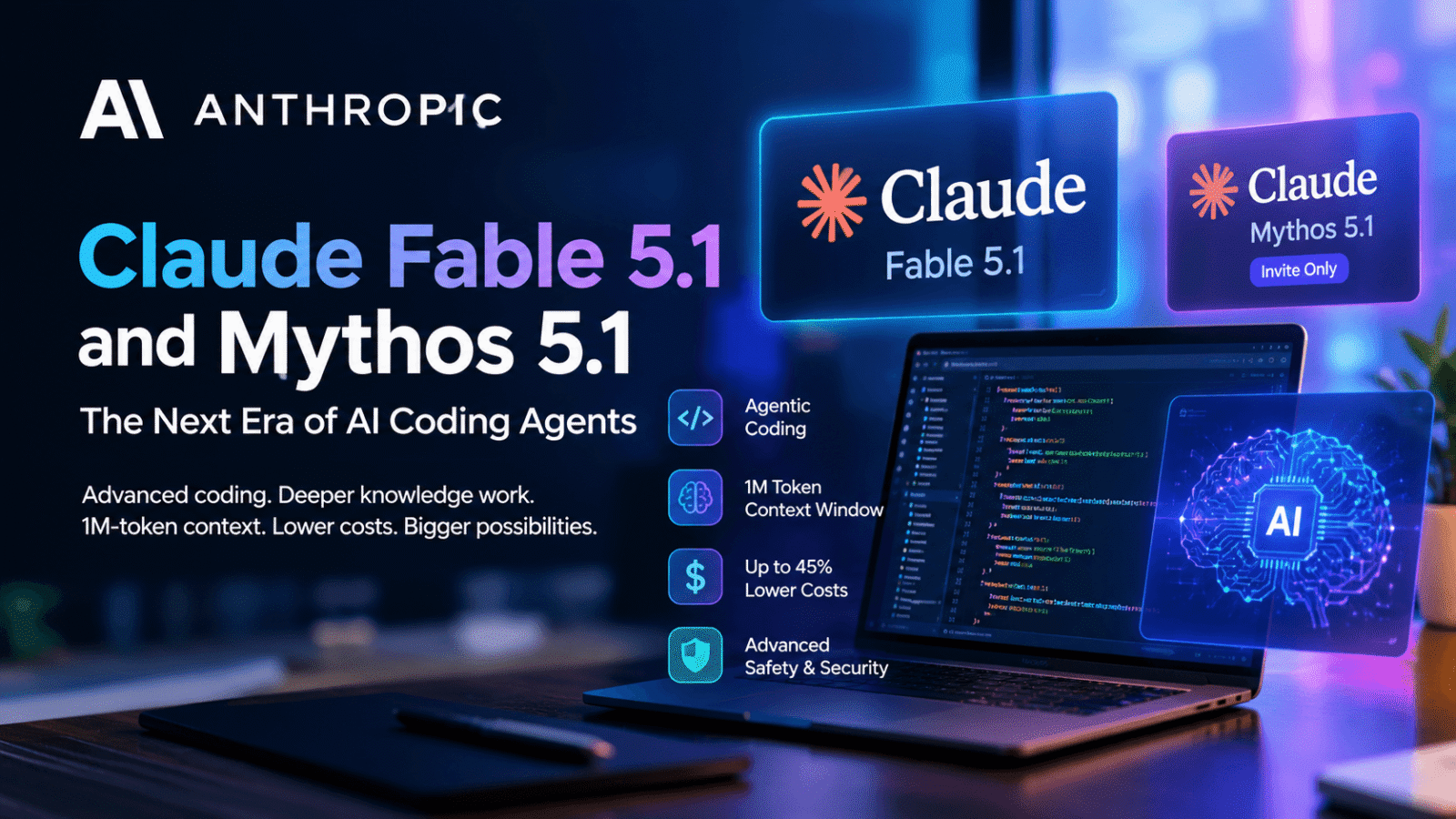
Anthropic has launched Claude Fable 5.1 and Claude Mythos 5.1, its latest frontier AI models designed for advanced coding, long-running agentic workflows, knowledge work and scientific research. Fable 5.1 is now generally available, while Mythos 5.1 remains restricted to vetted organizations because of its advanced cybersecurity and biology capabilities.
Anthropic’s latest Claude launch is less about making an AI chatbot simply “smarter” and more about making AI capable of doing complex work independently.
Claude Fable 5.1 is designed for ambitious coding projects, deep research, enterprise workflows and tasks that can run for hours across multiple applications. Anthropic describes it as its most capable generally available model for coding and knowledge work.
The launch also introduces Claude Mythos 5.1, which uses the same underlying model as Fable 5.1 but with different safeguards and access restrictions for sensitive cybersecurity and biology applications.
Quick Answer: What Is Claude Fable 5.1?
Claude Fable 5.1 is Anthropic’s latest advanced AI model for coding, knowledge work, research and long running AI agents. It can work across large codebases, use tools, operate browsers, write and verify code, analyze documents and continue multi-step projects with less human supervision.
Fable 5.1 supports a 1-million-token context window and up to 128,000 tokens of output, making it suitable for very large projects and document heavy workflows.
Its API pricing is $10 per million input tokens, $50 per million output tokens and $0.25 per million cached input tokens. Anthropic says the lower cache-read price can reduce typical workload costs by an estimated 25% and highly agentic workloads by up to approximately 45%.
What’s New in Claude Fable 5.1?
The biggest change is the model’s focus on long running, agentic work.
Traditional AI assistants generally respond to one prompt at a time. Fable 5.1 is designed to take a larger objective and work through multiple steps.
For example, an AI coding agent can:
- Understand the project.
- Inspect the existing codebase.
- Plan the required changes.
- Modify multiple files.
- Write tests.
- Run those tests.
- Identify failures.
- Fix the underlying problems.
- Verify the final result.
- Report what it completed.
Anthropic says Fable 5.1 can work on tasks that take hours and span multiple applications. It can plan work, use tools, recover when a step fails and keep users updated while it works.
That is the key difference between an AI assistant and an increasingly capable AI agent.
Fable 5.1 Benchmark Performance
Anthropic’s September 1 evaluation shows particularly strong gains on agentic tasks.
On Terminal Bench Science 0.1, Fable 5.1 scored 52.6%, compared with 24.7% for Fable 5. That is more than twice its predecessor’s score. Anthropic notes that the benchmark has a standard error of approximately 3.5–4.5 percentage points per model, so individual benchmark results should still be interpreted with appropriate caution.
Other reported results include:
| Benchmark | Claude Fable 5.1 | Claude Fable 5 |
|---|---|---|
| Terminal-Bench-Science 0.1 | 52.6% | 24.7% |
| Terminal-Bench 4.0 | 55.8% | 42.0% |
| AutomationBench | 31.4% | 17.1% |
| CursorBench 3.2.0 | 73.4% | 70.5% |
| OSWorld 2.0 — partial | 77.9% | 72.9% |
| OSWorld 2.0 — strict | 41.7% | 36.1% |
| Humanity’s Last Exam — no tools | 60.9% | 57.8% |
| GDPval-AA v2 | 1,853 | 1,723 |
These are Anthropic’s launch evaluations, and different benchmarks measure different capabilities. The numbers should therefore be compared within each benchmark, rather than treated as one universal model score. Anthropic also notes that some benchmark results were affected by production safety safeguards and fallback routing.

Fable 5.1 on CursorBench
The model is also performing strongly in real world style coding agent evaluations.
Cursor’s own CursorBench 3.2 leaderboard currently lists Fable 5.1 Max at 73.4%, placing it at the top of the published ranking. Cursor describes CursorBench as an evaluation of ambiguous, multi-file tasks based on real Cursor sessions.
This is particularly relevant because developers are increasingly using AI coding agents inside their normal development environments rather than interacting with AI only through a chatbot.
Why the Terminal Bench Science Result Matters
The 52.6% result is one of the most interesting numbers in the launch.
Terminal Bench Science evaluates agentic scientific workflows. Instead of simply answering a science question, the AI needs to perform a sequence of actions using tools and a terminal environment.
Fable 5.1’s score increased from 24.7% with Fable 5 to 52.6% with Fable 5.1.
That suggests the improvement is particularly significant when the model needs to execute a workflow rather than simply generate an answer.
This distinction is important for the future of AI.
The next generation of AI systems will increasingly be judged not only by whether they can answer questions but by whether they can complete useful tasks.
What Is Agentic AI?
Agentic AI is artificial intelligence that can plan and execute multiple steps toward a goal with limited human intervention.
Instead of:
User → Question → AI → Answer
An agentic system looks more like:
User → Goal → AI plans → AI uses tools → AI executes → AI verifies → AI completes task
Claude Fable 5.1 is specifically designed around this second workflow.
Anthropic says it can work through backlogs, operate browsers, interact with applications, run as a managed agent and recover when individual steps fail.
Claude Fable 5.1 for Coding
Coding is one of Fable 5.1’s biggest use cases.
Anthropic describes it as its most capable model for ambitious coding projects, including:
- Features spanning entire codebases
- Code reviews
- Performance optimization
- Multi-day autonomous coding sessions
- Automated testing
- Design implementation
- Visual verification
The model can also use vision to compare its output with the original design or goal.
This means developers can increasingly give Claude a high level software objective instead of manually directing every individual coding step.
Claude Fable 5.1 for Knowledge Work
Fable 5.1 is not limited to software engineering.
Anthropic is positioning the model for complex knowledge work such as:
- Deep research
- Data analysis
- Financial analysis
- Legal workflows
- Business reports
- Document processing
- Spreadsheet analysis
- Presentation preparation
- Enterprise research
The model can understand diagrams, charts and tables embedded in files and PDFs, which could be particularly useful for finance, legal, analytics and architecture workflows.
The broader idea is simple:
Instead of asking AI to help with individual tasks, businesses can increasingly hand AI an entire project and review the result.
Claude Fable 5.1 Pricing
API Pricing & Cost Savings
Claude Fable 5.1 keeps standard input and output pricing while significantly reducing cached input costs.
AI agents often revisit the same large context during long-running tasks. Lower cached-input costs can therefore make complex coding, research and agentic workflows more economical to operate.
Why Does Cheaper Caching Matter?
AI agents often revisit the same large context during a long-running task.
Imagine an agent working on a large software project. It may repeatedly reference:
- The same codebase
- Project instructions
- Documentation
- Previous outputs
- Test results
- Configuration files
If that context has to be processed from scratch every time, costs can grow quickly.
Lower cache read pricing makes these repeated interactions more economical.
For companies building AI agents, this can be just as important as raw model intelligence.
What Is Claude Mythos 5.1?
Claude Mythos 5.1 is the same underlying model as Fable 5.1, but with a different safety and access configuration.
Anthropic created Mythos because the model has highly advanced capabilities in sensitive fields such as cybersecurity and biology.
Rather than making those capabilities broadly available, Anthropic currently provides Mythos access to a small and growing set of vetted organizations through trusted access programs.
Mythos-level access is therefore not equivalent to normal Claude availability.
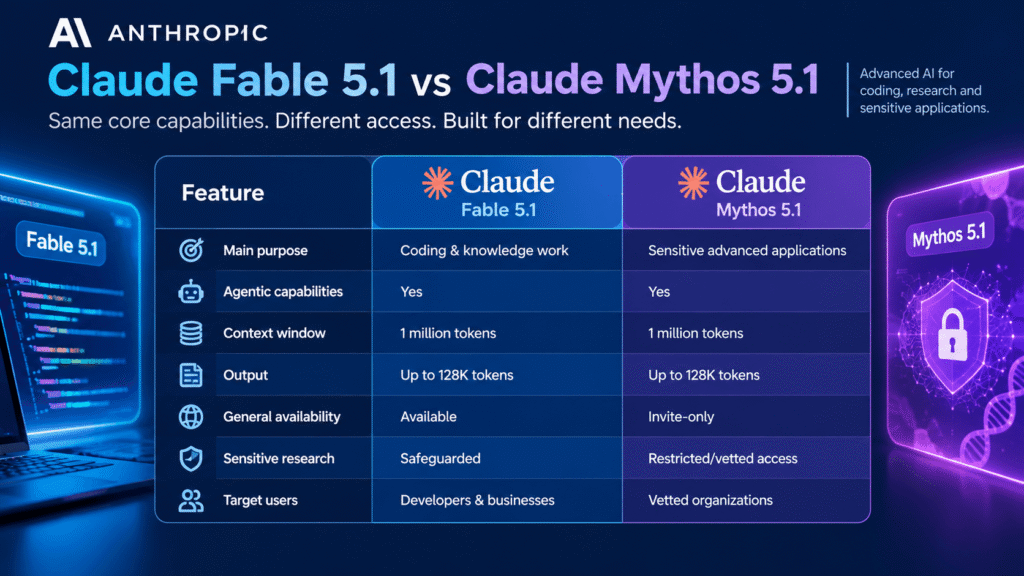
Claude Fable 5.1 vs Claude Mythos 5.1
| Feature | Claude Fable 5.1 | Claude Mythos 5.1 |
|---|---|---|
| Main purpose | Coding & knowledge work | Sensitive advanced applications |
| Underlying model | Same | Same |
| Agentic capabilities | Yes | Yes |
| Context window | 1 million tokens | 1 million tokens |
| Output | Up to 128K tokens | Up to 128K tokens |
| General availability | Available | Invite-only / vetted access |
| Sensitive research | Safeguarded | Restricted access |
| Target users | Developers & businesses | Vetted organizations |
The biggest difference is therefore not the core model itself but how access and safeguards are configured.
For readers who want to explore how Anthropic’s latest AI models compare with OpenAI’s newest generation, check out our detailed guide to GPT-5.6, including its features, capabilities, model variants, and what’s new in 2026.
Why Does Anthropic Need Fable and Mythos?
This two model approach highlights an increasingly important issue in frontier AI.
More capable models can provide enormous benefits in areas such as:
- Scientific research
- Cybersecurity defense
- Drug discovery
- Software engineering
- Automation
But the same capabilities can potentially be misused.
Anthropic says Fable 5.1 includes safeguards for cybersecurity and biology. Some flagged requests can be routed to other Claude models rather than being handled directly by Fable 5.1.
Anthropic also says Fable 5.1’s biology safeguards were recently improved, reducing biology-related fallbacks by about 85% in its testing.
Fable 5.1 and AI Safety
Safety is an especially important part of this release.
Anthropic’s current approach allows Fable 5.1 to provide broader assistance while maintaining restrictions around higher risk cybersecurity and biology activities.
According to Anthropic, Fable 5.1 can now identify software vulnerabilities in source code, while safeguards still restrict penetration testing, exploit generation and binary-based vulnerability scanning.
This shows the challenge facing frontier AI companies:
How do you make a model powerful enough to be genuinely useful without making dangerous capabilities unnecessarily easy to misuse?
Fable 5.1 is one of Anthropic’s latest attempts to solve that problem.
What Does Claude Fable 5.1 Mean for Developers?
For developers, the biggest change could be the move from AI assisted coding to AI driven software development.
A traditional coding assistant might generate a function or explain an error.
An agentic coding system can potentially:
Understand → Plan → Code → Test → Debug → Verify → Deliver
That means developers may spend less time writing every line manually and more time defining architecture, reviewing results and making high-level decisions.
This does not mean developers become unnecessary.
Instead, the developer’s role can shift toward orchestration, architecture, quality control and decision-making.
What Does Fable 5.1 Mean for Businesses?
For businesses, the most important opportunity may be long-running automation.
Companies could potentially use advanced AI agents to handle projects involving:
- Research
- Customer operations
- Data analysis
- Internal documentation
- Software development
- Financial workflows
- Business intelligence
- Enterprise knowledge management
The economics become especially interesting when agents can work for hours without continuous human supervision.
Lower cache costs could further improve the economics of these workflows.
Is Claude Fable 5.1 Better Than Fable 5?
On Anthropic’s reported evaluations, Fable 5.1 improves significantly over Fable 5 on several agentic and coding benchmarks.
The largest improvement is on Terminal-Bench-Science 0.1, where the score rises from 24.7% to 52.6%.
Other improvements include AutomationBench rising from 17.1% to 31.4% and CursorBench 3.2.0 moving from 70.5% to 73.4%.
However, benchmark scores should not be interpreted as proof that Fable 5.1 will be better for every real-world workload.
The best model for a particular company still depends on its tools, prompts, latency requirements, reliability needs and cost structure.
Is Claude Fable 5.1 Available Now?
Yes.
Anthropic says Fable 5.1 is available to Pro, Max, Team and Enterprise users and through the Claude Platform.
Developers can access it through Anthropic’s API using the model identifier:
claude-fable-5-1
Anthropic also lists availability through marketplaces and cloud platforms including Amazon Web Services, Google Cloud and Microsoft Foundry.
Is Claude Mythos 5.1 Available to Everyone?
No.
Claude Mythos 5.1 is currently available only to vetted organizations through Anthropic’s trusted access programs.
Anthropic says cybersecurity organizations can apply through its Cyber Verification Program, with broader Mythos access being developed over time.
Frequently Asked Questions
What is Claude Fable 5.1?
Claude Fable 5.1 is Anthropic’s latest generally available AI model for advanced coding, knowledge work, research and long-running agentic workflows.
What is Claude Mythos 5.1?
Claude Mythos 5.1 is the same underlying model as Fable 5.1 with a different safeguard and access configuration, intended for vetted organizations working on sensitive applications.
How much does Claude Fable 5.1 cost?
Claude Fable 5.1 costs $10 per million input tokens, $50 per million output tokens and $0.25 per million cached input tokens.
How much cheaper is Fable 5.1?
Anthropic says cached input pricing is 75% lower than Fable 5. The company estimates typical workloads can be around 25% cheaper, while highly agentic workloads can be up to approximately 45% cheaper.
What is the context window of Claude Fable 5.1?
Claude Fable 5.1 supports a 1-million-token context window.
How much output can Claude Fable 5.1 generate?
The model supports up to 128,000 tokens of output.
Is Claude Fable 5.1 good for coding?
Yes. Anthropic specifically positions Fable 5.1 for ambitious coding projects, including large codebases, code reviews, performance work, testing and long-running autonomous coding sessions.
What is agentic AI?
Agentic AI refers to systems that can plan, use tools, execute multiple steps, evaluate results and continue working toward a goal with limited human intervention.
What is the difference between Fable 5.1 and Mythos 5.1?
The two models share the same underlying model, but Mythos 5.1 is provided through restricted trusted-access programs for sensitive applications, while Fable 5.1 is generally available with stronger safeguards in areas such as cybersecurity and biology.
Can Claude Fable 5.1 replace software developers?
Fable 5.1 can automate more software-development work, but developers remain important for architecture, requirements, security, testing, review and business decisions. The more realistic shift is from developers writing every line to developers managing increasingly capable AI coding agents.
The Bigger Picture: AI Is Moving From Answers to Actions
The most important part of the Fable 5.1 launch may not be any single benchmark.
It is the direction of AI development.
The industry is moving from:
Chatbots → Assistants → Agents → Autonomous Workflows
Fable 5.1 is firmly positioned in the agentic stage.
Its ability to work across codebases, use tools, verify its own work, process large documents and continue long-running projects shows how frontier AI is evolving from systems that primarily generate information into systems that can increasingly perform work.
The lower cache-read price is equally important because intelligence alone does not make an AI agent commercially useful.
Companies need agents that are:
- Capable
- Reliable
- Fast enough
- Safe enough
- And affordable enough to operate at scale
Fable 5.1’s combination of stronger agentic performance and lower cache costs suggests Anthropic is targeting exactly that market.
Final Verdict
Claude Fable 5.1 is more than a routine model update.
Its strongest improvements are concentrated in long-running, agentic workflows, coding and complex knowledge work. Anthropic’s reported 52.6% score on Terminal-Bench-Science, 73.4% result on CursorBench 3.2 and 31.4% AutomationBench score highlight the model’s focus on actually completing tasks rather than simply producing answers.
At the same time, Claude Mythos 5.1 demonstrates the other side of frontier AI development: the more capable the model becomes, the more important access controls and safety systems become.
For developers, Fable 5.1 could mean more autonomous coding.
For businesses, it could mean more sophisticated AI workflows.
For the AI industry, it represents another step toward a future where AI systems don’t just answer questions—they plan, execute, verify and complete complex work.
And that may ultimately be the real significance of Claude Fable 5.1.
