
One of the most valuable and urgent skills in relation to working with AI in 2025 is prompt engineering. Simply put, it is the art of writing instructions to obtain the desired results of AI models. Regardless of whether it is text, images or audio, how you word your request can be the difference between achieving a lot or a little.
As AI models are getting more sophisticated and accessible, it is no longer a choice in knowing how to write successful prompts but a necessity. An effective prompt can save time, enhance accuracy, and open new opportunities in creative works, business processes, or educational activities. For beginners, learning prompt engineering for beginners 2026 is the first step toward confidently interacting with AI.
This tutorial will take you through the definition of what it is, why it is important, methods used in practice, a few practical examples and a few places to study it. By the end, you’ll understand how prompt engineering best practices can help you get the most out of AI tools while avoiding common mistakes.
What Is Prompt Engineering?
Prompt engineering involves creating instructions that can be passed to AI models to generate the desired results. It began to feel the traction as AI models such as ChatGPT, DALL-E, and other LLMs were becoming more functional and popular. In essence, it is all about communicating clearly with AI, and hence it knows what you want and it responds appropriately.
Types of AI Prompting Techniques
Choose the right prompting method for better AI results
Prompt engineering not only works with text but also with images, audio, and other AI outputs, which is why it is a versatile skill. Knowing these fundamentals is important for explaining the concept of zero shot vs few shot prompting explained and applying the chain of thought prompt engineering tutorial successfully.
After learning how to do prompt engineering, novices can begin to produce more useful results, save time, and transform AI into a more valuable collaborator in their work.
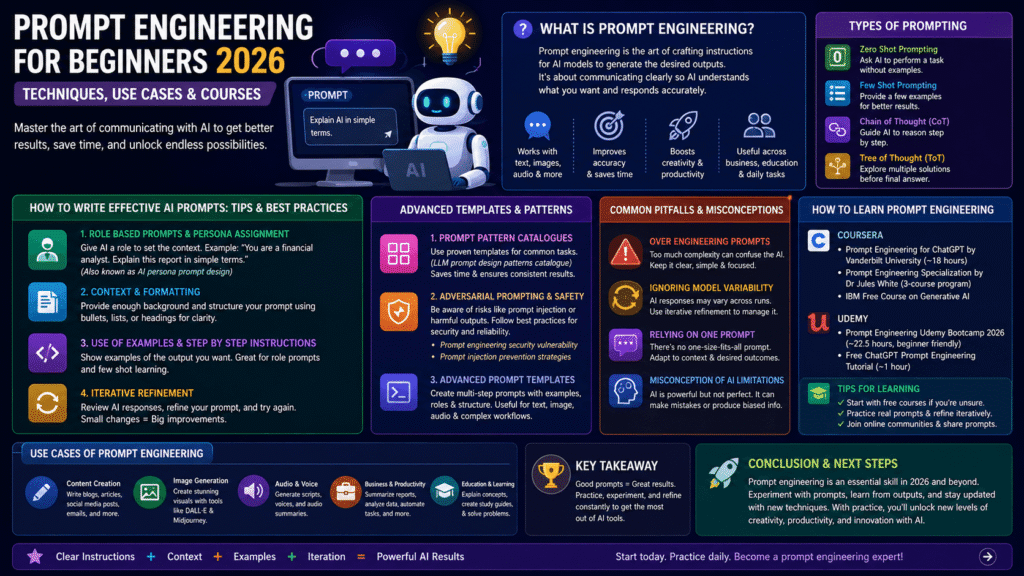
How to Write Effective AI Prompts: Tips & Best Practices
In order to maximize AI, it is worth doing some basic tricks and tips when designing prompts. Those are the strategies that enable beginners to create effective instructions and do not confuse the AI.
Role Based Prompts & Persona Assignment
Provide directions to the AI by giving it a role. As an example, you are a financial analyst. Give an explanation of this report in normal terms. This strategy is also referred to as AI persona prompt design and assists the AI to give answers that fit in the context.
Context & Formatting
Give a sufficient background and organise your prompt. You can use bullets, lists, or headings to help the instructions be easy to follow.
Use of Examples & Step by Step Instructions
Provide an example of what it is that you want the AI to produce. This comes in handy, particularly with role prompt pattern ChatGPT and a few shot prompting examples LLM.
Iterative Refinement
Aiming for a perfect output is not what to expect at the first attempt. Check the answer of the AI and edit your prompt, and restart. This method is known as the iterative prompt refinement method, which guarantees more useful and accurate results.
With such methods regularly, the novices will be able to enhance the quality of the AI output and make timely engineering best practices an integral part of their workflow.
Advanced Templates & Patterns for Prompt Engineering
After mastering the earlier templates and patterns, you can use more powerful and reliable prompts by examining more advanced templates and patterns. These tips can assist you in dealing with multifaceted assignments and also ensure consistency in projects.
1- Prompt Pattern Catalogues
Apply templates and patterns of common tasks. Such catalogues are referred to as the LLM prompt design patterns catalogue, and they save time and allow you to write prompts that produce high-quality results repeatedly.
2- Adversarial Prompting and Safety
Watch out for possible harmful consequences such as timely injection or unforeseen AI actions. Adhering to guidelines on prompt engineering security vulnerability and prompt injection prevention strategies will make your AI safe and trustworthy.
3- Advanced Prompt Templates
With more intricate processes, you have the chance to build an advanced prompt template LLM with a series of steps, examples, and roles. The templates can be used in text generation and summarisation, and can also be applied to image or audio tasks.
With the acquisition of these advanced strategies, beginners can transition to structured, reusable, and safe prompts that will be reliable to use in various AI applications.
Common Pitfalls & Misconceptions
Prompt engineering is prone to error, even with experienced users, and beginners should be aware of the pitfalls so as not to get frustrated.
Over Engineering Prompts
Giving too complex instructions to the AI can cause more confusion than better results. Use clear and concise keep prompts.
Ignoring Model Variability
AI solutions may vary depending on the run. The response is not always the same, and the iterative refinement can be used to control it.
Relying on One Prompt
There is no single prompt that can always be used in each case. Modify and tailor your prompts depending on context and the desired results.
Misconception of AI Limitations
Artificial intelligence is strong but not flawless. It is able to commit errors, misinterpret instructions, or produce biased information.
Having these in mind will enable beginners adhere to prompt engineering best practices and prevent the pitfalls discussed in prompt engineering mistakes to avoid.
How to Learn Prompt Engineering
In case you are interested in becoming confident in prompt engineering, you can find numerous courses and resources designed to learn the basics as a beginner and a non-technical user.
Coursera
- Prompt Engineering for ChatGPT by Vanderbilt University – A 6 unit introductory course (~18 h).
- Prompt Engineering Specialization by Dr Jules White – 3 course program on practical techniques.
- IBM free Prompt engineering course on Generative AI.
Udemy
- Prompt Engineering Udemy Bootcamp 2026 – 22.5 h, beginner friendly, high rated.
- Free short courses, such as ChatGPT Prompt Engineering tutorial (~1 h).
Tips for Learning
- Get free courses in case you are not sure.
- Test on actual prompts, and improve them progressively.
- Form online communities by sharing prompts and learning.
These sources ensure that an online course, free and structured learning, becomes available and accessible to beginners, who can successfully master prompt engineering Coursera Vanderbilt, prompt engineering specialization Coursera, and prompt engineering udemy bootcamp 2025 effectively.
Other useful references: free ChatGPT prompt engineering tutorial, prompt engineering course reviews 2025, and guidance for learning prompt engineering non technical learners.
Conclusion & Next Steps
One of the necessary skills in working with AI in 2026 is prompt engineering. It enables you to talk to AI models effectively, receive the correct response, and use all the benefits of such tools as ChatGPT, DALL-E, and other LLMs.
There is a constant evolution in the field, and therefore experimentation is a major aspect. Test various role prompts, develop your instructions gradually, and learn through the outputs. The faster way to learn is to join online communities and practice by example.
Using the tricks of this guide, newcomers will be able to put prompt engineering best practices into practice, prevent prompt engineering pitfalls, and find new opportunities in text, image, and audio generation.
With practice, you will realize shortly how prompt engineering non technical can open the doors to creativity, productivity and innovation in AI workflows.
You can also explore this realistic AI ASMR video prompt for creating detailed styrofoam sculpture videos. AI ASMR Video Prompt: Realistic Styrofoam Sculpture Carving
